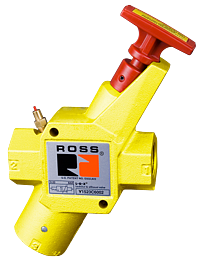




Energy Isolation Valves Manually Actuated - 15 Series Lockout L-O-X®Valves
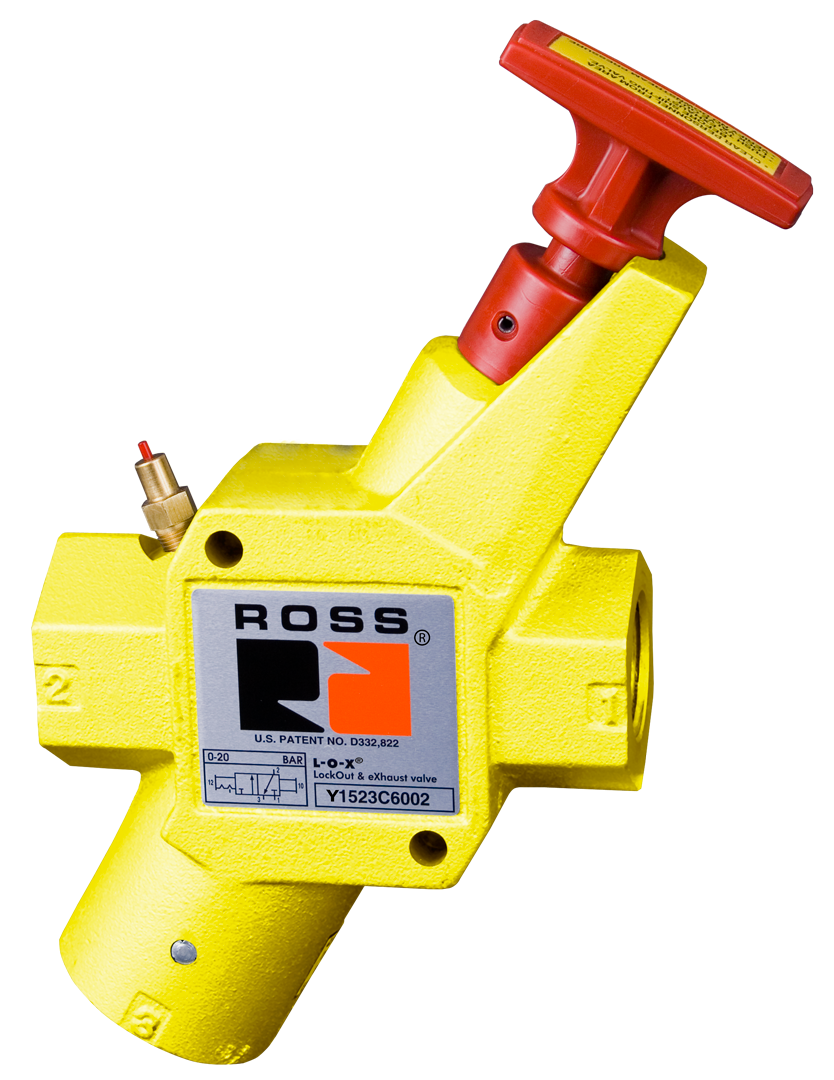
- Easily identifiable with a yellow body and a red handle to control ON/OFF positions (non-Stainless Steel)
- Full size exhaust ports (equal to or larger than supply) provide rapid exhaust of downstream air and are threaded for silencers or remote exhaust lines
- Design only allows the valve to be lockable in the OFF (closed) position
- Fluorocarbon slipper seals for easy shifting, even after long periods of inactivity
- Includes integrated sensing port for pressure verification with either a visual pop-up indicator or electrical pressure switch
- ROSS Controls [https://www.rosscontrols.com/en/series/1287-15-series-lockout-l-o-x-valves]
loading...
loading...
Product Overview
The Automatic Valve 15 Series Lockout L-O-X valve is a manually actuated energy isolation device engineered to block compressed air supply and exhaust all downstream pneumatic energy before maintenance personnel access a machine or pneumatic system. The L-O-X (Lockout and Exhaust) function addresses the requirements of OSHA 29 CFR 1910.147 (Control of Hazardous Energy) and ISO 14118 (Stored Energy) by providing a single valve that simultaneously de-energizes the upstream supply and exhausts all stored downstream air pressure to atmosphere.
The 15 Series is offered in five body configurations: Slim-Line (compact bar stock aluminum, 0 to 145 psig, 1/4 and 3/8 inch ports), Modular (cast aluminum, 0 to 200 psig, 1/4 to 3/4 inch ports, optional EEZ-ON soft start), Classic (cast aluminum, 0 to 300 psig, 3/8 to 1-1/4 inch ports, multiple body sizes), High-Capacity (cast aluminum, 0 to 300 psig, 1-1/2 and 2 inch ports), and Stainless Steel (316 SS body, 0 to 200 psig, 1/4 to 3/4 inch ports). This range covers virtually all industrial pneumatic system pipe sizes and pressure levels.
The valve is immediately recognizable by its yellow body and red handle, providing visual identification of the energy isolation point on any machine or panel. The design intentionally allows the valve to be locked only in the OFF (closed) position. When the red handle is pushed inward, supply air is blocked and downstream air is exhausted through the full-size exhaust port. The exhaust port is equal to or larger than the supply port to ensure rapid exhaust of downstream air pressure. Once in the closed position, a standard padlock shackle fits through the lock hole to prevent the handle from being pulled outward during servicing.
Fluorocarbon slipper seals allow easy handle operation and consistent shifting even after extended periods of inactivity, which is critical for energy isolation valves that may sit in the closed position for weeks between maintenance intervals. An integrated sensing port with 1/8 NPT threads accepts either a pop-up visual indicator (model 988A30) or an electrical pressure switch (models 586A86 or 1153A30) to verify that downstream pressure has been fully exhausted before personnel access the hazardous zone.
Key Engineering Features
- OSHA 29 CFR 1910.147 and ISO 14118 Compliance - Designed specifically as an energy isolation device per OSHA Control of Hazardous Energy (lockout/tagout) requirements and ISO 14118 stored energy isolation standard. The valve blocks supply and exhausts downstream energy in a single operation.
- Yellow Body and Red Handle for Visual Identification - The internationally recognized yellow-and-red color scheme makes the energy isolation point immediately visible on any machine, panel, or pneumatic system from across the work area (non-stainless steel models).
- Lockable in OFF Position Only - The valve design permits padlocking only in the closed (OFF) position, preventing the handle from being pulled outward inadvertently during maintenance. The open (ON) position is not lockable, providing for ready shut-off when necessary.
- Full-Size Exhaust Ports - Exhaust port size equals or exceeds the supply port size, providing rapid and complete exhaust of all downstream compressed air. Exhaust ports are threaded to accept silencers or remote exhaust lines.
- Fluorocarbon Slipper Seals - Fluorocarbon seals provide easy handle operation and reliable shifting even after extended inactivity, which is essential for a valve that may remain in the closed position for days or weeks between maintenance cycles.
- Integrated Sensing Port - A 1/8 NPT sensing port between the valve and the downstream system accepts a pop-up visual indicator (988A30) or an electrical pressure switch (586A86 or 1153A30) for positive verification that downstream pressure is zero before personnel access.
- Multiple Pressure Ratings - Slim-Line: 0 to 145 psig (0 to 10 bar); Modular: 0 to 200 psig (0 to 14 bar); Classic: 0 to 300 psig (0 to 20.7 bar); High-Capacity: 0 to 300 psig (0 to 20.7 bar). Covering low-pressure instrument air systems through high-pressure industrial air systems.
- Padlock Compatibility - Lock hole diameter is 0.27 inch (7.0 mm) with 0.43 inch (10.9 mm) depth, accepting standard safety padlocks and multiple lockout hasps per OSHA group lockout procedures. High-Capacity models can be padlocked at both the handle and the end of the spool.
- EEZ-ON Soft Start Option (Modular Series) - Optional EEZ-ON module for the Modular series allows gradual pressurization of the downstream system on re-energization, protecting personnel and equipment from sudden pressure buildup after a lockout event.
- PL c Safety Performance Level - 15 Series energy isolation valves carry a Safety Category 1 and Performance Level c (PL c) rating per EN ISO 13849-1, suitable for integration into machine safety control architectures.
Technical Specifications
General Specifications
| Parameter | Specification |
| Valve Function | 3/2 (block supply and exhaust downstream) |
| Actuation | Manual - Push/Pull Handle |
| Construction | Spool |
| Mounting | Inline |
| Valve Body Material | Bar Stock Aluminum (Slim-Line); Cast Aluminum (Modular, Classic, High-Capacity); 316 Stainless Steel (SS variant) |
| Spool Material | 316 Stainless Steel (all variants) |
| Seal Material | Fluorocarbon (all variants) |
| Fluid Media | Filtered air |
| Ambient / Media Temperature | 40 to 175 F (4 to 80 C) |
| Safety Category | Category 1 |
| PL Rating | PL c (EN ISO 13849-1) |
| Sensing Port | 1/8 NPT (for pop-up indicator or pressure switch) |
| Lock Hole Diameter | 0.27 inch (7.0 mm) |
| Lock Hole Depth | 0.43 inch (10.9 mm) |
Flow Performance Data
| Variant | Inlet Port | Exhaust Port | Model (NPT) | Cv 1-2 | Cv 2-3 | Weight lb (kg) |
| Slim-Line | 1/4" | 3/8" | Y1523D2002 | 1.84 | 1.79 | 0.9 (0.4) |
| Slim-Line | 3/8" | 3/8" | Y1523D3012 | 2.67 | 2.64 | 0.9 (0.4) |
| Modular | 1/4" | 3/4" | Y1523A2003 | 3.7 | 7.8 | 1.7 (0.8) |
| Modular | 3/8" | 3/4" | Y1523A3003 | 5.1 | 8.3 | 1.7 (0.8) |
| Modular | 1/2" | 3/4" | Y1523A4003 | 5.5 | 8.6 | 1.8 (0.8) |
| Modular | 3/4" | 3/4" | Y1523A5013 | 5.6 | 8.1 | 1.8 (0.8) |
| Classic (Body 1/2) | 3/8" | 3/4" | Y1523C3002 | 4.74 | 3.57 | 2.0 (0.9) |
| Classic (Body 1/2) | 1/2" | 3/4" | Y1523C4002 | 7.10 | 4.0 | 2.0 (0.9) |
| Classic (Body 1/2) | 3/4" | 3/4" | Y1523C5012 | 8.26 | 4.10 | 2.0 (0.9) |
| Classic (Body 1) | 3/4" | 1-1/4" | Y1523C5002 | 13.12 | 8.98 | 3.0 (1.4) |
| Classic (Body 1) | 1" | 1-1/4" | Y1523C6002 | 16.56 | 9.52 | 3.0 (1.4) |
| Classic (Body 1) | 1-1/4" | 1-1/4" | Y1523C7012 | 19.25 | 9.74 | 3.0 (1.4) |
| High-Capacity | 1-1/2" | 2" | Y1523C8002 | 35.53 | 50.98 | 8.3 (3.7) |
| High-Capacity | 2" | 2" | Y1523C9012 | 40.38 | 52.23 | 8.3 (3.7) |
Certifications & Compliance
| Certification/Standard | Detail |
| OSHA 29 CFR 1910.147 | Defined as an energy isolation device per OSHA Control of Hazardous Energy (lockout/tagout) standard. The valve enables compliance with OSHA LOTO requirements by providing a lockable means to block energy and exhaust stored energy from pneumatic systems. |
| ISO 14118 | Compliant with ISO 14118 (Prevention of Unexpected Start-Up) requirements for energy isolation of pneumatic systems before maintenance access. |
| Safety Category 1 / PL c | EN ISO 13849-1 Safety Category 1, Performance Level c, for integration into machine safety architectures requiring a formally rated energy isolation function. |
| EAC Declaration | EAC Declaration applicable to applicable variants for Eurasian Conformity marking. |
| CSA / UL | CSA/UL certification not standard on most 15 Series variants. Confirm specific model certification requirements with Automatic Valve. |
| DGUV (German Statutory Accident Insurance) | DGUV certification not standard on standard 15 Series variants. Confirm with Automatic Valve for European machine safety applications requiring DGUV approval. |
Typical Applications & Industries
General Industrial Manufacturing - Machine Lockout
- Main pneumatic supply isolation valve for any industrial machine or workstation before maintenance personnel perform die changes, jam clearances, tooling adjustments, or component replacements. The L-O-X valve is installed as the first valve in the compressed air supply line to the machine.
- Group lockout procedures at multi-energy machines where multiple maintenance technicians each apply their own padlock to the L-O-X valve hasp, ensuring no single person can re-energize the machine while any other is still working.
- Pneumatic robot and automated system maintenance access where the robot must be fully de-energized and proven safe before a maintenance technician enters the work envelope.
- Conveyor and transfer line maintenance isolation where sections of the line must be de-energized during jam clearance or component servicing without shutting down adjacent production zones.
Automotive and Tier Manufacturing
- Body shop and assembly line pneumatic tool and fixture energy isolation for die changes, weld tip replacements, and robot end-effector swaps where the frequency of tooling changes demands a fast and reliable LOTO procedure.
- Stamping press and transfer press air isolation before die setup crews enter the die area during die changes, where stored air in counterbalance cylinders and die cushions must be verified at zero before entry.
- Paint line conveyor and actuation system isolation for spray head cleaning, nozzle replacement, and track maintenance operations.
- Engine and transmission assembly cell isolation during cylinder and fixture component replacement at high-turnover production cells.
Food and Beverage Processing
- 316 Stainless Steel L-O-X valves for washdown-compliant energy isolation at filling, sealing, and portioning machine maintenance points in food and dairy processing facilities with frequent high-pressure cleaning.
- Beverage carbonation and dispensing equipment pneumatic energy isolation before maintenance personnel perform CO2 line servicing, valve replacements, or pump maintenance.
- Poultry, meat, and seafood processing equipment pneumatic isolation before knife, blade, and tool changes at cutting, trimming, and portioning machinery.
- Packaging line isolation for film roll changes, seal bar replacements, and jaw maintenance on HFFS and VFFS packaging machines.
Pharmaceutical and Chemical Processing
- 316 Stainless Steel L-O-X valve applications at GMP-compliant manufacturing equipment where FDA and cGMP requirements demand verifiable energy isolation at all maintenance points.
- Chemical process pneumatic actuator isolation for vessel, valve, and actuator maintenance in corrosive or reactive process environments where standard aluminum bodies are not appropriate.
- Pharmaceutical tableting, filling, and coating machine energy isolation for format change and cleaning procedures.
- Laboratory and pilot plant pneumatic system isolation for experimental setups requiring frequent configuration changes.
Oil, Gas, and Energy Infrastructure
- High-pressure L-O-X Classic and High-Capacity valves (up to 300 psig) for compressor station, wellhead, and pipeline instrument air system isolation during maintenance and inspection activities.
- Process plant pneumatic control system isolation at turbine compressor and pump maintenance points where stored instrument air energy must be positively isolated.
- Power plant pneumatic actuator and damper system isolation for turbine overhaul, valve maintenance, and instrumentation calibration activities.
- Offshore platform and marine vessel pneumatic system energy isolation for confined space entry and hot work permits.
Rubber, Plastics, and Composites Manufacturing
- Injection molding and blow molding machine pneumatic circuit isolation before mold change crews enter the clamping unit or barrel area for mold swaps and purge plate installations.
- Rubber vulcanization press and autoclave pneumatic isolation during mold loading, unloading, and mold change operations.
- Composite layup and infusion equipment pneumatic isolation before maintenance on vacuum systems, bagging equipment, and infusion hardware.
- Extrusion line die change isolation where the die head pneumatic clamps and actuators must be de-energized before the die crew approaches the extrusion head.
Ordering and Model Number Configuration
Accessories
Pop-Up Visual Pressure Indicator
Model 988A30 installs in the 1/8 NPT sensing port to provide a visual pop-up flag when downstream pressure is present. The indicator is held down (flush) when pressure is at zero, confirming the safe state before maintenance access. 1/8 NPT port threads.
| Model | Connection | Function |
| 988A30 | 1/8 NPT | Pop-up indicator - shows presence of downstream pressure |
Electrical Pressure Switches
Pressure switches install in the 1/8 NPT sensing port to provide an electrical signal indicating downstream pressure status. The switch closes on falling pressure at 5 psig (0.34 bar), providing a hardwired signal to a PLC, safety relay, or indicator light.
| Model | Connection Type | Port Threads |
| 586A86 | EN 175301-803 Form A | 1/8 NPT |
| 1153A30 | M12 | 1/8 NPT |
Multiple Lockout Hasp
Model 356A30 attaches to the valve handle to provide multiple padlock attachment points for group lockout procedures where each maintenance technician applies their own padlock.
| Model | Application |
| 356A30 | Multiple padlock attachment for group LOTO procedures |
Exhaust Silencers
Threaded exhaust silencers reduce noise at the valve exhaust port during system depressurization. Match silencer flow capacity to or greater than the valve's exhaust Cv. Contaminated silencers must be replaced to prevent restricted exhaust.
| Port Size | Thread | Model (NPT) | Avg. Cv |
| 3/8" | Male NPT | 5500A3013 | 2.7 |
| 3/4" | Male NPT | 5500A5003 | 11.5 |
| 1-1/4" | Male NPT | 5500A7013 | 16.4 |
| 2" | Female NPT | 5500B9001 | 34.2 |
Related Products & Accessories
- L20 Series Foot Pedal Manually Actuated Valves - Directional control valves for machine cycle operation that require upstream L-O-X energy isolation for LOTO compliance. https://www.automaticvalve.com/series/2821-foot-pedal
- L20 Series Cam Roller Mechanically Actuated Valves - Machine-actuated directional control valves requiring upstream energy isolation for safe maintenance access. https://www.automaticvalve.com/series/2820-cam-roller
- L20 Series Foot Treadle Manually Actuated Valves - Treadle-operated directional control valves for operator workstations that require upstream L-O-X energy isolation. https://www.automaticvalve.com/series/2823-foot-treadle
- Hand Lever Manually Actuated Valves - I15, I45, L20, L21, L45 Series - Hand lever directional control valves across multiple platforms, each requiring OSHA-compliant energy isolation upstream. https://www.automaticvalve.com/series/2824-hand-lever
- Palm Button Manually Actuated Valves - I20, L20 Series - Palm button directional control and two-hand circuit valves requiring upstream energy isolation for maintenance. https://www.automaticvalve.com/series/2825-palm-button
Frequently Asked Questions (FAQ)
Q: What is the difference between the L-O-X valve and an ordinary shutoff valve?
A: An ordinary shutoff valve blocks the supply air flow but leaves downstream pneumatic energy stored in cylinders, actuators, accumulators, and tubing. The L-O-X valve simultaneously blocks supply and exhausts all stored downstream air through the full-size exhaust port, ensuring that both the supply energy and the stored energy are removed in a single valve operation. This dual-action design is what makes the L-O-X a true energy isolation device rather than simply a shutoff valve.
Q: Does the L-O-X valve satisfy OSHA 29 CFR 1910.147 requirements?
A: The L-O-X valve is designed to satisfy the energy isolation device requirements of OSHA 29 CFR 1910.147 by providing a means to block the hazardous energy source (compressed air supply) and to dissipate stored energy (downstream air pressure) in a lockable, verifiable manner. Note: the complete OSHA lockout/tagout compliance program requires written procedures, employee training, periodic auditing, and coordination with all energy sources at the equipment - not just the pneumatic system. The valve is the hardware component of the compliance program.
Q: Can the L-O-X valve be used as an emergency stop device?
A: No. Per OSHA specifications and regulations, the 15 Series L-O-X valve is defined as an energy isolation device, NOT as an emergency stop device. Emergency stop devices must comply with IEC 60947-5-5 and machine-specific ANSI B11 standards, requiring immediate response to a stop command. The L-O-X valve is operated manually by maintenance personnel initiating a lockout procedure and is not part of the machine's automated safety stop circuit.
Q: What is the difference between the Slim-Line, Modular, Classic, and High-Capacity variants?
A: Slim-Line: compact bar stock aluminum body, 1/4 and 3/8 inch ports, 0 to 145 psig, smallest envelope for tight installations. Modular: cast aluminum, 1/4 to 3/4 inch ports, 0 to 200 psig, optional EEZ-ON soft start for gradual re-pressurization. Classic: cast aluminum, 3/8 to 1-1/4 inch ports, 0 to 300 psig, two body sizes (1/2 and 1 inch) for higher flow. High-Capacity: cast aluminum, 1-1/2 and 2 inch ports, 0 to 300 psig, dual padlock positions for maximum security.
Q: What pressure can the Classic and High-Capacity variants handle?
A: Classic and High-Capacity variants are rated to 0 to 300 psig (0 to 20.7 bar) operating pressure. Slim-Line is rated to 0 to 145 psig. Modular and Stainless Steel variants are rated to 0 to 200 psig.
Q: How do I verify that downstream pressure is zero before allowing maintenance access?
A: Install the pop-up visual indicator (model 988A30) or electrical pressure switch (model 586A86 or 1153A30) in the 1/8 NPT sensing port located between the L-O-X valve and the downstream system. The pop-up indicator provides a visual flag when pressure is present and retracts (flush) when pressure is at zero. The electrical pressure switch closes on falling pressure at 5 psig, providing a signal to a safety relay or PLC that can be used to enable a safe-access interlock.
Q: Can multiple technicians lock out the same L-O-X valve?
A: Yes. Install the multiple lockout hasp (model 356A30) on the valve handle. Each technician applies their own personal padlock to the hasp. The valve cannot be re-opened until every technician removes their own padlock, ensuring that no one can re-energize the machine while another person is still working on it. This is the standard group lockout procedure required by OSHA 1910.147.
Q: What are Fluorocarbon slipper seals and why are they used?
A: Fluorocarbon (FKM, fluoroelastomer) seals provide a low-friction slipper seal design in the spool bore that enables easy handle operation and consistent shifting force regardless of how long the valve has been in the closed position. Energy isolation valves may remain closed for days or weeks between maintenance cycles. Standard elastomers can develop adhesion or stiction after extended static contact with the spool bore, making the handle stiff or difficult to operate. Fluorocarbon seals resist this phenomenon.
Q: Is the Stainless Steel variant available for washdown environments?
A: Yes. The 316 Stainless Steel body variant is available for food processing, pharmaceutical, chemical, and other washdown or corrosive environments where aluminum body valves are not acceptable. All external parts on the SS variant are corrosion resistant. Operating pressure is 0 to 200 psig.
Q: What is the EEZ-ON soft start option for the Modular series?
A: The EEZ-ON option is an optional module for the Modular series L-O-X valve that provides gradual downstream pressure buildup when the valve is re-opened after a lockout procedure. Instead of the full supply pressure instantly reaching all downstream actuators and cylinders, the EEZ-ON module ramps pressure up slowly to prevent sudden uncontrolled movement of actuators, protect tooling and parts, and avoid pressure shock to pneumatic components. This is particularly valuable on machines with large cylinders, heavy loads, or sensitive tooling where instant pressurization could cause equipment damage or uncontrolled motion.
Q: Can the L-O-X valve be used for remote exhaust applications?
A: Yes. The threaded exhaust port (port 3) can be connected to a remote exhaust line that routes the exhausted downstream air to a safe discharge location, such as a ventilated area away from the work zone or a noise-controlled exhaust manifold. Ensure the remote exhaust line is sized to the full exhaust Cv of the valve to prevent restricted exhaust, and that the line does not create back pressure that prevents complete downstream depressurization.
Q: What is the PL c safety performance rating?
A: PL c (Performance Level c) per EN ISO 13849-1 is a formal safety performance rating that quantifies the probability of dangerous failure of a safety function. Category 1 PL c is suitable for machine safety applications where the energy isolation function must meet a formally verified risk reduction requirement. Integration into a machine safety architecture requires a safety performance analysis per ISO 13849-2 to confirm that the complete energy isolation circuit meets the required PL for the specific application.
Installation & Maintenance Guidelines
- Install the L-O-X valve as the first valve in the compressed air supply line to each machine, work cell, or zone that requires OSHA lockout/tagout isolation. The valve must be positioned so that its lock hole is accessible to all maintenance personnel who may work on the downstream equipment.
- Mount the valve vertically with the handle pointing upward for best ergonomics and to keep the lock hole accessible for padlocking at eye level. Other orientations are acceptable if the lock hole remains accessible and the handle motion is unobstructed.
- Select the correct body size to ensure the exhaust port flow capacity equals or exceeds the supply pressure requirements. A restrictive exhaust port slows downstream depressurization and extends the time to achieve zero energy state before maintenance access is safe.
- Connect the downstream sensing port (1/8 NPT) to either the visual pop-up indicator (model 988A30) or electrical pressure switch (model 586A86 EN connector, or 1153A30 M12 connector) so that maintenance personnel can verify downstream pressure is at zero before proceeding with LOTO.
- Thread exhaust silencers onto the exhaust port if noise levels in the area require attenuation. Use silencers with a Cv capacity at least equal to the exhaust Cv listed for the selected valve model. Do not use silencers that restrict exhaust flow below the valve's rated exhaust capacity.
- For remote exhaust applications, connect the threaded exhaust port to a remote exhaust line that discharges to a safe location. Ensure the exhaust line is sized for the full exhaust Cv of the valve to prevent restricted exhaust.
- Where multiple padlocks must be applied during group lockout procedures, install a multiple lockout hasp (model 356A30) on the valve handle to provide attachment points for each technician's padlock.
- The L-O-X valve is NOT designed as an emergency stop device. Do not use it in lieu of a pressure-sensitive safety edge, safety mat, or other OSHA-defined emergency stop device.
- After installation, verify that the valve opens fully when the handle is pulled outward and that downstream pressure builds to full supply pressure. Verify that the valve closes fully when the handle is pushed inward and that downstream pressure exhausts to zero through the exhaust port.
- If the system requires gradual downstream pressure buildup on re-energization to protect cylinders, actuators, or tooling from pressure shock, specify the Modular series with the EEZ-ON soft start option.
Warranty & Global Support
Automatic Valve provides a one-year warranty on all products, covering defects in material and workmanship from the date of purchase.
Technical support is available from Automatic Valve at (248) 474-6761.
For energy isolation application engineering, OSHA compliance guidance, product selection, and group lockout procedure support, visit automaticvalve.com or contact Automatic Valve directly.
For complete technical data, dimensional drawings, pressure switch and indicator accessories, and product catalog downloads, visit automaticvalve.com.
Download Catalog: https://www.automaticvalve.com/documents/422/Accessories.pdf
Download Documents
Energy Isolation Valves