



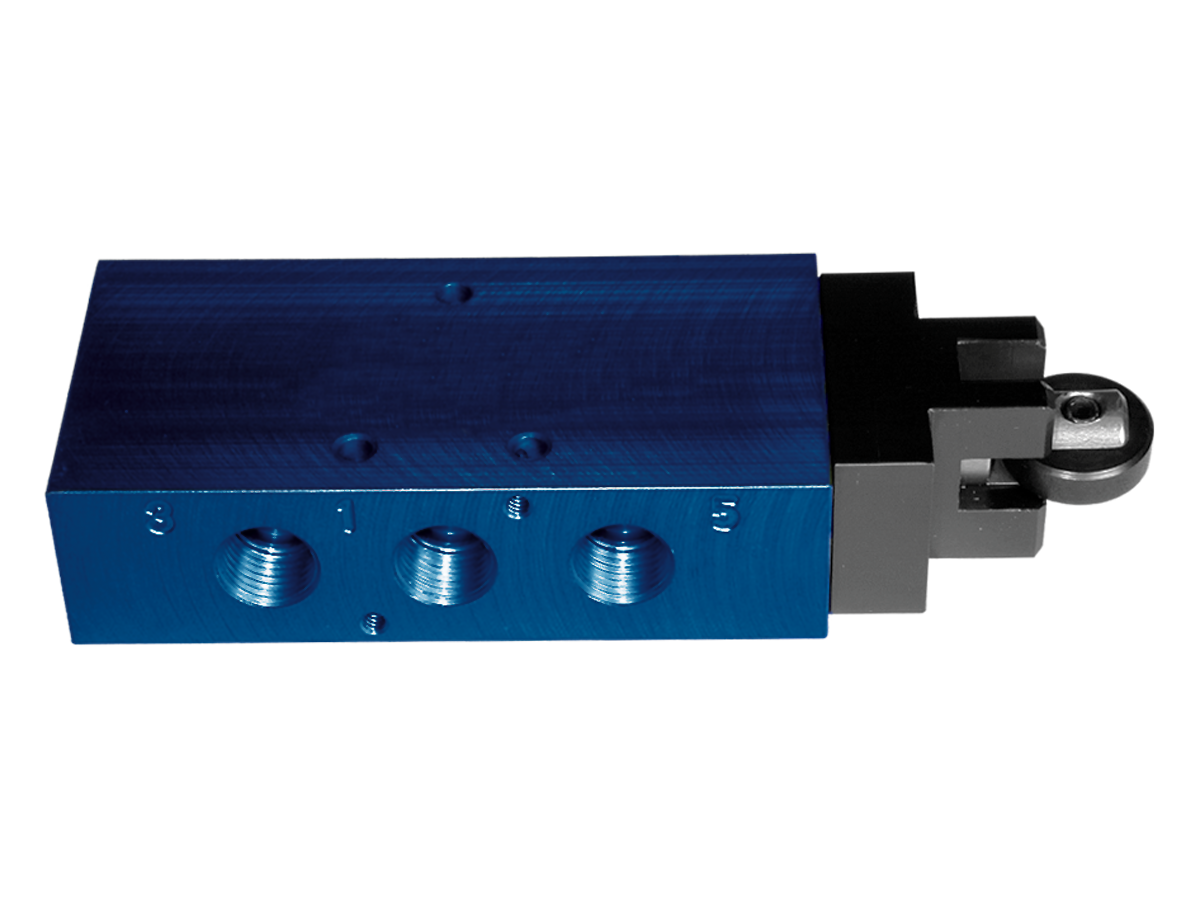
Cam Roller Mechanically Actuated- L20 Series
 Product Catalog
- 5/2 spring return
- In-line mount
- Spool construction
- 1/4" & 3/8" port sizes
- Additional models available, please view downloadable literature
loading...
loading...
Product Overview
The Automatic Valve Cam Roller series provides mechanically actuated pneumatic directional control for machine-controlled sensing, positioning, and sequence operations. Built on the L20 compact spool valve platform, these mechanically actuated valves respond to cam or roller contact from moving machine elements to shift the internal spool and redirect airflow without any electrical input, making them inherently suited to intrinsically safe, explosion-proof, or electrically isolated environments.
The cam roller operator consists of a hardened roller mounted on a pivoting arm that engages a cam profile or contact surface on a moving machine element such as a conveyor dog, cylinder rod, rotary cam, or linear slide. When the cam surface contacts and deflects the roller arm, the operator translates this mechanical motion into a linear spool-shifting force. The spring return mechanism restores the spool to its default position as the cam contact is withdrawn.
Available in 1/4 inch port (L2003 body) and 3/8 inch port (L2004 body) variants, the L20 cam roller valve provides 5/2 spring return function with a flow capacity of 1,770 l/min (Cv 1.8). The same Tapered Tee-Seal construction used throughout the L20 platform delivers 20-million-cycle validated service life with bidirectional spool cleaning on every stroke.
Cam roller valves in the L20 series mount inline and share the same body footprint as all other L20 operator types, enabling mixed-station manifold configurations. Two variants are listed for Automatic Valve: model L2003AAJR for 1/4 inch ports and L2004AAJR for 3/8 inch ports, both in aluminum bodies with NBR seals for standard temperature service.
Key Engineering Features
- Machine-Controlled Actuation Without Electrical Input - The cam roller operator converts mechanical cam contact into spool-shifting force with no electrical signal, solenoid, or pilot supply required, making these valves suitable for intrinsically safe zones, explosive atmospheres, and circuits requiring complete electrical isolation.
- Hardened Roller and Pivoting Arm Operator - The precision-machined roller and arm assembly translates cam or contact surface engagement into a repeatable, defined spool-shifting stroke with low actuation force requirements and high cycle life.
- 5/2 Spring Return Function - 5-port, 2-position spring return operation provides single-acting control of double-acting actuators, with the spool shifting to the actuated position under cam contact and automatically returning to the default position when contact is withdrawn.
- Tapered Tee-Seal Construction - Bidirectional tapered Tee-Seal mechanically locks in position with no spiral twist, wiping air line sediment from the spool bore on every actuation. SAE-validated to 20 million cycles with rust and water injection testing.
- Compact Inline Body - Inline mount with 1/4 or 3/8 NPT port threads allows installation directly in air lines with minimal plumbing. The same body footprint as other L20 operator types enables manifold mixing.
- Manifold Compatibility - L20 cam roller valves mount on A8020 series L20 manifolds at any station, allowing machine-controlled cam sensing to be combined with solenoid, foot pedal, hand lever, and other L20 operator types on a shared manifold body.
- Aluminum Body with NBR Seals - Die-cast aluminum body with treated Buna-N seals for standard industrial temperature service from -18 to 50 C (0 to 123 F). Fluoroelastomer seals available as Option A for media compatibility requirements.
- Low Actuation Force - The cam roller operator requires low contact force from the actuating cam or dog, enabling use with lightweight cams, low-mass mechanical elements, and low-inertia rotating mechanisms.
Technical Specifications
General Specifications
| Parameter | Specification |
| Valve Series | L20 |
| Valve Function | 5/2 Spring Return |
| Actuation | Mechanical - Cam Roller |
| Construction | Spool |
| Mounting | Inline |
| Port Sizes | 1/4" and 3/8" NPT |
| Thread Type | NPT standard; G (BSPP) optional |
| Operating Pressure | 35 to 150 psig (2.4 to 10.3 bar) |
| Flow (5/2) | 1,770 l/min (Cv 1.8) |
| Ambient / Media Temperature | 18 to 50 C (0 to 123 F) |
| Fluid Media | Filtered compressed air or inert gas |
| Filtration Recommendation | 50 microns or better |
| Valve Body Material | Aluminum |
| Spool Material | Aluminum |
| Seal Material | Treated Buna-N (NBR); Fluoroelastomer optional (Option A) |
| Weight (5/2) | 0.3 kg (0.7 lb) |
Flow Performance Data
| Series | Port Size | Function | Flow l/min (Cv) | Body Material | Seal | Weight kg (lb) |
| L20 | 1/4" | 5/2 | 1,770 (1.8) | Aluminum | NBR | 0.3 (0.7) |
| L20 | 3/8" | 5/2 | 1,770 (1.8) | Aluminum | NBR | 0.3 (0.7) |
Certifications & Compliance
| Certification/Standard | Detail |
| CSA | C22.2 and UL STD 429 for L20 platform solenoid variants. Mechanically actuated cam roller models require no electrical certification. |
| CE | CE marking applicable to L20 platform per EMF and Low Voltage Directives for solenoid variants. Mechanical-only cam roller models do not carry electrical certifications. |
| SAE Cycle Testing | Tapered Tee-Seal validated to 20 million cycles with rust and water injection every 864,000 cycles per SAE test protocol. |
| ATEX / FM Suitability | Mechanically actuated cam roller valves contain no electrical components, making them inherently suitable for use in explosive atmospheres without ATEX or FM electrical certification. Confirm installation requirements with the authority having jurisdiction. |
Typical Applications & Industries
Transfer Lines and Automated Machining
- Linear transfer line end-of-travel sensing where a cam dog on the transfer bar contacts the cam roller to signal completion of a station advance stroke and initiate clamp, drill, or tool engagement.
- CNC machine pallet changer position confirmation where the cam roller detects pallet seating before allowing spindle engagement, providing a hardwired signal independent of the machine control system.
- Rotary indexing table position locking circuits where the cam roller senses index completion and pilots the locking cylinder to engage before tooling descends.
- Cylinder end-of-stroke sensing on press transfer automation where cam roller detection confirms part ejection before the next blank is fed.
Conveyor and Material Handling Systems
- Accumulation conveyor stop-gate control where cam rollers mounted at fixed positions detect pallet or carrier presence and signal divert gates, stop cylinders, or accumulation logic without hardwiring to a PLC.
- Pneumatic pallet lift and lower circuits on roller conveyor lines where a cam profile on the pallet carrier actuates the cam roller to initiate the lift or lower cycle at each work station.
- Gravity roller conveyor stop and release stations where a cam dog on the conveyor frame triggers the cam roller to release a pneumatic pin stop when the upstream position is clear.
- Chain conveyor dog-sensing for automatic lubricator cycle initiation, where each chain dog triggers the cam roller to inject a metered shot of lubricant.
Pneumatic Cylinder Sequencing
- Multi-cylinder sequencing circuits where an extending cylinder carries a cam dog that actuates a cam roller valve at the end of stroke to initiate the next cylinder in the sequence without solenoid valves or PLC logic.
- Pneumatic press and clamping fixture sequencing where the approach stroke cam contact initiates a second clamp cylinder, and the return stroke contact releases the secondary clamp after the primary clamp retracts.
- Cascade circuit design for fail-safe cylinder sequencing in explosive or electrically sensitive environments where no solenoid valves can be used.
- Pick-and-place robot end-of-travel sensing at each axis limit to provide positive mechanical confirmation of axis position for the pneumatic control circuit.
Packaging Machinery
- Carton erecting machine where the mandrel reaching the bottom of stroke actuates a cam roller to initiate the folding or glue injection cycle.
- Vertical form-fill-seal (VFFS) bag machine jaw cycling where a cam profile on the main drive initiates the sealing jaw closure through a cam roller valve.
- Label application machinery where rotary cam profiles synchronize the label application stroke with product travel on the conveyor.
- Case packer indexing where the case infeed chain dog triggers the cam roller to initiate the packer head advance stroke.
Press and Stamping Operations
- Mechanical press clutch-engage position sensing where a rotary cam profile on the crankshaft confirms top-dead-center position before allowing another press cycle initiation.
- Scrap ejection and part blow-off circuits on progressive die presses where cam profiles on the press ram trigger sequential air blasts timed to die open position.
- Die protection sensing for large-format punch and form presses, where cam roller detection of material feed confirms correct strip position before the press stroke.
- Rotary cam-controlled spray lubrication systems on stamping dies where the cam roller valve meters die lubricant in precise synchrony with press speed.
Intrinsically Safe and Hazardous Locations
- Grain, flour, and feed mill equipment where electrical actuators are prohibited or undesirable near combustible dust atmospheres and mechanical cam actuation provides inherent intrinsic safety.
- Paint booth and solvent coating line position sensing where zero electrical energy in the sensing element eliminates ignition risk near flammable vapors.
- Chemical process equipment where cam-actuated pneumatic sequencing avoids electrical components in corrosive or explosive atmospheres.
- Underground mining and tunneling equipment where cam roller sequencing provides machine position feedback in zones where electrical apparatus must be minimized.
Ordering and Model Number Configuration
Automatic Valve L20 cam roller valves use the standard L20 model number structure. The example below decodes model L2003AAJR.
|
Model: L2003AAJR
L20 Series (L20 Compact Spool)
03 Port Size (03 = 1/4", 04 = 3/8")
A Body Type (A = 5/2 Single)
A Center Operator Position
J Operator Code (J = Cam Roller)
R Return Type (R = Spring Return) |
Standard port threads are NPT. For G (BSPP) threads, add suffix W to the model number.
For fluoroelastomer seals (FKM), add suffix A to the model number.
Option B converts the valve to external pilot supply for inlet pressures below 35 psig. Field conversion is also possible by rotating the gasket 180 degrees.
Option D (Dustproof) plugs vent ports for extremely contaminated environments.
Stainless steel body options: suffix S = 303 SS, suffix SS = 316 SS (L20 only).
Additional models beyond the standard listing may be available. Consult Automatic Valve or the Compact Spool Valves product catalog.
Accessories
L20 Manifolds
A8020 series manifolds accept L20 cam roller valves alongside other L20 operators on common inlet and exhaust ports. Cam roller stations can be mixed with solenoid, foot pedal, hand lever, or palm button stations.
| Stations | Model Number | Port Size | Weight kg (lb) |
| 2 | A8020-002 | 3/8 | 0.42 (0.9) |
| 4 | A8020-004 | 3/8 | 0.6 (1.3) |
| 6 | A8020-006 | 3/8 | 0.8 (1.7) |
| 8 | A8020-008 | 3/8 | 1.0 (2.2) |
| 10 | A8020-010 | 3/8 | 1.19 (2.7) |
Interposed Flow Controls
Model B8022-005 mounts between the L20 valve body and manifold to provide cylinder exhaust speed control at the valve without separate flow control valves.
| Series | Model Number | Dimension H mm (in) | Weight kg (lb) |
| L20 | B8022-005 | 12.7 (0.50) | 0.09 (0.19) |
Related Products & Accessories
- L20 Series Foot Pedal Manually Actuated Valves - Manually foot-actuated companion to the cam roller series for operator-controlled applications on the same L20 platform. https://www.automaticvalve.com/series/2821-foot-pedal
- L20 Series Foot Treadle Manually Actuated Valves - Foot treadle variants for applications requiring a larger foot platform and 5/2 or 5/3 function options. https://www.automaticvalve.com/series/2823-foot-treadle
- L20 Series Hand Lever Manually Actuated Valves - Hand lever variants on the L20 platform for manually controlled directional switching. https://www.automaticvalve.com/series/2824-hand-lever
- Compact Solenoid L Series Valves - Standard Temperature - Solenoid-actuated L20 directional control valves for integration with PLC-controlled automation. https://www.automaticvalve.com/series/2979-compact-solenoid-l-series-valves-standard-temperature-applications
- Energy Isolation Valves - 15 Series Lockout L-O-X Valves - Upstream lockout valves for OSHA-compliant energy isolation during maintenance of any machine using cam roller or other manual and mechanical valves. https://www.automaticvalve.com/series/3010-energy-isolation-valves
Frequently Asked Questions (FAQ)
Q: What distinguishes a mechanically actuated valve from a solenoid valve?
A: A mechanically actuated cam roller valve shifts its spool through direct physical contact between the roller operator and a moving machine element such as a cam, dog, or trip pin. No electrical signal, solenoid coil, or pilot air supply is needed for actuation. This makes cam roller valves inherently suitable for electrically sensitive, explosive, or intrinsically safe environments and eliminates the failure modes associated with solenoid coils and electrical wiring.
Q: What function does the L20 cam roller valve provide?
A: The L20 cam roller valve provides 5/2 (5-port, 2-position) spring return function. Cam contact shifts the spool to connect port 1 to port 4 and exhaust port 2 through port 3. When the cam withdraws, the integral spring returns the spool to the default position connecting port 1 to port 2 and exhausting port 4 through port 5.
Q: What is the operating pressure range?
A: Operating pressure is 35 to 150 psig (2.4 to 10.3 bar) for the 5/2 spring return function.
Q: What flow capacity does the L20 cam roller valve provide?
A: Flow capacity is 1,770 l/min (Cv 1.8) for the 5/2 function in both 1/4 inch and 3/8 inch port sizes.
Q: How much force is required to actuate the cam roller valve?
A: The cam roller operator requires low actuation force, proportional to the spool-shifting force required to overcome the return spring and internal spool friction at the operating pressure. Consult Automatic Valve for specific force values at the required operating pressure to size cam geometry and cam drive motor loads correctly.
Q: Can cam roller valves be used in explosive atmospheres?
A: Yes. Because cam roller valves contain no electrical components, they are inherently suitable for use in explosive atmospheres and hazardous locations without ATEX or FM electrical certification requirements. Confirm specific installation requirements with the authority having jurisdiction and the applicable area classification standard.
Q: Can the cam roller and foot pedal valves share a manifold?
A: Yes. The L20 cam roller valve shares the same body footprint as all other L20 operators and mounts directly on the A8020 series manifolds. Cam roller stations can be combined with solenoid, foot pedal, hand lever, or palm button stations on a common manifold at any mix of positions.
Q: What temperature range is the L20 cam roller valve rated for?
A: Standard NBR seal variants are rated for ambient and media temperatures from -18 to 50 C (0 to 123 F). Fluoroelastomer seals (Option A) are available for applications where the fluid media or ambient conditions are not compatible with nitrile seals.
Q: Does the cam roller valve require lubrication?
A: Air line lubrication is not required. Lubrication is recommended to maximize service life. Use petroleum-based oil at ISO 32 or lighter viscosity, aniline point between 82 C and 99 C. Do not use phosphate-type additives.
Q: What service kit is used to rebuild the L20 cam roller valve?
A: Use service kit K-L20-SGL for the standard single spring return L20 body. This kit includes 6 Tee-Seals, 1 piston seal, 1 spring, and lubricant. For fluoroelastomer seals, order K-L20-SGL-A.
Q: How do I ensure the cam roller valve returns reliably after cam contact?
A: Verify that the cam profile does not apply force to the roller arm beyond the full stroke travel. Over-stroking the roller arm can damage the operator linkage or cause the spool to jam at the end of travel. The cam must release completely to allow the return spring to pull the spool back. Check that the cam profile provides a smooth ramp-out that allows gradual roller release rather than a hard edge that could bounce or briefly re-contact the roller.
Q: What is the minimum cam dwell time required?
A: Minimum cam dwell time depends on the downstream actuator volume, line length, and the specific circuit design. Calculate the expected actuator fill time using the system flow capacity and ensure the cam dwell angle provides sufficient contact duration to complete the required pneumatic function before the roller releases.
Installation & Maintenance Guidelines
- Mount the cam roller valve in the inline orientation that places the roller arm in the correct plane to intercept the cam or contact surface. Ensure the roller arm can complete its full stroke without binding against valve body surfaces or adjacent hardware.
- Position the valve so that the cam profile contacts the roller at the center of the roller face to avoid side-loading the pivot arm, which reduces service life.
- Allow sufficient cam dwell angle or linear travel to hold the spool shifted for the required circuit dwell time. Minimum cam contact duration should be verified against the actuator response time for the downstream circuit.
- Supply filtered air at 50 microns or better at 35 to 150 psig (2.4 to 10.3 bar) operating pressure.
- Do not restrict the exhaust port. Install an exhaust silencer with a flow capacity equal to or greater than the valve's exhaust capacity.
- For inlet pressures below 35 psig (2.4 bar), use Option B external pilot supply or perform the field conversion by rotating the gasket 180 degrees and connecting pilot air at the 1/8 NPTF external pilot port.
- Lubrication is not required but is recommended for maximum service life. Use petroleum-based oil, ISO 32 or lighter viscosity, aniline point between 82 C and 99 C.
- Protect the cam roller arm from impact by machine elements other than the intended cam surface. A bent or damaged roller arm will prevent proper spool actuation.
- After installation, cycle the cam manually several times to confirm smooth spool shifting and positive spring return before placing the machine in production service.
- Torque operator cap M3 screws to 1.02 N-m (9 in-lbs) plus or minus 10 percent when reassembling after service.
Warranty & Global Support
Automatic Valve provides a one-year warranty on all products, covering defects in material and workmanship from the date of purchase.
Technical support is available from Automatic Valve at (248) 474-6761.
For product selection, cam geometry design assistance, and distributor information, visit automaticvalve.com or contact Automatic Valve directly.
For complete technical data, dimensional drawings, and product catalog downloads, visit the Automatic Valve website at automaticvalve.com or request the Compact Spool Valves product catalog.
Download Catalog: https://www.automaticvalve.com/documents/415/AV_Compact_L-Series_Manual-Mechanical_Valves_AV-C-MMV_en.pdf
Download Documents
Cam Roller