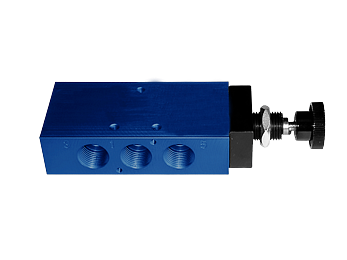




Palm Button Manually Actuated - I20, L20 Series
 Product Catalog
 - ISO-5599-1 Valves
Product Catalog
Product Catalog - ISO-5599-1 Valves
- 3/2 & 5/2 spring return and detented options
- In-line and top mount options
- 1/4", 3/8", and 1/2" ports
- Spool contruction
- Additional models available, please view downloadable literature
loading...
loading...
Product Overview
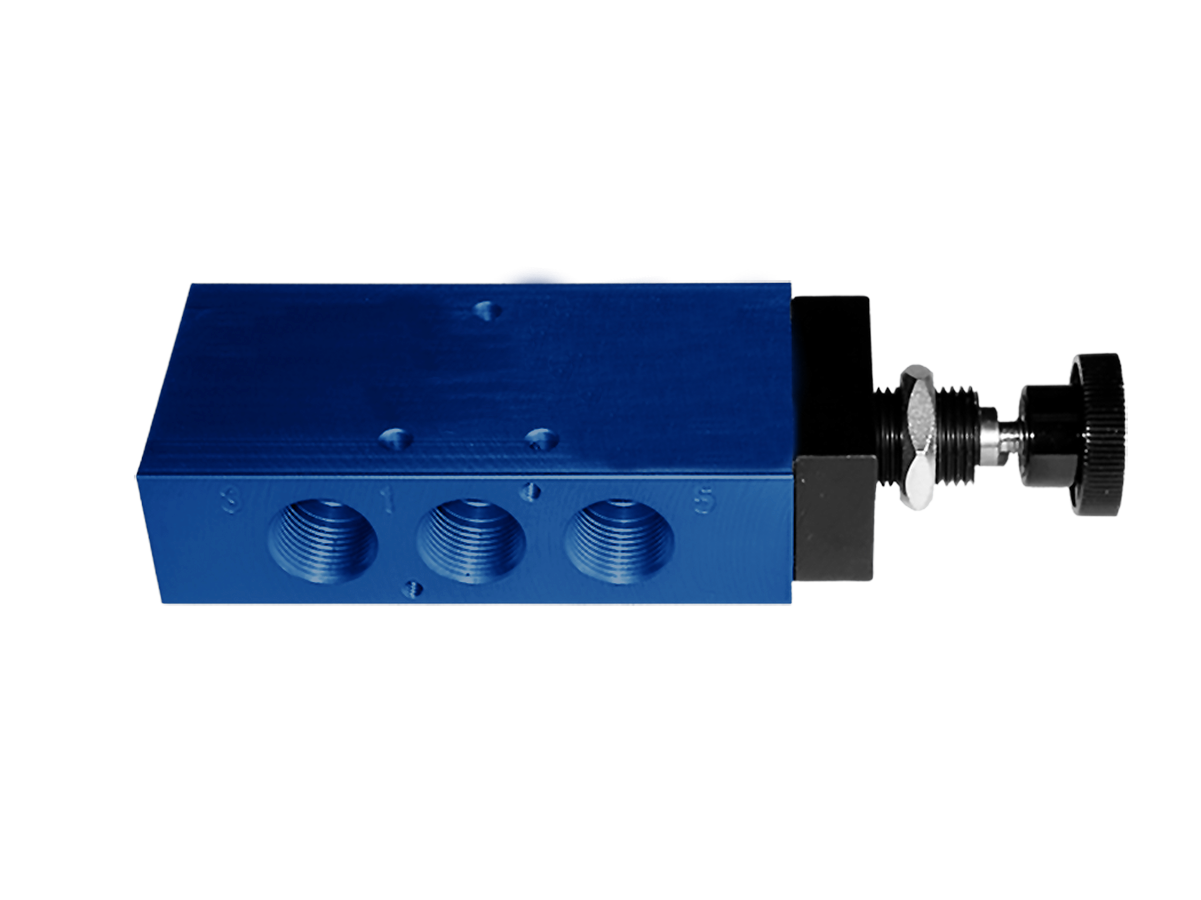
The Automatic Valve Palm Button series provides manually actuated pneumatic directional control with an ergonomic palm-actuated mushroom button designed for direct hand contact in industrial operator interface applications. Available in the L20 compact spool platform and the I20 inline series, these valves serve both as conventional single-station directional control valves and as the primary operator elements in two-hand no-tie-down (anti-tiedown) press and machine safety circuits.
The palm button operator uses a large-diameter mushroom cap that requires the operator to use the full palm to depress the button, preventing accidental actuation by incidental contact with a single finger or tool. The spring return mechanism ensures the valve immediately returns to its de-energized state when the operator lifts their hand, making this design the basis for two-hand control circuits that require simultaneous depression of two separate palm button valves to initiate a dangerous machine motion.
Available in 3/2 and 5/2 spring return and detented configurations, the L20 Palm Button series offers 1/4 and 3/8 inch NPT ports in both inline mount (operator I) and top mount configurations. The I20 series provides 1/2 inch port size for higher-flow applications. Flow capacity is 1,770 l/min (Cv 1.8) for L20 5/2 function and 0.41 kg body weight.
The Automatic Valve palm button series covers four standard variants: I2000BAIM (I20, 1/2 port, detented), L2003BAIM (L20, 1/4 port, detented), L2004BAIM (L20, 3/8 port, detented), and their spring return counterparts. The top-mount orientation of the palm button places the large mushroom cap on the upper face of the valve body, allowing the valve to be panel-recessed or fixture-integrated with the button accessible from the operator's working position.
Key Engineering Features
- Large Mushroom Palm Button Operator - The oversized mushroom cap requires full-palm contact for actuation, preventing accidental engagement by fingers, tools, or incidental contact. The large cap surface provides consistent actuation regardless of operator hand size or glove thickness.
- Anti-Tiedown Circuit Compatibility - Spring return actuation with immediate release upon hand removal makes palm button valves the standard operator element for two-hand no-tie-down (anti-tiedown) safety circuits that prevent a single operator from tying down one button while operating the machine unsafely with one hand.
- 3/2 and 5/2 Valve Functions - 3/2 function for single-acting cylinder control and pilot air signals; 5/2 for double-acting cylinder and full directional control applications. Both spring return and detented variants available.
- Inline and Top Mount Configurations - Inline mount for direct air-line installation with the button accessible from the side. Top mount places the button face on the upper valve surface for panel-integrated installations and operator workstation interfaces.
- Tapered Tee-Seal Construction - Bidirectional Tapered Tee-Seal wipes the spool bore clean on every actuation cycle, validated to 20 million cycles with SAE rust and water injection testing. No lubrication required for operation.
- 5/8-18 Thread Mounting - The palm button mushroom cap uses 5/8-18 thread mounting for secure attachment to the valve body, providing a defined stroke of approximately 10.7 mm (0.42 in) for positive tactile feedback.
- Manifold Compatibility (L20) - L20 palm button valves mount on A8020 series manifolds at any station, mixing with solenoid, cam roller, foot pedal, and hand lever operators on a common manifold body.
- Aluminum Body with NBR Seals - Die-cast aluminum body with treated Buna-N seals for standard temperature service. Fluoroelastomer seal option (suffix A) available for media compatibility.
Technical Specifications
General Specifications
| Parameter | Specification |
| Valve Series | L20 (1/4 and 3/8 ports), I20 (1/2 port) |
| Valve Functions | 3/2 NC; 5/2 Spring Return; 5/2 Detented |
| Actuation | Manual - Palm Button |
| Operator Types | Spring Return (R) and Detented (M) variants |
| Construction | Spool |
| Mounting | Inline and Top Mount |
| Port Sizes | 1/4" and 3/8" NPT (L20); 1/2" NPT (I20) |
| Thread Type | NPT standard; G (BSPP) optional |
| Operating Pressure (5/2) | 35 to 150 psig (2.4 to 10.3 bar) |
| Flow - L20 (5/2) | 1,770 l/min (Cv 1.8) |
| Ambient / Media Temperature | 18 to 50 C (0 to 123 F) |
| Fluid Media | Filtered compressed air or inert gas |
| Filtration Recommendation | 50 microns or better |
| Button Diameter | 25.4 mm (1.00 in) |
| Button Thread | 5/8-18 |
| Button Stroke (approx.) | 10.7 mm (0.42 in) |
| Valve Body Material | Aluminum |
| Spool Material | Aluminum |
| Seal Material | Treated Buna-N (NBR); Fluoroelastomer optional (Option A) |
| Weight (L20 palm button) | 0.41 kg (0.9 lb) |
Flow Performance Data
| Series | Port Size | Function | Flow l/min (Cv) | Body Material | Seal | Weight kg (lb) |
| L20 | 1/4" | 5/2 | 1,770 (1.8) | Aluminum | NBR | 0.41 (0.9) |
| L20 | 3/8" | 5/2 | 1,770 (1.8) | Aluminum | NBR | 0.41 (0.9) |
Certifications & Compliance
| Certification/Standard | Detail |
| CSA | C22.2 and UL STD 429 for L20 platform solenoid operator variants. Manual palm button models require no electrical certification. |
| CE | CE marking for applicable L20 platform solenoid variants per EMF and Low Voltage Directives. |
| SAE Cycle Testing | Tapered Tee-Seal validated to 20 million cycles with rust and water injection every 864,000 cycles per SAE test protocol. |
| Anti-Tiedown Suitability | Spring return palm button valves are suitable for use as operator elements in two-hand no-tie-down safety circuits per OSHA 29 CFR 1910.217 and ANSI B11 machine safety standards. The two-hand control circuit design must be engineered to OSHA and ANSI requirements; the palm button valve alone does not constitute a certified two-hand control system. |
Typical Applications & Industries
Press and Metal Forming - Two-Hand Control
- Two-hand no-tie-down (anti-tiedown) press control circuits where simultaneous depression of two palm buttons, one positioned for each of the operator's hands, initiates the press stroke only when both hands are away from the die area.
- Pneumatic punch and notching press cycle initiation where the two-palm-button circuit provides OSHA-compliant hand barrier between the operator and the tooling during the working stroke.
- Metal forming and embossing press single-stroke initiation using two-hand palm button logic to prevent repeat stroking caused by a tied-down single-hand control.
- Hydraulic press auxiliary air circuits where the palm button pilot circuit controls a safety clamp or guard interlock before the hydraulic stroke is initiated.
Assembly and Joining Operations
- Pneumatic riveting, staking, and swaging benches where the operator uses two palm buttons to initiate the cycle only when both hands are clear of the tooling zone.
- Pneumatic insertion and press-fit stations where the operator aligns the part with one hand and then transfers to the two-hand palm button position to trigger the insertion force.
- Wire and terminal crimping benches in electrical assembly where two-hand initiation ensures fingers are clear of the crimping die.
- Pneumatic stapling and fastening fixtures where the operator must position the work with both hands before actuating the fastener.
Packaging and Label Application
- Manual banding and strapping stations where the operator positions the strap with both hands on the package and then initiates the tension and seal cycle by releasing both hands to the palm buttons.
- Heat seal and impulse sealer initiation where both operator hands position the bag seam before activating the sealing bar through two-palm actuation.
- Manual label application and tamping fixtures where the operator positions the label and initiates the tamping stroke through a single or dual palm button.
- Shrink wrap and stretch wrap turntable control where the palm button provides a defined work cycle start after the load is positioned.
Woodworking and Panel Processing
- Router table and shaper cycle initiation where the operator positions the workpiece against the fence with both hands and initiates the air clamp by releasing to palm buttons.
- Pneumatic nailer and stapler cycle control where the panel is positioned with both hands and the fastener cycle is initiated with palm actuation after the hands are clear.
- Panel trimming and sizing saws with pneumatic hold-down circuits where two-hand palm actuation ensures the operator's hands are on the buttons rather than near the blade during the cut.
- Dowel and biscuit insertion station pneumatic press where both hands guide the workpiece into position before palm button actuation of the press cylinder.
Machine Tool and Workholding
- Pneumatic vise and collet clamping at manual machining stations where the operator loads the workpiece with both hands and initiates clamping with palm actuation.
- Rotary index table advance initiation using a palm button after the operator verifies part loading and hands clear of the fixture.
- Workpiece ejection and part transfer circuits at machining cells where the palm button provides a defined start signal that confirms the operator is in a safe position.
- Fixture unclamp and part-remove sequences at the end of machining cycles where the palm button confirms operator readiness before clamping force is released.
Test and Inspection Equipment
- Pneumatic leak test air supply initiation where the operator loads the part and activates the test air supply using a palm button after sealing the test fixture.
- Force and torque test bench cycle start where the operator positions the specimen and initiates the test load sequence through palm button actuation.
- Pneumatic gauging and dimensional check fixture cycle start ensuring the part is fully seated before air jets or probes are activated.
- Burst and pressure test initiation at hydrostatic and pneumatic test benches where the palm button provides a deliberate cycle start after all connections are verified.
Ordering and Model Number Configuration
Automatic Valve L20 palm button valves use the standard L20 model number structure. The example below decodes model L2003BAIM.
|
Model: L2003BAIM
L20 Series (L20 Compact Spool)
03 Port Size (03 = 1/4", 04 = 3/8")
B Body Type (A = Single 5/2 Spring Return, B = Detented 5/2)
A Center Operator Position
I Operator Code (I = Palm Button)
M Return Type (M = Detented / Maintained; R = Spring Return) |
Standard port threads are NPT. For G (BSPP) threads, add suffix W to the model number.
For fluoroelastomer seals, add suffix A to the model number.
Option B provides external pilot supply for inlet pressures below 35 psig. Field conversion is also possible.
Option D (Dustproof) plugs vent ports for very contaminated environments.
Stainless steel body options: suffix S = 303 SS, suffix SS = 316 SS (L20 only).
Additional models including 3/2 function and additional top-mount configurations are available. Consult Automatic Valve or download the product catalog.
Accessories
L20 Manifolds
A8020 series manifolds for combining L20 palm button valves with other L20 operator types on a common manifold body.
| Stations | Model Number | Port Size | Weight kg (lb) |
| 2 | A8020-002 | 3/8 | 0.42 (0.9) |
| 4 | A8020-004 | 3/8 | 0.6 (1.3) |
| 6 | A8020-006 | 3/8 | 0.8 (1.7) |
| 8 | A8020-008 | 3/8 | 1.0 (2.2) |
| 10 | A8020-010 | 3/8 | 1.19 (2.7) |
Interposed Flow Controls
Model B8022-005 for cylinder exhaust speed control between the L20 valve body and manifold.
| Series | Model Number | Dimension H mm (in) | Weight kg (lb) |
| L20 | B8022-005 | 12.7 (0.50) | 0.09 (0.19) |
Related Products & Accessories
- L20 Series Foot Pedal Manually Actuated Valves - Foot-actuated companion for hands-free applications on the same L20 platform. https://www.automaticvalve.com/series/2821-foot-pedal
- L20 Series Hand Lever Manually Actuated Valves - Hand lever valves across I15, I45, L20, L21, and L45 platforms for manually switched directional control. https://www.automaticvalve.com/series/2824-hand-lever
- L20 Series Foot Treadle Manually Actuated Valves - Full-sole foot treadle valves for ergonomic hands-free operation. https://www.automaticvalve.com/series/2823-foot-treadle
- Compact Solenoid L Series Valves - Standard Temperature - Solenoid-actuated L20 and L45 valves for automated circuit integration. https://www.automaticvalve.com/series/2979-compact-solenoid-l-series-valves-standard-temperature-applications
- Energy Isolation Valves - 15 Series Lockout L-O-X Valves - Upstream energy isolation for OSHA lockout/tagout compliance at any palm button or other manual valve workstation. https://www.automaticvalve.com/series/3010-energy-isolation-valves
Frequently Asked Questions (FAQ)
Q: What makes a palm button valve different from other push-button valves?
A: A palm button valve uses an oversized mushroom-shaped cap that requires the full palm to depress. The large cap surface area prevents accidental actuation by a single finger, knuckle, or tool contact and provides a comfortable, natural actuation motion for operators who must cycle the valve many times per shift. The same physical geometry that ensures palm-only actuation also makes it difficult to tie down or bypass with tape or wire, which is essential for two-hand no-tie-down safety circuits.
Q: Can the L20 palm button valve be used in a two-hand no-tie-down press control circuit?
A: Yes. Two L20 spring return palm button valves positioned for simultaneous two-hand actuation are the standard operator elements for pneumatic two-hand no-tie-down circuits. The complete anti-tiedown function requires a pneumatic or electronic logic circuit that monitors concurrent depression of both valves and releases the machine cycle only when both buttons are held simultaneously. The palm button valve alone does not constitute a certified safety system; the complete design must meet OSHA 29 CFR 1910.217 and ANSI B11.19 requirements.
Q: What valve functions are available for the palm button series?
A: Available functions include 3/2 normally closed (for single-acting actuator and pilot signal applications) and 5/2 in both spring return and detented configurations (for double-acting cylinder directional control). The detented 5/2 variant holds the shifted spool position until the button is pressed again, supporting latched circuit designs.
Q: What is the button stroke and diameter?
A: The palm button mushroom cap diameter is 25.4 mm (1.00 inch), threaded with a 5/8-18 thread for secure mounting to the valve body. Button stroke is approximately 10.7 mm (0.42 inch). This stroke length provides sufficient mechanical travel for reliable spool shifting while offering positive tactile feedback at full depression.
Q: What flow capacity does the L20 palm button valve provide?
A: The L20 palm button valve provides 1,770 l/min (Cv 1.8) for 5/2 function at both 1/4 and 3/8 inch port sizes. The I20 series provides higher flow capacity at 1/2 inch port size.
Q: Can palm button valves be panel-mounted?
A: Yes. The palm button is designed for panel mounting with the mushroom cap protruding through a panel cutout. Top-mount configurations allow the valve body to be recessed behind the panel face while the button is accessible from the front. Ensure the panel mounting prevents valve body rotation and secures the valve against the actuation force and repeated button impact.
Q: What is the operating pressure range?
A: Operating pressure for 5/2 spring return and detented functions is 35 to 150 psig (2.4 to 10.3 bar). Maximum pressure is 150 psig. Do not operate below 35 psig minimum for 2-position functions.
Q: Does the L20 palm button valve require lubrication?
A: Air line lubrication is not required. It is recommended to extend seal and spool service life. Use petroleum-based oil with ISO 32 or lighter viscosity, aniline point between 82 C and 99 C. Avoid phosphate-type additives.
Q: Can the palm button valve be converted to external pilot supply?
A: Yes. The field conversion requires removing the operator cap, rotating the gasket 180 degrees to cover the internal pilot hole, refastening the cap, and connecting pilot air to the 1/8 NPTF external pilot port. External pilot pressure must be 35 to 150 psig.
Q: What service kit is used to rebuild the L20 palm button valve?
A: For spring return 5/2 configurations, use K-L20-SGL. For detented 5/2 configurations, use K-L20-DBL. Fluoroelastomer versions are K-L20-SGL-A and K-L20-DBL-A respectively.
Q: How should the palm button be cleaned and maintained?
A: Periodically clean the mushroom cap surface to remove oil, grease, metalworking fluid, and other contaminants that could cause the operator's hand to slip during actuation. Inspect the spring return function at regular maintenance intervals to confirm positive and complete return when the operator's hand is removed. Replace the spring if return is sluggish or incomplete.
Q: Are guards or shrouds required around the palm button?
A: Guards or shrouds are not typically required for palm button valves used as operator interface elements, as the button geometry itself provides anti-accidental-actuation properties. In applications where the valve is positioned near moving machine elements or where objects could fall and depress the button, a partial shroud or basket guard around the mushroom cap is recommended. Guard design must not obstruct free palm access for the operator.
Installation & Maintenance Guidelines
- Mount palm button valves at a height and reach position that requires the operator to hold both buttons simultaneously for the full duration of the cycle. In two-hand anti-tiedown circuits, the buttons must be positioned so that no single hand can reach both buttons at the same time.
- For two-hand anti-tiedown circuits, follow the two-hand control system design requirements in OSHA 29 CFR 1910.217 and ANSI B11.19. The palm button valves are operator elements; the complete anti-tiedown function requires pneumatic or electronic logic that monitors simultaneous depression and releases the machine only on concurrent actuation.
- Supply filtered air at 50 microns or better at 35 to 150 psig (2.4 to 10.3 bar).
- Do not restrict the exhaust port. Use an exhaust silencer with a flow capacity at least equal to the valve's exhaust capacity.
- For inlet pressure below 35 psig (2.4 bar), use Option B external pilot or perform field conversion by rotating the gasket and connecting pilot air to the 1/8 NPTF external pilot port.
- Lubrication is not required but is recommended for maximum service life. Use petroleum-based oil, ISO 32 or lighter, aniline point 82 to 99 C.
- The palm button mushroom cap should be kept clean and free of oil, grease, or contaminants that could cause the operator's palm to slip off the button during actuation.
- Inspect the button cap and spring return function regularly in high-cycle applications to ensure positive return and detection of spring fatigue.
- For top-mount panel installations, ensure that the panel cutout and mounting arrangement prevent the valve body from rotating, which could misalign port connections.
- Torque operator cap M3 screws to 1.02 N-m (9 in-lbs) plus or minus 10 percent when reassembling after service.
Warranty & Global Support
Automatic Valve provides a one-year warranty on all products, covering defects in material and workmanship from the date of purchase.
Technical support is available from Automatic Valve at (248) 474-6761.
For two-hand control circuit design guidance, anti-tiedown circuit application engineering, and product selection assistance, visit automaticvalve.com or contact Automatic Valve directly.
For complete technical data, dimensional drawings, and product catalog downloads, visit automaticvalve.com.
Product Catalog - L Series Manual & Mechanical Valves: https://www.automaticvalve.com/documents/415/AV_Compact_L-Series_Manual-Mechanical_Valves_AV-C-MMV_en.pdf
Product Catalog - Heavy-Duty Palm Button Valves: https://www.automaticvalve.com/documents/6606/Heavy-Duty_Palm_Button_Valves_AV-HD-PBV_en.pdf
Download Documents
Palm Button