



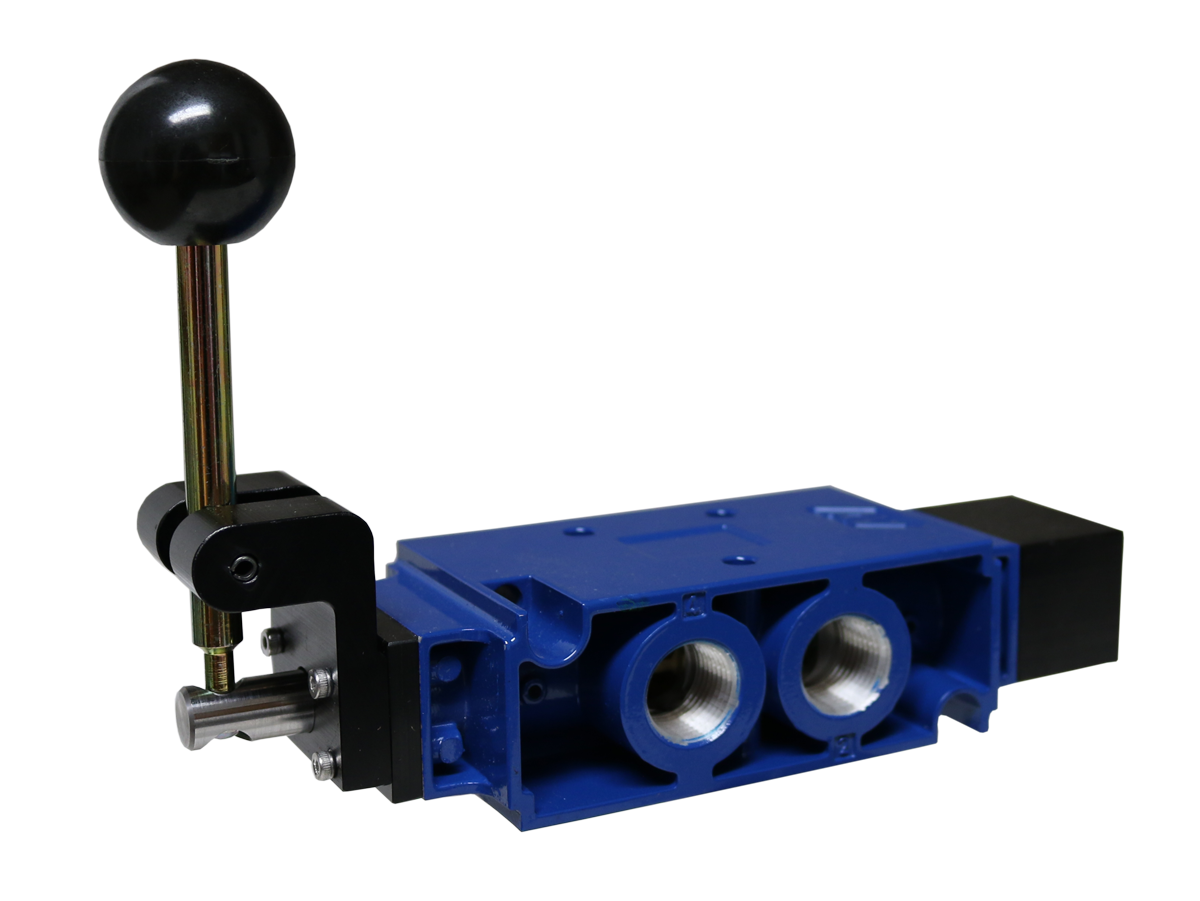
Hand Lever Manually Actuated - I15, I45, L20, L21, L45 Series
 Product Catalog
 - ISO-5599-1 Valves
Product Catalog
Product Catalog - ISO-5599-1 Valves
- 3/2, 5/2 & 5/3 spring return and detented options
- In-line, base mount, and manifold mount options
- 1/4", 3/8", and 1/2" ports
- Spool contruction
- Additional models available, please view downloadable literature
loading...
loading...
Product Overview
The Automatic Valve Hand Lever series provides manually actuated pneumatic directional control across five valve platform families: the compact L20 and L21 series, the medium-duty L45 series, and the ISO 5599-1 compliant I15 and I45 base-mount series. This breadth of coverage enables design engineers, procurement managers, and OEM machine builders to specify a hand lever valve matched precisely to the flow, port size, mounting geometry, and interface standard required for each application.
Hand lever valves are the standard selection for manually controlled pneumatic circuits where the operator determines when and how long the valve is actuated. The lever geometry provides clear visual indication of valve position, positive tactile feedback, and a defined actuation force that suits gloved operators and high-cycle manual workstations. Both spring return (lever returns to default when released) and detented (lever holds position until moved again) variants are available, supporting latch-type circuits and maintained position applications.
The L20 and L45 inline series provide 5/2 and 5/3 valve functions with 1/4, 3/8, and 1/2 inch NPT ports in line-mounted and manifold-mounted body configurations. The I15 and I45 ISO series conform to ISO 5599-1 specifications for size 1, 2, and 3 base-mount interfaces, enabling drop-in compatibility with ISO standard manifolds, sub-bases, and multi-station assemblies. The L21 series provides additional manifold-mount variants for panel-built pneumatic circuits.
All platforms in the hand lever series share the Tapered Tee-Seal spool construction that delivers validated 20-million-cycle service life, self-cleaning spool action, and proven dirt tolerance in industrial environments. The balanced spool construction allows ports to be plugged to convert from 5-way to 3-way or 2-way function in the field.
Key Engineering Features
- Five Platform Coverage - A single hand lever series spans five valve families (I15, I45, L20, L21, L45), providing the same manually actuated interface across compact inline, medium-duty inline, and ISO base-mount configurations for design consistency and multi-platform circuit standardization.
- 3/2, 5/2, and 5/3 Functions - 3/2 (three-way) function for single-acting cylinder and pilot signal applications; 5/2 for double-acting cylinder control; 5/3 with Block, Exhaust, or Pressure center for applications requiring a defined safe or hold position when the lever is released.
- Spring Return and Detented Options - Spring return levers automatically restore to the valve default position when released. Detented levers lock in the shifted position until deliberately moved, enabling latched circuits, manual selector function, and maintained-position control without continuous operator engagement.
- Inline, Base Mount, and Manifold Mount Options - Inline mounting for direct air-line installation; base mount for ISO 5599-1 sub-base or manifold systems (I15, I45); manifold mount for compact multi-station assemblies on L20 manifolds. This flexibility covers virtually every pneumatic system architecture.
- ISO 5599-1 Compliance (I15, I45 Series) - I15 and I45 series valves conform to ISO 5599-1 size 1, 2, and 3 base-mount interfaces, enabling global interchangeability with any ISO 5599-1 sub-base or multi-station manifold assembly without custom porting.
- Tapered Tee-Seal Construction - Bidirectional Tapered Tee-Seal with mechanically locked position, no spiral twist, no extrusion, and self-cleaning spool wipe action on every stroke. SAE-validated to 20 million cycles.
- Balanced Spool for Port Plugging - The balanced spool design allows any work port to be plugged to reduce function from 5-way to 3-way or 2-way operation, providing a single valve body for multiple circuit configurations.
- Aluminum Body with NBR Seals - Die-cast aluminum body with treated Buna-N seals for standard temperature service. Fluoroelastomer seals (Option A) available for fluid media compatibility. 303 and 316 stainless steel body options available for L20 series.
Technical Specifications
General Specifications
| Parameter | Specification |
| Valve Series | I15 (ISO Size 1), I45 (ISO Size 1, 2, 3), L20 (inline and manifold), L21 (manifold), L45 (inline) |
| Valve Functions | 3/2 NC/NO; 5/2 Spring Return (single); 5/2 Detented (double); 5/3 Block, Exhaust, Pressure Center |
| Actuation | Manual - Hand Lever |
| Operator Types | Spring Return and Detented (maintained position) |
| Construction | Spool |
| Mounting | Inline (L20, L45); Base Mount (I15, I45); Manifold Mount (L20, L21) |
| Port Sizes | 1/4", 3/8" NPT (L20, L21); 1/2" NPT (L45); ISO 5599-1 base-mount (I15 Size 1; I45 Size 1, 2, 3) |
| Thread Type | NPT standard; G (BSPP) optional |
| Operating Pressure (5/2) | 35 to 150 psig (2.4 to 10.3 bar) |
| Operating Pressure (5/3) | 50 to 150 psig (3.5 to 10.3 bar) |
| Flow - L20 (5/2) | 1,770 l/min (Cv 1.8) |
| Flow - L20 (5/3) | 1,381 l/min (Cv 1.4) |
| Flow - L45 (5/2) | 4,800 Nl/min (Cv 4.8) |
| Flow - I45 Size 3 (5/2) | 4,430 l/min (Cv 4.5) |
| Flow - I45 Size 3 (5/3) | 3,455 l/min (Cv 3.5) |
| Ambient / Media Temperature | 18 to 50 C (0 to 123 F) |
| Fluid Media | Filtered compressed air or inert gas |
| Filtration Recommendation | 50 microns or better |
| Valve Body Material | Aluminum (standard); 303 or 316 SS optional (L20) |
| Spool Material | Aluminum |
| Seal Material | Treated Buna-N (NBR); Fluoroelastomer optional (Option A) |
Flow Performance Data
| Series | Port Size | Function | Mount | Flow l/min (Cv) |
| L20 | 1/4" | 5/2 | Inline / Manifold | 1,770 (1.8) |
| L20 | 3/8" | 5/2 | Inline / Manifold | 1,770 (1.8) |
| L20 | 1/4" | 5/3 | Inline / Manifold | 1,381 (1.4) |
| L20 | 3/8" | 5/3 | Inline / Manifold | 1,381 (1.4) |
| L45 | 1/2" | 5/2 | Inline | 4,800 (4.8) |
| I45 | ISO Size 3 | 5/2 | Base Mount | 4,430 (4.5) |
| I45 | ISO Size 3 | 5/3 | Base Mount | 3,455 (3.5) |
Certifications & Compliance
| Certification/Standard | Detail |
| CSA | C22.2 and UL STD 429 for L20 and L45 platform solenoid operator variants. Manual hand lever models require no electrical certification. |
| CE | CE marking for applicable L20 and L45 platform variants per EMF and Low Voltage Directives. |
| ISO 5599-1 | I15 and I45 series conform to ISO 5599-1 dimensional specifications for size 1, 2, and 3 base-mount interfaces, ensuring global interchangeability with ISO standard sub-bases and manifold assemblies. |
| SAE Cycle Testing | Tapered Tee-Seal validated to 20 million cycles with rust and water injection every 864,000 cycles per SAE test protocol. |
Typical Applications & Industries
OEM Machine Building and Panel-Built Systems
- Panel-mounted hand lever valves in custom machine control cabinets for operator-selected circuit modes such as automatic, semi-automatic, and manual modes where the lever position visually confirms the selected circuit state.
- Pneumatic logic panels and sequencing boards where hand levers provide operator override, bypass, or test functions without modifying PLC programs or solenoid wiring.
- ISO base-mount manifold assemblies using I45 or I15 hand lever valves for interchangeable, field-replaceable manual control on standardized ISO 5599-1 interfaces.
- Test stands and dynamometer stations where the operator manually selects load configurations, flow paths, or pressure levels by hand lever position.
Maintenance and Commissioning Operations
- Manual valve stations for actuator jog and setup operations during machine commissioning, allowing maintenance personnel to extend and retract cylinders, position tooling, and verify actuator function without energizing the automated control system.
- Bypass and isolation circuits where the hand lever diverts airflow around a solenoid valve for troubleshooting without removing components from the circuit.
- Pneumatic circuit verification at startup where the detented hand lever holds the valve in the test position while both hands are free to measure pressures, check flow, and verify actuator response.
- Scheduled maintenance position circuits where the hand lever locks the valve in a defined safe state before the lockout procedure begins.
Agricultural and Mobile Equipment
- Agricultural implement control panels where the operator manually selects between alternative hydraulic or pneumatic functions using a hand lever without relying on electrical actuation in high-vibration, outdoor-exposure environments.
- Grain handling, seed processing, and bulk material conveying systems where manually selected flow paths direct product to different storage, processing, or discharge locations.
- Pneumatic seeder and planter row control where the hand lever enables or disables planting sections.
- Livestock feed and water system controls where manually operated valves provide reliable operation in environments with moisture, dust, and corrosive conditions.
Assembly and Production Lines
- Semi-automatic assembly cells where an operator initiates each cycle by moving the hand lever, providing a natural work pace setter that does not rely on electronic sensors or PLCs.
- Pneumatic fixture clamping and unclamping at manual assembly benches where the lever provides a clear ON/OFF indicator for supervisory verification.
- Line-start and line-stop selector valves at conveyor zones where the operator manually controls accumulation zone air cylinders.
- Quality inspection stations where the hand lever positions pneumatic part holders or probes for manual measurement operations.
Pharmaceutical, Chemical, and Food Processing
- Stainless steel body L20 hand lever valves (303 or 316 SS options) for washdown and corrosive process environments in food processing and pharmaceutical manufacturing.
- Manually controlled divert valves on powder, pellet, and bulk solid conveying lines where the operator selects the destination silo or bin by hand lever position.
- CIP (clean-in-place) and SIP (steam-in-place) circuit isolation valves where the hand lever manually isolates sections of the process piping during cleaning cycles.
- Manual valve panels for operator control of pneumatic actuators in classified hazardous areas where electrical isolation is required.
Energy, Oil and Gas, and Utilities
- Hand lever selector valves on wellhead and pipeline pneumatic control panels for manually selecting instrument air paths, control loop bypasses, or actuator manual override positions.
- Pneumatic panel boards at compressor stations and pump facilities where the operator uses hand levers to align suction and discharge paths during startup, shutdown, and surge events.
- Gas processing plant manually operated valve panels for purge, vent, and blanket gas circuit control.
- Power plant auxiliary system manually operated valves for instrument air distribution, pneumatic positioner supply isolation, and testing circuits.
Ordering and Model Number Configuration
The Automatic Valve hand lever series spans multiple platforms. Below is the L20 model number structure decoded for model L2003BAFM.
|
Model: L2003BAFM (L20 Hand Lever, Line Mount)
L20 Series (L20 Compact Spool)
03 Port Size (03 = 1/4", 04 = 3/8")
B Body Type (A = Single 5/2, B = Detented 5/2, C = 5/3 Block, D = 5/3 Exhaust, E = 5/3 Pressure)
A Center Operator Position
F Operator Code (F = Hand Lever Line Mount, G = Hand Lever Manifold Mount)
M Return Type (M = Detented / Maintained, R = Spring Return, N = Spring Center) |
Standard port threads are NPT. For G (BSPP) threads, add suffix W to the model number.
For fluoroelastomer seals, add suffix A to the model number.
For L20 stainless steel body: suffix S = 303 SS, suffix SS = 316 SS.
I15 and I45 series use different base-mount model number structures. Refer to the ISO 5599-1 Valves catalog or contact Automatic Valve for the complete I-series model number matrix.
Minimum operating pressure for 5/3 spring center functions is 50 psig (3.5 bar).
Additional models covering 3/2 function and L21 manifold variants are available. Consult Automatic Valve or the downloadable product literature for the complete selection.
Accessories
L20 Manifolds
A8020 series manifolds for L20 hand lever valves with common inlet and exhaust ports. Supports mixed-operator station configurations.
| Stations | Model Number | Port Size | Weight kg (lb) |
| 2 | A8020-002 | 3/8 | 0.42 (0.9) |
| 4 | A8020-004 | 3/8 | 0.6 (1.3) |
| 6 | A8020-006 | 3/8 | 0.8 (1.7) |
| 8 | A8020-008 | 3/8 | 1.0 (2.2) |
| 10 | A8020-010 | 3/8 | 1.19 (2.7) |
Interposed Flow Controls
Model B8022-005 mounts between the L20 hand lever valve and the manifold to provide cylinder exhaust speed control.
| Series | Model Number | Dimension H mm (in) | Weight kg (lb) |
| L20 | B8022-005 | 12.7 (0.50) | 0.09 (0.19) |
Related Products & Accessories
- L20 Series Foot Pedal Manually Actuated Valves - Foot-actuated companion for the same L20 platform where hands-free operation is required. https://www.automaticvalve.com/series/2821-foot-pedal
- L20 Series Cam Roller Mechanically Actuated Valves - Machine-actuated cam roller valves for automatic position sensing on the L20 platform. https://www.automaticvalve.com/series/2820-cam-roller
- L20 Series Foot Treadle Manually Actuated Valves - Full-sole treadle valves for hands-free operation requiring a larger actuation platform. https://www.automaticvalve.com/series/2823-foot-treadle
- Palm Button Manually Actuated Valves - I20, L20 Series - Palm button actuated valves for two-hand operation and operator safety circuit applications. https://www.automaticvalve.com/series/2825-palm-button
- Compact Solenoid L Series Valves - Standard Temperature - Solenoid-actuated L20 and L45 valves for integration with automated control systems. https://www.automaticvalve.com/series/2979-compact-solenoid-l-series-valves-standard-temperature-applications
- Energy Isolation Valves - 15 Series Lockout L-O-X Valves - Upstream energy isolation valves for OSHA lockout/tagout compliance at any manual valve workstation. https://www.automaticvalve.com/series/3010-energy-isolation-valves
Frequently Asked Questions (FAQ)
Q: What is the advantage of a hand lever valve over a solenoid valve for manual control?
A: A hand lever valve provides immediate, direct, and unambiguous positional control that does not depend on electrical power, control system availability, or signal integrity. The lever position is visible from across the machine floor, providing supervisory confirmation of valve state. In power-loss conditions, solenoid valves default to their spring positions while hand lever valves maintain whatever position the operator last selected. For setup, maintenance, and troubleshooting operations, hand lever valves allow controlled actuation without powering the electrical control system.
Q: What is the difference between the L20 line-mount and manifold-mount hand lever valves?
A: The line-mount hand lever valve (operator code F) installs inline in a pipe or tubing run using NPT port threads. The manifold-mount variant (operator code G) uses a bottom gasket and mounting screws to attach to an A8020 series L20 manifold, sharing common inlet and exhaust ports with other valves on the manifold. Both provide the same spool function and flow capacity.
Q: How does the I45 hand lever valve differ from the L20 hand lever valve?
A: The I45 series conforms to ISO 5599-1 base-mount dimensional standards (size 1, 2, or 3), mounting on ISO-standard sub-bases and manifolds. The L20 series uses Automatic Valve's compact inline or proprietary manifold interface. I45 valves are specified when the machine design uses ISO 5599-1 sub-bases for solenoid valve interchangeability across manufacturers. L20 valves are specified for compact inline or L20-manifold integrated designs.
Q: What center position options are available for 5/3 hand lever valves?
A: Three 5/3 center position options are available: Block center (all ports blocked, holding the actuator in position when the lever is released or centered), Exhaust center (both work ports exhausted, allowing loads to retract under gravity or spring), and Pressure center (both work ports connected to supply, pressure-balancing the actuator). The Block center is the most common for mid-stroke positioning. Minimum operating pressure for 5/3 functions is 50 psig.
Q: Can hand lever valves be used for operator safety circuits?
A: Hand lever valves serve as directional selectors and are not rated for safety-circuit functions such as emergency stop or press control. Safety-rated circuits require certified press control valves per OSHA 29 CFR 1910.217 and ANSI B11 standards. However, hand lever valves can be part of a machine's control panel for mode selection and manual operation modes when the machine has already been placed in a safe state. Upstream energy isolation is provided by the 15 Series L-O-X lockout valve.
Q: What flow capacity does the L20 hand lever valve provide?
A: The L20 hand lever valve provides 1,770 l/min (Cv 1.8) for 5/2 function and 1,381 l/min (Cv 1.4) for 5/3 function at both 1/4 and 3/8 inch port sizes. The L45 series at 1/2 inch port size provides 4,800 Nl/min (Cv 4.8). The I45 ISO size 3 provides 4,430 l/min (Cv 4.5) for 5/2 and 3,455 l/min (Cv 3.5) for 5/3 function.
Q: What is the operating pressure range?
A: For 5/2 spring return function: 35 to 150 psig (2.4 to 10.3 bar). For 5/3 spring center functions: 50 to 150 psig (3.5 to 10.3 bar). Do not operate below minimum pressure as the spring may not return the spool reliably.
Q: Are stainless steel body options available for the hand lever series?
A: Yes, for the L20 series only. Option S provides a 303 stainless steel body with all other external parts corrosion resistant. Option SS provides a 316 stainless steel body for more aggressive corrosive environments. Add suffix S or SS to the model number when ordering.
Q: Can the hand lever valve be used without lubrication?
A: Yes. Air line lubrication is not required. It is recommended to extend seal and spool service life. Use petroleum-based oil with ISO 32 or lighter viscosity, aniline point between 82 C and 99 C. Do not use phosphate additives.
Q: What service kit should I use to rebuild the L20 hand lever valve?
A: Use K-L20-SGL for single (spring return) 5/2 L20 bodies. Use K-L20-DBL for double (detented) 5/2 and all 5/3 L20 bodies. Fluoroelastomer versions are K-L20-SGL-A and K-L20-DBL-A respectively. Each kit includes 6 Tee-Seals, the appropriate number of piston seals, a spring (single models), and lubricant.
Q: How does the ISO 5599-1 I-series differ from the L-series in terms of mounting?
A: The I15 and I45 series use a base-mount interface with a flat mounting gasket that registers on a standard ISO 5599-1 sub-base. The sub-base contains the supply and exhaust port connections, and the valve sits on top with all pneumatic connections made through the gasket interface. The L20 series uses threaded NPT ports either inline or through a proprietary L20 manifold. ISO base-mount valves are preferred when the machine design specifies ISO 5599-1 manifolds for solenoid valve interchangeability.
Q: How many stations can I put on an L20 manifold for hand lever valves?
A: The A8020 manifold series supports up to 10 valve stations (model A8020-010). All stations can be hand lever valves or any mix of L20 operator types. Blocking disks (A8020-202) can be installed at unused stations.
Installation & Maintenance Guidelines
- Mount hand lever valves in a position that makes the lever clearly visible to the operator and to supervisors performing safety verification. Lever position must be unambiguous at the operator's normal working posture.
- For inline mount (L20, L45), install the valve in any orientation. For base-mount I-series valves, follow ISO 5599-1 sub-base torque specifications and use the correct gasket for internal or external pilot supply as required.
- Supply filtered air at 50 microns or better at 35 to 150 psig (2.4 to 10.3 bar) for 5/2 function. For 5/3 spring center functions, minimum pressure is 50 psig (3.5 bar).
- Do not restrict the exhaust port. Install an exhaust silencer with a flow capacity at least equal to the valve exhaust capacity.
- For inlet pressures below 35 psig (2.4 bar), use Option B (external pilot supply) or perform the field conversion by rotating the gasket 180 degrees and connecting pilot air to the 1/8 NPTF external pilot port.
- Lubrication is not required but is recommended for maximum service life. Use petroleum-based oil, ISO 32 or lighter, aniline point 82 to 99 C. Avoid phosphate additives.
- Label the hand lever valve and its position (ON/OFF or named function) with permanent, machine-readable identification to support lockout/tagout procedures and operator training.
- Torque L20 operator cap M3 screws to 1.02 N-m (9 in-lbs) plus or minus 10 percent when reassembling after service.
- For manifold-mounted (L20 manifold mount) variants, torque the manifold-to-valve mounting hardware per the A8020 manifold installation instructions using a T-handle wrench on the M5 screw end and a torque wrench on the hex nut end to 6.21 to 7.34 N-m (55 to 65 in-lbs) plus or minus 10 percent.
- After installation, verify valve function and spring return (or detent hold as applicable) by cycling the lever several times at minimum operating pressure before placing the machine in production service.
Warranty & Global Support
Automatic Valve provides a one-year warranty on all products, covering defects in material and workmanship from the date of purchase.
Technical support is available from Automatic Valve at (248) 474-6761.
For product selection across the I15, I45, L20, L21, and L45 series and for ISO 5599-1 sub-base and manifold compatibility guidance, visit automaticvalve.com or contact Automatic Valve directly.
For complete technical data, dimensional drawings, ISO 5599-1 interface specifications, and product catalog downloads, visit automaticvalve.com.
Download Catalog: https://www.automaticvalve.com/documents/415/AV_Compact_L-Series_Manual-Mechanical_Valves_AV-C-MMV_en.pdf
Download Documents
Hand Lever