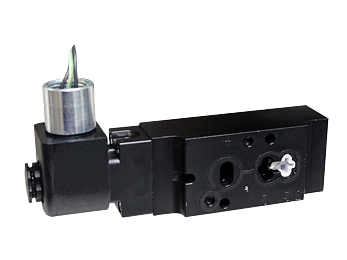




NAMUR Valves - CSA/FM, Low Temperature Applications -40 to 123 F (-40 to 50 C)
 Operating Instructions
Valve Conversion Instructions
Product Catalog - NAMUR Interface Valves for Hazardous Locations
Operating Instructions
Valve Conversion Instructions
Product Catalog - NAMUR Interface Valves for Hazardous Locations
- Compact Design - Balanced spool construction, compact size, low profile and high performance
- Solenoid Pilot - Pilot uses full air line pressure to shift the valve; Solenoid guaranteed against burnout
- Solenoid Coils -Explosion-Proof CSA / FM and CSA / UL Certified
- Tapered Tee-Seal - Bidirectional tapered Tee-Seal eliminates sticking problems
- Tested Tough - Proven reliable according to SAE specifications: rust & water injected every 864,000 cycles for 20-million cycle
- Manual Override - Allows the solenoid valve to be used manually in case of electrical failure, or for quick cycle testing
- External Pilot Supply - Easily field convertible to external pilot supply
Valves
NAMUR interface valves are designed to easily mount directly to pneumatic valve actuators, and are used as pilot valves to control the actuator in many flow processes. The balanced spool construction allows ports to be plugged for 2 way or 3 way function, or restricted for inexpensive cylinder exhaust speed control. A wide variety of options and operators available.
Tapered Tee-Seal ........ Eats Dirt
Bidirectional tapered Tee-Seal eliminates sticking problems.
- Flexes to clean spool
- Mechanically Locked
- No Spiral Twist
No Extrusion - Air Line Sediment is Wiped Away
- Tested tough and proven reliable according to SAE specifications: Rust and water injected every 864,000 cycles for 20 million cycles.
Solenoid ... Guaranteed Against Burnout
Three-way pilot uses full air line pressure to shift the valve. The pilot is internally supplied when the pressure at port one is 35 to 150 PSIG (240 to 1030 kPa). The coil is hermetically sealed as an integral watertight molded unit. Intrinsically-safe and explosion-proof versions available. Push Non-Locking Override is standard. (Extended Turn and Turn-Locking available).
Unable to load products. Please try again.
loading...
loading...
Product Overview
The Automatic Valve D20 Series NAMUR Valves with CSA/FM Explosion-Proof coils for Low Temperature Applications combine hazardous area electrical protection with cold-service temperature capability, covering the demanding operating range of -40 to 123 F (-40 to 50 C). These solenoid pilot directional control valves are designed for direct mounting to pneumatic valve actuators in classified areas where flammable gas, vapor, or dust atmospheres may be present, and where low ambient temperatures are an ongoing operating condition.
The CSA/FM explosion-proof solenoid coil assembly (coil code Y) is certified by CSA and Factory Mutual for use in hazardous classified locations per NEC Article 500. The coil uses a 1/2" conduit connection with 24" leads, enclosing the solenoid in a heavy-duty explosion-proof housing that contains any internal arc or spark without igniting the surrounding atmosphere. Combined with Buna-N seals that maintain elasticity at -40 F, these valves deliver reliable directional control in arctic-climate hazardous area applications.
The D20 Series body construction uses bar stock aluminum with stainless steel spool and Buna-N seals. Both D2003 (1-1/4" body height) and D2013 (1" body height) are available with 1/4" NPT ports. Valve functions include 3/2, 5/2 single or double solenoid, and 5/3 configurations. The Tapered Tee-Seal self-cleaning design maintains spool cleanliness throughout 20 million validated cycles even with rust and water contamination per SAE test protocols.
For instrumentation engineers, EPC contractors, and process safety engineers specifying actuator pilot valves at arctic LNG terminals, cold-climate oil sands facilities, northern offshore platforms, and sub-zero chemical plant hazardous areas, the CSA/FM Low Temperature D20 NAMUR valve provides North American Division 1 hazardous area compliance combined with proven -40 F cold-service performance.
Key Engineering Features
- CSA/FM Explosion-Proof Certified Solenoid Coil - Solenoid coil assembly certified by CSA and Factory Mutual (FM) for use in North American hazardous classified locations per NEC Article 500. The explosion-proof housing contains any arc or spark internally, preventing ignition of surrounding flammable atmospheres in Class I, Division 1 and Division 2 areas.
- Low Temperature Rating to -40 F (-40 C) - Buna-N seal material retains elasticity and sealing integrity at temperatures as low as -40 F (-40 C), providing reliable directional control in arctic-climate hazardous area installations without seal embrittlement or spool sticking.
- 1/2" Conduit Connection with 24" Leads - CSA/FM coil assembly uses 1/2" conduit connection with factory-installed 24" leads, enabling integration with standard industrial conduit wiring systems required in Division 1 hazardous area electrical installations per NEC Article 501.
- Tapered Tee-Seal Self-Cleaning Design - Bidirectional tapered Tee-Seal flexes to clean the spool on every actuation stroke, maintaining spool cleanliness in cold environments where condensate and particulate accumulation can be accelerated by temperature-driven air quality changes.
- Compact Balanced Spool Construction - Balanced spool design delivers compact size, low profile, and high flow performance in a direct-mount package optimized for tight hazardous area actuator installations where space is limited and external tubing runs are undesirable.
- Full Line Pressure Pilot Shifting - Three-way pilot uses full air line pressure (35-150 psig internal supply) to shift the spool, ensuring decisive and complete spool actuation even at low temperatures where system pressure variations are more common.
- Push Non-Locking Manual Override - Standard push non-locking manual override allows manual valve actuation during electrical failure or commissioning, critical in hazardous area cold-service applications where electrical de-energization may require manual process control.
- Field Convertible to External Pilot Supply - Pilot supply can be field converted from internal to external to accommodate applications where supply pressure is below the 35 psig minimum requirement, or where pilot supply independence from line pressure is required.
- SAE Tested - 20 Million Cycle Durability - Validated to 20 million cycles with rust and water injection every 864,000 cycles per SAE specifications, confirming suitability for high-cycle hazardous area process automation across the full low-temperature operating range.
- NAMUR Interface per VDI/VDE 3845 - Standardized direct-mount interface eliminates external tubing between pilot valve and actuator, reducing the number of fittings and connections exposed to cold-climate thermal cycling and potential leak paths in hazardous classified areas.
Technical Specifications
General Specifications
| Parameter | Specification |
| Series | D20 (D2003: 1-1/4" body height; D2013: 1" body height) |
| Valve Functions | 3/2 Normally Closed; 5/2 Single Solenoid (NC); 5/2 Double Solenoid; 5/3 Closed Center; 5/3 Open Center; 5/3 Power Center |
| Port Size | 1/4" |
| Port Thread | NPT |
| Maximum Flow (3/2 and 5/2) | Cv 1.8 (1800 Nl/min) |
| Maximum Flow (5/3) | Cv 1.4 (1400 Nl/min) |
| Operating Pressure (3/2 D20) | 35-150 psig (2.4-10.3 bar) |
| Operating Pressure (5/2) | 35-150 psig (2.4-10.3 bar) |
| Operating Pressure (5/3) | 50-150 psig (3.4-10.3 bar) |
| Actuation | Solenoid Pilot Controlled (CSA/FM Explosion-Proof Coil) |
| Construction | Spool |
| Mounting | Direct Mount; NAMUR Interface per VDI/VDE 3845 |
| Valve Body Material | Bar Stock Aluminum |
| Spool Material | Aluminum |
| Seal Material | Buna-N |
| Coil Connection | 1/2" Conduit with 24" Leads (CSA/FM explosion-proof housing) |
| Coil Certification | CSA/FM Explosion-Proof (Coil Code Y) |
| Flow Media | Filtered air (lubricated or non-lubricated) |
| Duty Rating | Continuous Duty |
| Weight (D2003 / D2013 single solenoid) | 0.70 lb (0.32 kg) valve body; coil assembly 0.44 lb (0.20 kg) |
Temperature Ratings
Low temperature operation to -40 F is achieved through Buna-N seal material. Compressed air supplied at temperatures below 40 F must be free of water vapor to prevent ice formation inside the valve.
| Configuration | Ambient Temperature | Media Temperature |
| CSA/FM Explosion-Proof - Low Temp (Buna-N Seals) | 40 to 123 F (-40 to 50 C) | 40 to 123 F (-40 to 50 C) |
Important: For media temperatures below 40 F (4 C), compressed air must be completely free of water vapor. Ice formation inside the valve can block spool actuation. Ensure upstream air dryers are rated for the dew point required by the minimum installation temperature.
Electrical Data (Solenoid Pilot Valves)
CSA/FM explosion-proof solenoid coils are available in 24 VDC only. The explosion-proof coil housing uses 1/2" conduit connection with 24" factory-installed leads. Resistance at 25 C is 275 ohms. All coils are rated for continuous duty.
| Voltage | Power Consumption |
| 24 VDC | 1.6 W |
| 24 VDC (Inrush) | Inrush: 0.05A; Holding: 0.05A; Resistance: 275 ohms at 25 C |
Electrical Connection Options
| Connection Type | Coil Code |
| CSA/FM Explosion-Proof 1/2" Conduit with 24" Leads | Y (suffix on model number) |
Flow Performance Data
Flow performance data for D20 Series CSA/FM low-temperature NAMUR valves. Values apply across the full -40 to 123 F operating range.
| Body | Port Size | Function | Cv | Flow (Nl/min) | Weight lb (kg) |
| D2003 | 1/4" | 3/2 or 5/2 Single | 1.8 | 1800 | 0.70 (0.32) |
| D2003 | 1/4" | 5/2 Double Solenoid | 1.8 | 1770 | 0.75 (0.34) |
| D2003 | 1/4" | 5/3 | 1.4 | 1400 | 0.80 (0.36) |
| D2013 | 1/4" | 3/2 or 5/2 Single | 1.8 | 1800 | 0.70 (0.32) |
| D2013 | 1/4" | 5/2 Double Solenoid | 1.8 | 1770 | 0.75 (0.34) |
| D2013 | 1/4" | 5/3 | 1.4 | 1400 | 0.80 (0.36) |
Certifications & Compliance
| Certification/Standard | Detail |
| CSA Explosion-Proof (C22.2) | CSA certified explosion-proof for North American hazardous classified locations per C22.2 standard, covering Class I, Division 1 and Division 2 flammable gas and vapor environments per NEC Article 501 and CEC Section 18. |
| Factory Mutual (FM) Approved | Factory Mutual approved explosion-proof solenoid coil assembly, satisfying FM requirements for hazardous area electrical equipment in Class I, Division 1 locations commonly specified by insurance underwriters and industrial facility risk assessments. |
| CSA/UL STD 429 | Solenoid valve electrical components certified to CSA and UL Standard 429 for electrically operated valves. |
| CE Marking | CE marked for compliance with applicable EU directives for installations where CE requirements apply. |
| NAMUR Interface Standard | Compliant with VDI/VDE 3845 NAMUR interface standard for direct-mount pneumatic actuator compatibility across all compliant actuator manufacturers. |
| SAE Durability Testing | Validated to 20 million cycles per SAE specifications with rust and water contamination injection every 864,000 cycles, confirming long-term durability in demanding industrial service. |
| SIL Capability | SIL 3 rated for applicable configurations, enabling integration into safety instrumented systems where both hazardous area electrical protection and functional safety ratings are required. |
Typical Applications & Industries
LNG and Natural Gas Processing - Hazardous Areas
- Automated ball valve and emergency shutoff valve actuator pilot control at LNG import/export terminals where both Division 1 explosion-proof electrical protection and -40 F cold-service performance are required simultaneously.
- Gas processing plant inlet separator, slug catcher, and dehydration unit valve automation in classified areas at northern facilities experiencing arctic ambient temperatures during winter operating seasons.
- LNG storage tank isolation and vent valve actuator control in classified areas where cryogenic liquid proximity creates cold ambient conditions and flammable gas atmospheres are continuously present.
- Compressor station anti-surge, recycle, and emergency block valve automation in Division 1 areas at northern pipeline facilities operating through severe winter weather.
Offshore and Subsea Operations - Cold Climate
- Offshore platform topsides valve automation in the Beaufort Sea, North Sea, Barents Sea, and other arctic and sub-arctic offshore regions where both explosion-proof electrical protection and sub-zero ambient temperature performance are required.
- FPSO vessel process valve control in high-latitude deployments where winter ambient temperatures can reach -40 F and classified area electrical requirements apply throughout topsides process areas.
- Cold-climate offshore production riser and production manifold valve actuator control combining Division 1 coil certification with -40 F temperature capability.
Oil Sands and Unconventional Resource Extraction
- Northern Alberta oil sands in-situ SAGD facility process valve automation in classified areas where winter ambient temperatures regularly reach -40 F and bitumen handling creates flammable atmosphere conditions requiring Division 1 or Division 2 electrical classification.
- Diluent and naphtha storage and transfer system valve automation in classified areas at oil sands upgrader facilities with cold-climate winter operating conditions.
- Mine-face extraction equipment pneumatic actuator control in classified zones at open-pit oil sands facilities experiencing extreme winter cold.
Petrochemical and Chemical Plant Hazardous Areas - Cold Service
- Cold-service distillation column and refrigeration system valve automation in classified areas of petrochemical facilities located in cold-climate regions.
- Ethylene and propylene plant refrigeration circuit valve control in Division 1 classified areas where low-boiling hydrocarbon refrigerants require both flameproof electrical protection and cold-service mechanical performance.
- Arctic climate chemical plant utility and process valve automation in classified areas requiring CSA/FM coil certification combined with -40 F low-temperature operation.
Cold Storage and Refrigerated Warehousing - Classified Areas
- Industrial ammonia refrigeration system valve automation in classified areas of cold storage facilities, blast freezers, and food processing plants where ammonia release creates flammable and hazardous atmosphere conditions at sub-zero temperatures.
- Propane and hydrocarbon refrigerant system valve control in classified zones at cold storage facilities where standard temperature coils would be insufficient for the ambient conditions.
- Large cold storage facility fire suppression and emergency ventilation valve automation in classified areas where reliable operation at -40 F and explosion-proof protection are both required.
Mining and Remote Industrial Operations - Cold Climates
- Hard rock and open-pit mining operations in Canada, Alaska, Siberia, and northern Scandinavia where classified area electrical protection is required in fueling, explosive handling, and processing zones at sub-zero ambient temperatures.
- Remote pipeline compression and pumping stations in classified areas at cold-climate locations where a single valve must meet both Division 1/2 electrical safety and arctic temperature requirements.
- Oilfield services and well completion fluid handling operations in classified areas at cold-climate drilling sites where pneumatic actuator reliability across the full winter temperature range is essential.
Ordering and Model Number Configuration
The Automatic Valve D20 Series CSA/FM explosion-proof NAMUR valve uses the standard D20 model number system with the Y coil certification suffix. The Y suffix identifies CSA/FM explosion-proof coil certification. For low-temperature service, Buna-N seals are standard. Sample model numbers include D2003AAWR-DBY and D2013GAWR-DBY.
|
Model Number Structure: D20 - 03 - AAWR - DB - Y
D20 Series (D20 NAMUR Interface Valve)
03/13 Body Height (03 = 1-1/4" height; 13 = 1" height)
AA/GA Valve Function / Actuation Code AA = 5/2 Single Solenoid Right AC = 5/2 Single Solenoid Left BW = 5/2 Double Solenoid GA = 3/2 Single Solenoid Right GC = 3/2 Single Solenoid Left CB = 5/3 Double Solenoid
WR Actuation Type Code WR = Weather-Proof Solenoid Base (CSA/FM coil separately certified)
DB Voltage Code DB = DC 24V (only voltage available for CSA/FM explosion-proof coil)
Y Coil Certification Suffix Y = CSA/FM Explosion-Proof, 1/2" Conduit, 24" Leads |
The Y suffix on the model number designates the CSA/FM explosion-proof coil assembly. This coil uses 1/2" conduit connection with factory-installed 24" leads.
CSA/FM explosion-proof coils are available in 24 VDC only. Power consumption is 1.6 W at 24 VDC.
Low-temperature operation to -40 F is provided by the standard Buna-N seals. No additional seal option code is required for low-temperature service.
Body height: 03 indicates D2003 (1-1/4" body height); 13 indicates D2013 (1" body height). Both use 1/4" NPT ports.
For CSA/FM installations, conduit wiring must comply with NEC Article 501 requirements for Class I, Division 1 locations, including explosion-proof conduit fittings, sealing fittings at required intervals, and appropriate wire insulation ratings.
Contact Automatic Valve at (248) 474-6761 for stainless steel body options, G (BSPP) port threads, external pilot supply configuration, and custom ordering for cold-climate hazardous area applications.
Accessories
CSA/FM Explosion-Proof Solenoid Coil Assembly
Replacement CSA/FM explosion-proof solenoid coil assemblies are available for field coil replacement without replacing the valve body. The coil assembly (model 7019-9**Y) uses 1/2" conduit connection with 24" factory-installed leads and carries CSA/FM explosion-proof certification.
| Coil Model | Type | Certification | Voltage | Weight lb (kg) |
| 7019-9**Y | CSA/FM Explosion-Proof, 1/2" Conduit | CSA/FM | 24 VDC | 0.44 (0.20) |
Warning: Always use coils with CSA/FM certification in classified area installations. Installing non-certified coils in explosion-proof applications violates NEC Article 501 requirements and creates a potentially lethal ignition source in flammable atmosphere locations.
Conduit Seal Fittings
NEC Article 501 requires conduit sealing fittings within 18" of an explosion-proof enclosure and at all conduit entries into explosion-proof equipment. Use only approved conduit seal fittings rated for Class I, Division 1 installations. Automatic Valve can provide guidance on compatible conduit seal fittings for CSA/FM installations.
Valve Conversion Kits
Valve conversion kits allow field reconfiguration between 4-way and 3-way functions, solenoid relocation, and internal to external pilot supply conversion. Refer to Automatic Valve's Valve Conversion Instructions for procedures. Note that any field modifications must be reviewed by the facility electrical safety authority for continued compliance with classified area requirements.
Related Products & Accessories
- NAMUR Valves - CSA/FM Standard Temperature - D20 Series NAMUR valves with CSA/FM explosion-proof coils for standard temperature hazardous area service, -20 to 123 F. https://www.automaticvalve.com/series/2990-namur-valves-csafm-standard-temperature-applications
- NAMUR Valves - ATEX Standard Temperature - D20 Series NAMUR valves with ATEX explosion-proof coils for European hazardous area applications at standard temperatures. https://www.automaticvalve.com/series/2988-namur-valves-atex-standard-temperature-applications
- NAMUR Valves - Intrinsically Safe Standard Temperature - D20 Series NAMUR valves with intrinsically safe coils for Division 1/Zone 0 hazardous areas at standard temperatures. https://www.automaticvalve.com/series/2992-namur-valves-intrinsically-safe-standard-temperature-applications
- NAMUR Valves - Low Temperature (General Automation) - D20 Series NAMUR valves for non-classified low-temperature service, -40 to 123 F, with standard weather-proof coils. https://www.automaticvalve.com/series/2987-namur-valves-low-temperature-applications
- NAMUR Valves - Standard Temperature (General Automation) - D20 Series NAMUR valves for non-classified standard temperature service, -20 to 123 F. https://www.automaticvalve.com/series/2986-namur-valves-standard-temperature-applications
- NAMUR Valves - High Temperature Applications - D20 Series NAMUR valves with high-temp conduit coil for 0 to 180 F ambient service. https://www.automaticvalve.com/series/3008-namur-valves-high-temperature-applications
Frequently Asked Questions (FAQ)
Q: What does CSA/FM explosion-proof certification mean for NAMUR valve applications?
A: CSA and Factory Mutual (FM) explosion-proof certification means the solenoid coil assembly has been tested and certified to contain any internal arc, spark, or explosion within its housing without igniting the surrounding atmosphere. This allows the valve to be installed in Class I, Division 1 and Division 2 hazardous classified locations per NEC Article 500/501, where flammable gas or vapor may be present in the air.
Q: What hazardous area classifications can the CSA/FM coil be used in?
A: The CSA/FM explosion-proof coil is certified for Class I (flammable gases and vapors), Division 1 (hazardous conditions present under normal operation) and Division 2 (hazardous conditions present only under abnormal conditions) locations per the NEC 500 classification system used in North America, as well as equivalent CEC Section 18 areas in Canada.
Q: What voltage is available for the CSA/FM explosion-proof coil?
A: The CSA/FM explosion-proof coil is available in 24 VDC only, with a power consumption of 1.6 W. The low power consumption reduces heat dissipation in the sealed explosion-proof housing, which is an important consideration for hazardous area coil longevity.
Q: Why is the power consumption of the CSA/FM coil lower than the standard weather-proof coil?
A: The CSA/FM explosion-proof coil draws 1.6 W, compared to 4.8 W for the standard 24 VDC weather-proof coil. Explosion-proof coils are specifically designed for low heat generation because heat buildup inside a sealed explosion-proof housing can reduce coil life. The lower power also requires less current from intrinsically safe barriers if used downstream of IS interfaces.
Q: What conduit installation requirements apply to CSA/FM explosion-proof valves?
A: NEC Article 501 requires explosion-proof conduit fittings rated for Class I, Division 1, conduit sealing fittings within 18" of the explosion-proof enclosure, and compliance with all applicable NEC and CEC installation requirements. Conduit systems must be completed before energizing the solenoid. All conduit entry points must use approved explosion-proof hubs or conduit fittings.
Q: Can a CSA/FM explosion-proof NAMUR valve be used in ATEX classified areas?
A: CSA/FM certification covers North American NEC 500 classification. It is not equivalent to ATEX certification required by European ATEX Directive 2014/34/EU for Zone 1 and Zone 2 areas. For European hazardous area installations, specify the ATEX Standard Temperature series. Some jurisdictions accept cross-certifications, but this requires project-specific approval from the authority having jurisdiction.
Q: What is the minimum operating temperature with CSA/FM explosion-proof coils?
A: The CSA/FM low-temperature series operates from -40 to 123 F (-40 to 50 C). The -40 F rating is provided by Buna-N seals, which retain elasticity at arctic temperatures. The CSA/FM explosion-proof coil assembly is rated for the full -40 to 123 F ambient range.
Q: What is the flow capacity of the CSA/FM low-temperature NAMUR valve?
A: The D20 CSA/FM low-temperature series delivers 1.8 Cv (1800 Nl/min) for 3/2 and 5/2 functions, and 1.4 Cv (1400 Nl/min) for 5/3 functions. These values are consistent across the full -40 to 123 F operating temperature range.
Q: Does the manual override comply with hazardous area requirements?
A: The push non-locking manual override is a mechanical device that does not generate sparks or electrical arcs. Manual override operation does not compromise the explosion-proof rating of the solenoid coil assembly. However, the override should only be used when the coil is de-energized and by authorized personnel following facility hot work and hazardous area entry procedures.
Q: Is an air dryer required when installing in cold classified areas?
A: Yes, for installations below 40 F (4 C), compressed air must be dried to a dew point at or below the minimum expected valve operating temperature. This prevents ice formation inside the valve that could block spool movement and cause actuator control loss. Air dryers in classified areas must also comply with hazardous area electrical installation requirements.
Q: What is the NAMUR interface standard and how does it benefit hazardous area installations?
A: VDI/VDE 3845 defines standardized mounting dimensions, port locations, and bolt patterns for direct-mount pilot valves on pneumatic actuators. In hazardous area installations, NAMUR direct mounting eliminates external tubing connections that represent additional potential leak paths for flammable process fluid. Reducing the number of tubing connections lowers the risk of atmospheric contamination events in classified areas.
Q: Can the valve be field-converted to external pilot supply in a classified area?
A: Field conversion to external pilot supply is mechanically possible per the Valve Conversion Instructions. However, in classified areas, any field modification to valve configuration should be reviewed by the facility instrument or electrical engineer to ensure continued compliance with the hazardous area installation documentation and authority having jurisdiction requirements.
Installation & Maintenance Guidelines
- In Class I, Division 1 classified areas, all wiring, conduit, and electrical installation must comply with NEC Article 501 and applicable facility hazardous area electrical codes before energizing any solenoid coil.
- Install conduit sealing fittings within 18" of the explosion-proof coil enclosure and at all conduit entry points per NEC Article 501.15 requirements.
- Mount the valve directly to the actuator NAMUR interface per VDI/VDE 3845. Inspect O-rings on the interface face for damage before assembly. Damaged O-rings create process leak paths in classified areas.
- Verify supply pressure at port 1 is within 35-150 psig for 3/2 and 5/2 functions, or 50-150 psig for 5/3 functions. Low pilot pressure in cold climates can cause incomplete spool shifting.
- For installations below 40 F (4 C), ensure compressed air is dried to a dew point at or below the minimum operating temperature. Ice in the valve creates a fail-danger condition in process safety applications.
- Do not modify the CSA/FM explosion-proof coil housing or coil leads in the field. Any damage to the coil housing voids CSA/FM certification and creates a hazardous ignition source.
- Test manual override function during commissioning. Verify that the connected actuator responds correctly before energizing the solenoid in the classified area environment.
- Ensure all conduit runs are properly supported and protected against physical damage from equipment, traffic, and thermal cycling. Cold environments increase conduit brittleness for plastic conduits.
- Periodically inspect coil condition and conduit connections per facility preventive maintenance intervals. In cold environments, conduit fittings should be inspected for loosening caused by thermal contraction cycles.
- When replacing coils, use only CSA/FM certified replacement coil assemblies of the correct voltage. Substitution with non-certified coils violates NEC 501 and creates an ignition hazard in the classified area.
Warranty & Global Support
Automatic Valve provides a standard warranty on all D20 Series NAMUR valve products covering defects in material and workmanship from the date of purchase. Contact Automatic Valve for specific warranty terms.
Technical support and product configuration assistance is available by phone at (248) 474-6761 or through the Automatic Valve website at automaticvalve.com.
Automatic Valve is a global family member of ROSS Controls, with technical resources and distribution support available throughout the United States and Canada for hazardous area classified applications.
For complete technical data, dimensional drawings, operating instructions, valve conversion instructions, and the product catalog for NAMUR Interface Valves for Hazardous Locations, visit the product series page at automaticvalve.com or contact the Automatic Valve team directly.
Product Catalog - NAMUR Hazardous Location Valves: https://www.automaticvalve.com/documents/5555/Hazardous_Locations_NAMUR_Interface_Valves_AV-NAMUR_en.pdf
Service Instructions - NAMUR Interface Solenoid Valves: https://www.automaticvalve.com/documents/408/NAMUR_Interface_Solenoid_Valves_Service_Form__AV-NAMUR-OI.pdf
Download Documents
NAMUR Valves - CSA/FM, Low Temperature Applications