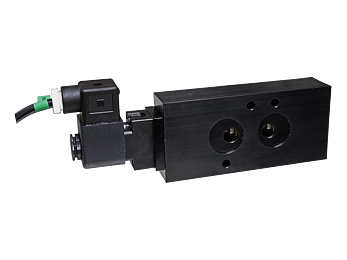




NAMUR Valves - ATEX, Standard Temperature Applications -20 to 123 F (-29 to 50 C)
 Operating Instructions
Valve Conversion Instructions
Product Catalog - NAMUR Interface Valves for Hazardous Locations
Operating Instructions
Valve Conversion Instructions
Product Catalog - NAMUR Interface Valves for Hazardous Locations
- Compact Design - Balanced spool construction, compact size, low profile and high performance
- Solenoid Pilot - Pilot uses full air line pressure to shift the valve; Solenoid guaranteed against burnout
- Solenoid Coils -Explosion-Proof ATEX Certified
- Tapered Tee-Seal - Bidirectional tapered Tee-Seal eliminates sticking problems
- Tested Tough - Proven reliable according to SAE specifications: rust & water injected every 864,000 cycles for 20-million cycle
- Manual Override - Allows the solenoid valve to be used manually in case of electrical failure, or for quick cycle testing
- External Pilot Supply - Easily field convertible to external pilot supply
Valves
NAMUR interface valves are designed to easily mount directly to pneumatic valve actuators, and are used as pilot valves to control the actuator in many flow processes. The balanced spool construction allows ports to be plugged for 2 way or 3 way function, or restricted for inexpensive cylinder exhaust speed control. A wide variety of options and operators available.
Tapered Tee-Seal ........ Eats Dirt
Bidirectional tapered Tee-Seal eliminates sticking problems.
- Flexes to clean spool
- Mechanically Locked
- No Spiral Twist
No Extrusion - Air Line Sediment is Wiped Away
- Tested tough and proven reliable according to SAE specifications: Rust and water injected every 864,000 cycles for 20 million cycles.
Solenoid ... Guaranteed Against Burnout
Three-way pilot uses full air line pressure to shift the valve. The pilot is internally supplied when the pressure at port one is 35 to 150 PSIG (240 to 1030 kPa). The coil is hermetically sealed as an integral watertight molded unit. Intrinsically-safe and explosion-proof versions available. Push Non-Locking Override is standard. (Extended Turn and Turn-Locking available).
Unable to load products. Please try again.
loading...
loading...
Product Overview
The Automatic Valve D20 Series NAMUR Valves with ATEX Explosion-Proof coils for Standard Temperature Applications are solenoid pilot directional control valves engineered for use in European and international hazardous area installations where the ATEX Directive (2014/34/EU) governs equipment selection for Zone 1 and Zone 2 explosive atmosphere areas. These valves operate from -20 to 123 F (-29 to 50 C) and provide direct-mount NAMUR interface actuator control per VDI/VDE 3845 in environments where flammable gas, vapor, or mist atmospheres may be present.
The ATEX explosion-proof solenoid coil assembly (coil code Z) is certified for European hazardous areas, using a strain relief connection with a 10-foot cord for flexible installation in Zone 1 and Zone 2 classified areas. The coil assembly operates at 24 VDC with 1.6 W power consumption, using low heat generation to maintain safe surface temperatures within the explosion-proof housing. The valve body construction uses bar stock aluminum with Buna-N seals and an aluminum spool.
Available in D2003 (1-1/4" body height) and D2013 (1" body height) variants with 1/4" NPT ports, the ATEX series supports 3/2, 5/2, and 5/3 valve functions. Maximum flow is 1.8 Cv (1800 Nl/min) for 3/2 and 5/2 functions. The Tapered Tee-Seal self-cleaning design maintains spool reliability across 20 million validated cycles per SAE specifications. Push non-locking manual override is standard.
For instrumentation engineers, EPC project teams, and safety authorities specifying pneumatic actuator pilot valves in European oil and gas facilities, chemical plants, pharmaceutical manufacturing, and offshore installations, the ATEX Standard Temperature D20 NAMUR series provides EU Directive compliance combined with the proven performance and standardized NAMUR interface mounting that simplifies specification, installation, and maintenance.
Key Engineering Features
- ATEX Explosion-Proof Certified Solenoid Coil - Solenoid coil assembly certified for European hazardous areas under the ATEX Directive (2014/34/EU), providing Ex d (explosion-proof/flameproof) protection for Zone 1 and Zone 2 classified areas with flammable gas and vapor atmospheres. The coil housing is designed to contain any internal ignition and prevent propagation to the surrounding explosive atmosphere.
- Strain Relief Connection with 10-Foot Cord - The ATEX coil assembly uses a strain relief connection with a 10-foot cord, providing flexible cable routing in Zone 1 and Zone 2 classified area installations without requiring conduit. The cord length facilitates routing to junction boxes while maintaining the coil's ATEX-certified enclosure integrity.
- CE Marked and ATEX Directive Compliant - CE marked for compliance with EU ATEX Directive 2014/34/EU, satisfying the legal requirements for placing equipment intended for use in explosive atmospheres on the European market. CE marking is required for equipment installation in Zone 1 and Zone 2 areas throughout the EU and many international markets that adopt ATEX standards.
- Compact Balanced Spool Design - Balanced spool construction provides compact, low-profile direct-mount installation on pneumatic actuators, simplifying valve skid layout in European classified area installations where space is typically constrained.
- Solenoid Pilot - Full Line Pressure Shifting - Three-way pilot uses full air line pressure (35-150 psig internal supply) to shift the spool, providing fast and complete actuation in classified area applications where reliable, decisive valve actuation is required for process safety and control.
- Tapered Tee-Seal Self-Cleaning Design - Bidirectional tapered Tee-Seal eliminates sticking problems by flexing to clean the spool bore on every actuation stroke, preventing spool binding in high-cycle process automation applications common in European chemical and petrochemical facilities.
- Push Non-Locking Manual Override - Standard push non-locking manual override allows valve actuation during power loss or commissioning, a critical capability in classified area process control applications where manual intervention may be required during planned or unplanned electrical outages.
- NAMUR Interface per VDI/VDE 3845 - Standardized direct-mount interface eliminates external tubing between pilot valve and actuator, reducing leak points in classified areas and providing universal compatibility with any VDI/VDE 3845 compliant pneumatic actuator used throughout European process industries.
- SAE Tested - 20 Million Cycle Durability - Validated to 20 million cycles per SAE specifications with rust and water contamination injection every 864,000 cycles, confirming suitability for high-cycle European process automation over long maintenance intervals.
- Field Convertible to External Pilot Supply - Pilot supply can be field converted from internal to external to accommodate installations where supply pressure is below the 35 psig minimum, or where independent pilot supply is required for fail-safe design or SIL-rated safety instrumented function architectures.
Technical Specifications
General Specifications
| Parameter | Specification |
| Series | D20 (D2003: 1-1/4" body height; D2013: 1" body height) |
| Valve Functions | 3/2 Normally Closed; 5/2 Single Solenoid (NC); 5/2 Double Solenoid; 5/3 Closed Center; 5/3 Open Center; 5/3 Power Center |
| Port Size | 1/4" |
| Port Thread | NPT |
| Maximum Flow (3/2 and 5/2) | Cv 1.8 (1800 Nl/min) |
| Maximum Flow (5/3) | Cv 1.4 (1400 Nl/min) |
| Operating Pressure (3/2 D20) | 35-150 psig (2.4-10.3 bar) |
| Operating Pressure (5/2) | 35-150 psig (2.4-10.3 bar) |
| Operating Pressure (5/3) | 50-150 psig (3.4-10.3 bar) |
| Actuation | Solenoid Pilot Controlled (ATEX Explosion-Proof Coil) |
| Construction | Spool |
| Mounting | Direct Mount; NAMUR Interface per VDI/VDE 3845 |
| Valve Body Material | Bar Stock Aluminum |
| Spool Material | Aluminum |
| Seal Material | Buna-N |
| Coil Connection | Strain Relief with 10-foot cord (ATEX explosion-proof housing) |
| Coil Certification | ATEX Explosion-Proof (Coil Code Z) |
| Voltage | 24 VDC only (ATEX explosion-proof coil) |
| Power Consumption | 1.6 W at 24 VDC |
| Flow Media | Filtered air (lubricated or non-lubricated) |
| Duty Rating | Continuous Duty |
| Coil Weight | 0.78 lb (0.36 kg) |
Temperature Ratings
Standard temperature operation from -20 to 123 F (-29 to 50 C) applies to all D20 ATEX variants with Buna-N seals and the ATEX certified coil assembly.
| Configuration | Ambient Temperature | Media Temperature |
| ATEX Explosion-Proof - Standard Temp (Buna-N Seals) | 20 to 123 F (-29 to 50 C) | 20 to 123 F (-29 to 50 C) |
Important: For media temperatures below 40 F (4 C), compressed air must be free of water vapor. For cold-climate ATEX installations below -20 F, consult Automatic Valve for low-temperature ATEX options.
Electrical Data (Solenoid Pilot Valves)
ATEX explosion-proof coils are available in 24 VDC only with a power consumption of 1.6 W. The ATEX coil uses a strain relief connection with 10-foot cord. Low power consumption minimizes heat generation inside the sealed explosion-proof housing.
| Voltage | Power Consumption |
| 24 VDC | 1.6 W |
| 24 VDC - Coil Weight | 0.78 lb (0.36 kg) |
Electrical Connection Options
| Connection Type | Coil Code |
| ATEX Explosion-Proof Strain Relief with 10-foot cord | Z (suffix on model number) |
Flow Performance Data
Flow performance data for D20 Series ATEX standard-temperature NAMUR valves. Identical valve body performance to standard and CSA/FM variants.
| Body | Port Size | Function | Cv | Flow (Nl/min) | Weight lb (kg) |
| D2003 | 1/4" | 3/2 or 5/2 Single | 1.8 | 1800 | 0.70 (0.32) |
| D2003 | 1/4" | 5/2 Double Solenoid | 1.8 | 1770 | 0.75 (0.34) |
| D2003 | 1/4" | 5/3 | 1.4 | 1400 | 0.80 (0.36) |
| D2013 | 1/4" | 3/2 or 5/2 Single | 1.8 | 1800 | 0.70 (0.32) |
| D2013 | 1/4" | 5/2 Double Solenoid | 1.8 | 1770 | 0.75 (0.34) |
| D2013 | 1/4" | 5/3 | 1.4 | 1400 | 0.80 (0.36) |
Certifications & Compliance
| Certification/Standard | Detail |
| ATEX Directive 2014/34/EU | ATEX explosion-proof solenoid coil certified under EU Directive 2014/34/EU for equipment and protective systems intended for use in potentially explosive atmospheres. CE marking required for Zone 1 and Zone 2 installations in EU member states and countries that adopt ATEX standards. |
| Ex d (Flameproof) Protection Method | The ATEX coil assembly uses Ex d (flameproof/explosion-proof) protection, enclosing the solenoid in a housing strong enough to withstand internal ignition and prevent propagation to the surrounding explosive atmosphere. Ex d is accepted for Zone 1 and Zone 2 flammable gas group applications. |
| IECEx Compatibility | The ATEX certification is compatible with IECEx (International Electrotechnical Commission Explosive Atmospheres) requirements, enabling use in countries outside the EU that recognize IECEx certifications as the basis for hazardous area equipment approval. |
| CE Marking | CE marked to confirm compliance with ATEX Directive 2014/34/EU and all other applicable EU directives for equipment placed on the European market. |
| NAMUR Interface Standard | Compliant with VDI/VDE 3845 NAMUR interface standard, ensuring universal dimensional compatibility with pneumatic actuators from any compliant manufacturer across European process industries. |
| SAE Durability Testing | Validated to 20 million cycles per SAE specifications with rust and water contamination injection every 864,000 cycles. |
| SIL Capability | SIL 3 rated for applicable configurations, enabling integration into safety instrumented systems in EU classified area installations where both ATEX protection and functional safety ratings are required. |
Typical Applications & Industries
European Oil and Gas Onshore and Offshore
- Process valve actuator pilot control throughout European and North Sea offshore platforms, FPSO vessels, and onshore gas processing plants where ATEX certification is the mandatory standard for Zone 1 and Zone 2 electrical equipment.
- North Sea oil production platform topsides valve automation in Zone 1 classified areas where ATEX certification is required under European health and safety regulations and installation standards.
- European gas transmission compressor stations and pressure regulation facilities valve control in ATEX Zone 2 classified areas surrounding high-pressure gas handling equipment.
- Mediterranean and European continental offshore platform valve automation where ATEX compliance is enforced by national health and safety authorities and operator engineering standards.
European Chemical and Petrochemical Manufacturing
- Process valve actuator pilot control throughout EU chemical plants, pharmaceutical API manufacturing facilities, and petrochemical processing units where ATEX Directive compliance is a legal requirement for all electrical equipment in Zone 1 classified areas.
- Solvent handling, distillation, and extraction system valve automation in ATEX Zone 1 and Zone 2 areas of European chemical and pharmaceutical manufacturing plants.
- Reaction vessel charge, discharge, and safety shutoff valve automation in classified areas of European specialty chemical and fine chemical production facilities.
- European paint, coatings, and adhesives manufacturing plant valve control in Zone 1 and Zone 2 areas where flammable solvent vapors create classified atmosphere conditions.
Pharmaceutical Manufacturing
- Bioreactor, fermentation vessel, and API synthesis valve automation in ATEX classified zones of European pharmaceutical manufacturing facilities where solvent-based process steps require Zone 1 rated pilot valves.
- Spray drying, fluid bed drying, and solvent removal system valve control in ATEX Zone 1 classified areas at European pharmaceutical plants where flammable solvent atmospheres are present during processing.
- Contained API synthesis and isolation system valve automation in EU pharmaceutical plants where ATEX Zone 1 classification applies throughout containment areas during potent compound handling.
- Tablet coating, granulation, and formulation area valve automation in EU pharmaceutical plants where alcohol-based coating solvents create Zone 1 or Zone 2 classified areas.
European Refining and Fuel Processing
- Automated valve actuator pilot control in Zone 1 and Zone 2 classified process areas throughout European petroleum refineries, including atmospheric distillation, vacuum distillation, fluid catalytic cracking, and hydrocracking units.
- Fuel terminal tank farm and loading rack valve automation in ATEX classified areas where petroleum product handling creates Zone 1 or Zone 2 explosive atmosphere conditions.
- European refinery process unit block valve, isolation valve, and safety shutoff valve automation where ATEX certification is required by national health and safety legislation.
Food, Beverage, and Distillery - ATEX Zones
- Distillery and brewing plant valve automation in ATEX Zone 1 areas where ethanol vapor concentrations during fermentation, distillation, and filling operations create explosive atmosphere classifications.
- Cooking oil extraction and solvent defatting plant valve control in ATEX Zone 1 classified areas where hexane extraction creates flammable atmosphere conditions requiring ATEX certified equipment.
- European wine and spirits production facility valve automation in classified areas during bottling, blending, and tank transfer operations where alcohol vapor creates Zone 2 conditions.
- Flavor and fragrance manufacturing valve control in ATEX classified zones where concentrated aromatic compounds and solvents create explosive atmosphere conditions during production and packaging.
Paint, Coatings, and Printing Industries
- Solvent-based paint and coatings production facility valve automation in ATEX Zone 1 and Zone 2 classified areas where flammable solvent blending, filling, and storage creates explosive atmosphere conditions.
- Printing press and publication gravure printing plant valve control in classified areas where flammable ink solvents create Zone 1 conditions at press and drying oven equipment.
- Powder coating application system valve automation in areas where combustible powder dust creates ATEX Zone 21 and Zone 22 classified areas requiring appropriate explosion-proof equipment.
Ordering and Model Number Configuration
The ATEX explosion-proof D20 Series NAMUR valve is ordered using the standard D20 model number with the Z coil certification suffix. ATEX coils are available in 24 VDC only and use a strain relief connection with 10-foot cord. Sample model numbers include D2003AAWR-DBZ and D2013GAWR-DBZ.
|
Model Number Structure: D20 - 03 - AAWR - DB - Z
D20 Series (D20 NAMUR Interface Valve)
03/13 Body Height (03 = 1-1/4" height; 13 = 1" height)
AA/GA Valve Function / Actuation Code AA = 5/2 Single Solenoid Right AC = 5/2 Single Solenoid Left BW = 5/2 Double Solenoid GA = 3/2 Single Solenoid Right GC = 3/2 Single Solenoid Left CB = 5/3 Double Solenoid
WR Actuation Type Code WR = Weather-Proof Solenoid Base (ATEX coil separately certified)
DB Voltage Code DB = DC 24V (only voltage available for ATEX explosion-proof coil)
Z Coil Certification Suffix Z = ATEX Explosion-Proof, Strain Relief, 10-foot cord |
The Z coil suffix designates the ATEX explosion-proof coil assembly with strain relief and 10-foot cord.
ATEX explosion-proof coils are available in 24 VDC only. Power consumption is 1.6 W.
Standard temperature operation from -20 to 123 F applies to all D20 ATEX variants with standard Buna-N seals.
Body height: 03 = D2003 (1-1/4" body); 13 = D2013 (1" body). Both use 1/4" NPT ports.
ATEX installations must comply with local national implementation of the ATEX Directive (2014/34/EU), applicable EN IEC standards (EN 60079 series), and applicable installation codes for Zone 1 and Zone 2 areas.
Contact Automatic Valve at (248) 474-6761 for G (BSPP) port thread options, stainless steel body variants, external pilot supply configurations, and ATEX application engineering assistance.
Accessories
ATEX Explosion-Proof Solenoid Coil Assembly
Replacement ATEX explosion-proof solenoid coil assemblies (model 7152-9**Y) are available for field coil replacement without replacing the valve body. The coil assembly uses strain relief connection with 10-foot cord and carries ATEX explosion-proof certification. Specify 24 VDC when ordering.
| Coil Model | Type | Certification | Voltage | Weight lb (kg) |
| 7152-9**Y (ATEX) | ATEX Explosion-Proof, Strain Relief, 10-ft cord | ATEX | 24 VDC | 0.78 (0.36) |
Warning: Use only ATEX certified coil assemblies in EU and IECEx classified area installations. Non-certified coils violate ATEX Directive 2014/34/EU and create an uncontrolled ignition source in explosive atmosphere locations.
Valve Conversion Kits
Valve conversion kits enable field reconfiguration between 4-way and 3-way functions, solenoid relocation, and internal to external pilot supply conversion. In ATEX classified areas, any field modification to instrumentation must be reviewed by the responsible engineer to ensure continued compliance with EU ATEX certification and installation documentation requirements.
Related Products & Accessories
- NAMUR Valves - CSA/FM Standard Temperature - D20 Series NAMUR valves with CSA/FM explosion-proof coils for North American NEC 500 classified area service at standard temperatures. https://www.automaticvalve.com/series/2990-namur-valves-csafm-standard-temperature-applications
- NAMUR Valves - CSA/FM Low Temperature - D20 Series NAMUR valves with CSA/FM explosion-proof coils for North American hazardous areas down to -40 F. https://www.automaticvalve.com/series/2991-namur-valves-csafm-low-temperature-applications
- NAMUR Valves - Intrinsically Safe Standard Temperature - D20 Series NAMUR valves with intrinsically safe coils for Zone 0/1 and Division 1 hazardous areas at standard temperatures. https://www.automaticvalve.com/series/2992-namur-valves-intrinsically-safe-standard-temperature-applications
- NAMUR Valves - Standard Temperature (General Automation) - D20 Series NAMUR valves with standard weather-proof coils for non-classified area service, -20 to 123 F. https://www.automaticvalve.com/series/2986-namur-valves-standard-temperature-applications
- NAMUR Valves - High Temperature Applications - D20 Series NAMUR valves with high-temp conduit coil for 0 to 180 F ambient service. https://www.automaticvalve.com/series/3008-namur-valves-high-temperature-applications
- NAMUR Valves - Low Temperature Applications - D20 Series NAMUR valves for non-classified area low-temperature service to -40 F. https://www.automaticvalve.com/series/2987-namur-valves-low-temperature-applications
Frequently Asked Questions (FAQ)
Q: What is ATEX certification and why is it required in Europe?
A: ATEX (from ATmospheres EXplosibles) refers to the EU Directive 2014/34/EU that governs equipment and protective systems intended for use in potentially explosive atmospheres. In EU member states, ATEX certification is a legal requirement for all electrical equipment installed in Zone 1 and Zone 2 classified areas. Non-ATEX certified equipment cannot legally be placed on the EU market for use in explosive atmospheres.
Q: What zones can ATEX explosion-proof equipment be used in?
A: ATEX certified explosion-proof equipment with Ex d (flameproof) protection is certified for Zone 1 (explosive atmosphere likely to occur in normal operation) and Zone 2 (explosive atmosphere not likely in normal operation, but possible) classified areas for gas and vapor hazards. The specific gas group and temperature class of the ATEX certification must match the process substances and ambient conditions of the installation.
Q: How does ATEX Ex d (explosion-proof) differ from ATEX Ex e (increased safety) or Ex ia (intrinsic safety)?
A: Ex d (flameproof/explosion-proof) encloses the ignition source in a housing strong enough to contain any internal ignition, preventing it from reaching the surrounding explosive atmosphere. Ex e (increased safety) prevents sparks and hot surfaces from forming. Ex ia (intrinsic safety) limits electrical energy to prevent ignition even under fault conditions. The D20 ATEX series uses Ex d protection, appropriate for solenoid coil power levels that cannot qualify for intrinsic safety protection.
Q: Is ATEX certification equivalent to IECEx?
A: ATEX and IECEx are different certification schemes that use similar technical standards (the IEC 60079 series). ATEX is an EU legal framework; IECEx is an international certification scheme. Many ATEX certified products also carry IECEx certification, enabling their use outside the EU in countries that recognize IECEx. Verify that the specific product certification covers both ATEX and IECEx if both are required for the project.
Q: What is the coil connection type for the ATEX D20 NAMUR series?
A: The ATEX explosion-proof coil assembly uses a strain relief connection with a 10-foot cord. This differs from the CSA/FM coil which uses 1/2" conduit with 24" leads. The cord connection simplifies routing in European classified area installations where conduit is less commonly used than in North American installations.
Q: What voltage is available for the ATEX coil?
A: The ATEX explosion-proof coil is available in 24 VDC only, with a power consumption of 1.6 W. This low power level minimizes heat dissipation in the sealed explosion-proof coil housing and extends coil service life in continuous duty applications.
Q: Can the ATEX D20 NAMUR valve be used in North American NEC 500 classified areas?
A: ATEX certification covers EU and IECEx classification systems. For North American NEC 500 Class I, Division 1 or Division 2 applications, CSA/FM certification is required. Some jurisdictions may accept ATEX in North American facilities with authority having jurisdiction approval, but this requires project-specific review. For North American classified areas, specify the CSA/FM series.
Q: What is the flow capacity of the ATEX standard temperature NAMUR series?
A: The D20 ATEX series delivers 1.8 Cv (1800 Nl/min) for 3/2 and 5/2 valve functions, and 1.4 Cv (1400 Nl/min) for 5/3 functions. These values are identical to the standard and CSA/FM series, as the valve body and spool assembly are the same across all D20 series variants.
Q: What is the minimum pilot supply pressure for internal pilot operation?
A: For 3/2 and 5/2 functions, internal pilot supply requires 35 to 150 psig (2.4 to 10.3 bar) at port 1. For 5/3 functions, minimum pilot pressure is 50 psig (3.4 bar). The valve can be field converted to external pilot supply when line pressure does not consistently meet these requirements.
Q: Does the ATEX valve include a manual override?
A: Yes. Push non-locking manual override is standard on all D20 Series NAMUR valves including the ATEX version. The mechanical manual override does not generate electrical arcs or sparks and does not compromise the ATEX certification of the coil assembly. Follow facility Zone 1 access and hot work permit procedures when using manual overrides in classified areas.
Q: What documentation is provided with ATEX certified products?
A: ATEX certified products are supplied with a Declaration of Conformity confirming compliance with ATEX Directive 2014/34/EU, along with technical documentation required for installation in EU classified areas. The ATEX certificate identifies the certification body, the Ex protection concept, applicable gas groups, and temperature class. Retain all certification documentation for facility electrical area classification records.
Q: Is this valve suitable for SIL-rated safety instrumented function (SIF) applications?
A: Yes. The D20 Series has SIL 3 capability per available certification documentation. For SIL-rated SIF applications in ATEX classified areas, the complete safety instrumented function (including pilot valve, actuator, and logic solver) must be assessed to verify that the combined probability of failure on demand (PFD) meets the required SIL level. Automatic Valve can provide failure data for SIL assessment calculations.
Installation & Maintenance Guidelines
- All wiring and electrical installation in ATEX Zone 1 classified areas must comply with EN IEC 60079-14 (Installation of Electrical Equipment in Explosive Gas Atmospheres) and the applicable national implementation of EU ATEX Directive 2014/34/EU before energizing any solenoid coil.
- Verify that the ATEX coil temperature class (T-class) is appropriate for the gases and vapors present at the installation. The temperature class must be below the auto-ignition temperature of the process substance.
- Route the 10-foot cord from the strain relief coil connection to the classified area junction box using cable types and routing methods approved for Zone 1 service under EN IEC 60079-14.
- Mount the valve directly to the pneumatic actuator NAMUR interface per VDI/VDE 3845. Inspect and confirm O-ring integrity on the NAMUR interface face before assembly.
- Verify pilot supply pressure at port 1 is within 35 to 150 psig for 3/2 and 5/2 functions, or 50 to 150 psig for 5/3 functions, under all expected operating conditions.
- Filter supply air to 40 microns or finer to maximize valve service life and prevent particulate accumulation on spool surfaces.
- Do not modify the ATEX certified coil housing, cord, or strain relief connection. Any modification voids the ATEX certification and creates an uncontrolled ignition source.
- Test manual override function at commissioning to verify spool actuation and actuator response before placing the valve into service in the classified area.
- Maintain all ATEX certification documentation, including Declaration of Conformity and ATEX certificate, in facility electrical area classification records as required by ATEX User Directive 1999/92/EC.
- When replacing coils in Zone 1 areas, follow facility classified area maintenance procedures. Use only ATEX certified replacement coil assemblies of the correct voltage and certification class.
Warranty & Global Support
Automatic Valve provides a standard warranty on all D20 Series NAMUR valve products covering defects in material and workmanship from the date of purchase. Contact Automatic Valve for specific warranty terms.
Technical support and product configuration assistance is available by phone at (248) 474-6761 or through the Automatic Valve website at automaticvalve.com.
Automatic Valve is a global family member of ROSS Controls, with technical resources and distribution support available throughout Europe, the United States, and internationally for ATEX classified area applications.
For complete technical data, dimensional drawings, operating instructions, valve conversion instructions, the NAMUR Interface Valves for Hazardous Locations catalog, and ATEX Declaration of Conformity documentation, visit automaticvalve.com or contact the Automatic Valve team directly.
Product Catalog - NAMUR Hazardous Location Valves: https://www.automaticvalve.com/documents/5555/Hazardous_Locations_NAMUR_Interface_Valves_AV-NAMUR_en.pdf
Service Instructions - NAMUR Interface Solenoid Valves: https://www.automaticvalve.com/documents/408/NAMUR_Interface_Solenoid_Valves_Service_Form__AV-NAMUR-OI.pdf
Download Documents
NAMUR Valves - ATEX, Standard Temperature Applications