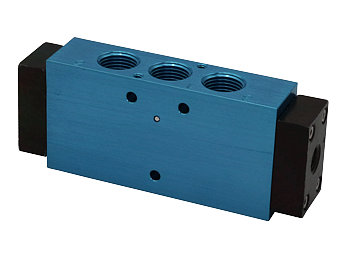




Compact Air Pilot L Series Valves - Standard Temperature -20 to 123 F (-29 to 50 C)
 Operating Instructions - Bottom Mount Valves
Product Catalog - Compact L Series
Operating Instructions - Top Mount Valves
Operating Instructions - Bottom Mount Valves
Product Catalog - Compact L Series
Operating Instructions - Top Mount Valves
- Compact Design - Balanced spool construction
- Tapered Tee-Seal - Bidirectional tapered Tee-Seal eliminates sticking problems
- Tested Tough - proven reliable according to SAE specifications: rust & water injected every 864,000 cycles for 20-million cycle
Valves
The AV inline L20 series valves are directional control spool valves, designed for a wide range of fluid control applications, providing users with a space-saving and lightweight design. With both inline or manifold mount, the L20 series provide flexible options for mounting. The balanced spool construction allows ports to be plugged for 2 way or 3 way function, or restricted for inexpensive cylinder exhaust speed control. A wide variety of options and operators available.
Tapered Tee-Seal ........ Eats Dirt
Bidirectional tapered Tee-Seal eliminates sticking problems.
- Flexes to clean spool
- Mechanically Locked
- No Spiral Twist
- No Extrusion
- Air Line Sediment is Wiped Away
- Tested tough and proven reliable according to SAE specifications: Rust and water injected every 864,000 cycles for 20 million cycles.
Unable to load products. Please try again.
loading...
loading...
Product Overview
The Automatic Valve Compact Air Pilot L Series - Standard Temperature is a pneumatically actuated 3-way directional control spool valve built on the proven L20 platform, designed for applications where an electrical pilot solenoid is not desired, not practical, or not permitted. Operating from -20 to 123 F (-29 to 50 C), the air pilot configuration delivers the same compact, high-flow performance as the solenoid L Series but with a 1/8 NPTF pneumatic pilot port replacing the electrical coil and solenoid assembly.
The air pilot design is the preferred configuration for hazardous locations where solenoid coils present an ignition risk, for remote outdoor pneumatic circuits too distant from electrical infrastructure, for simple cascade logic systems that sequence valves pneumatically without a PLC, and for high-cycle applications where solenoid coil life or power consumption is a concern. The pilot signal can be any pressure source within the 35 to 150 psig (2.4 to 10.3 bar) operating range.
The valve retains all the core mechanical features of the L Series platform: balanced spool construction with the Tapered Tee-Seal bidirectional self-cleaning seal, aluminum body and spool, Buna-N seal material, inline or manifold mount options, and the same compact envelope dimensions as the solenoid counterpart. Port sizes cover 1/4 and 3/8 inch in the L20 body and 1/2 inch in the L45 body, all providing 1.8 Cv at the smaller sizes and 4.0 Cv at 1/2 inch.
Available in both single and double air pilot body designs, the L Series air pilot valve supports both spring-return (single pilot) and detented (double pilot) circuit architectures. The detented configuration retains the last pilot signal position on pilot air loss, enabling last-position memory in pneumatic control circuits without any electrical components.
Key Engineering Features
- Pneumatic Pilot Actuation - No Electrical Supply Required - The 1/8 NPTF air pilot port accepts any standard compressed air signal within the 35 to 150 psig range, eliminating the need for electrical wiring, solenoid coils, conduit, and associated installation costs in remote or hazardous locations.
- Single and Double Air Pilot Configurations - Single pilot (spring return) and double pilot (detented) body designs are available. Double pilot provides last-position memory, retaining the valve position after pilot air loss without electrical control.
- Balanced Spool with Tapered Tee-Seal - Bidirectional tee-shaped seal flexes to wipe air line sediment from the spool bore on every cycle, eliminating sticking from contamination in environments where pneumatic circuit cleanliness is difficult to maintain.
- SAE-Tested 20-Million-Cycle Durability - Proven reliable per SAE specifications with rust and water injection every 864,000 cycles through 20 million cycles, providing a documented service life baseline for high-cycle pneumatic cascade and logic circuits.
- Ports Configurable for 2-Way or Speed Control - Balanced spool construction allows ports to be plugged for 2-way function or restricted for low-cost cylinder exhaust speed control, reducing total component count in pneumatic circuits.
- Inline and Manifold Mount Options - L20 inline and L21 top-mount manifold body variants support both individual valve installation and centralized multi-station manifold configurations for pneumatic cascade and sequencing circuits.
- Compact Lightweight Design - The L20 air pilot body weighs 0.40 kg (0.9 lb) for single or double pilot configurations, enabling installation on lightweight machine frames, mobile equipment, and space-constrained machine panels.
- Compatible with Pneumatic Logic Circuits - Air pilot actuation enables integration into fully pneumatic logic and sequencing systems using pressure signals from limit valves, pushbutton pilots, and pneumatic logic elements without PLC hardware.
- SAE Rust and Water Tested - Proven to handle contaminated air streams through SAE rust and water cycle testing, maintaining reliable operation in humid, outdoor, and industrial environments where air quality is not always ideal.
- CE, CSA, FM, and ATEX Certified - Full certification coverage across North American and European regulatory frameworks, enabling deployment in machinery, process control, and hazardous location applications without additional regulatory review.
Technical Specifications
General Specifications
| Parameter | Specification |
| Series | L20 (Inline), L21 (Top Mount / Manifold), L45 (1/2 inch Inline) |
| Valve Type | Directional Control Spool Valve |
| Valve Functions | 3-Way Normally Closed (3/2 NC); 3-Way Normally Open (3/2 NO) |
| Construction | Balanced Spool with Tapered Tee-Seal |
| Actuation | Pneumatic (Air Pilot) |
| Port Sizes | 1/4 inch, 3/8 inch (L20 / L21); 1/2 inch (L45) |
| Port Threads | NPT (standard); G/BSPP (Option W) |
| Pilot Port | 1/8 NPTF |
| Flow Capacity (L20 1/4 and 3/8 inch) | 1.8 Cv (1,800 Nl/min) |
| Flow Capacity (L45 1/2 inch) | 4.0 Cv (3,940 Nl/min) |
| Operating Pressure | 35 to 150 psig (2.4 to 10.3 bar) / 240 to 1,030 kPa |
| Pilot Supply Pressure | 35 to 150 psig (2.4 to 10.3 bar) |
| Ambient and Media Temperature | 20 to 123 F (-29 to 50 C) |
| Flow Media | Filtered air or inert gas |
| Filtration Requirement | 50 microns or better |
| Body Material | Aluminum |
| Spool Material | Aluminum |
| Seal Material | Treated Buna-N (NBR) |
| Mounting | Inline (L20); Top Mount / Manifold (L21); Inline (L45) |
| Return (Single Pilot) | Spring Return (2-Position) |
| Return (Double Pilot) | Detented (2-Position, last-position memory) |
| No Electrical Supply Required | Air pilot valves have no coil, no voltage requirement, and no electrical connection |
Flow Performance Data
| Series | Port Size | Flow Cv | Flow Nl/min | Body Design | Weight kg (lb) |
| L20 | 1/4 inch (NPT or G) | 1.8 | 1,800 | Single or Double Pilot | 0.40 (0.9) |
| L20 | 3/8 inch (NPT or G) | 1.8 | 1,800 | Single or Double Pilot | 0.40 (0.9) |
| L45 | 1/2 inch (NPT or G) | 4.0 | 3,940 | Single or Double Pilot | 0.90 (1.9) |
Certifications & Compliance
| Certification/Standard | Detail |
| CSA | C22.2 and UL Standard 429 certification. Air pilot valves with no electrical components are particularly well-suited to hazardous location installations where coil-free construction eliminates an ignition source. |
| Factory Mutual (FM) | FM approved for explosion-proof environments. The absence of solenoid coils in air pilot valves simplifies hazardous area classification compliance. |
| ATEX | Applicable for European hazardous area installations. The all-pneumatic construction of air pilot valves is intrinsically compatible with Zone 1 and Zone 2 hazardous areas. |
| CE | EMC and Low Voltage Directive compliance for European machinery and process equipment. |
Typical Applications & Industries
Hazardous Location Pneumatic Circuits
- Oil and gas production and processing facilities where solenoid valves present ignition risks and fully pneumatic pilot circuits using air pilot directional control valves eliminate the electrical component from the hazardous zone.
- Chemical and petrochemical processing pneumatic actuator controls where Class I, Division 1 or Zone 1 area classifications favor the simplicity and inherent safety of all-pneumatic directional control.
- Paint spray booth and finishing line actuator circuits where solenoid coils are restricted by explosion-proof area classification requirements, and air pilot valves provide an electrically simple alternative.
- Grain handling and dust collection facilities where combustible dust environments (Class II, Division 1) create challenges for solenoid coil installations, and pneumatic pilot valves avoid the classification compliance burden.
Pneumatic Cascade Logic and Sequencing
- Fully pneumatic machine sequencing circuits using air pilot L Series valves as the primary directional element in cascade logic systems, eliminating PLC hardware requirements in simple, repetitive cycle automation.
- Pneumatic time-delay and sequence control circuits where air pilot valves are actuated by pressure signals from limit valves, flow controls, and pneumatic timers to create defined sequence steps without electrical controls.
- Press and forming machine pneumatic interlocking where pressure-based interlocks use air pilot signals from upstream circuit elements to prevent out-of-sequence actuation.
- Pneumatic assembly fixture sequencing for multi-step clamping, locating, and ejection cycles that can be implemented with air pilot valves, limit valves, and shuttle valves without PLC integration.
General Industrial and Manufacturing Automation
- Pneumatic cylinder actuation for pick-and-place, clamping, indexing, and positioning systems where the absence of electrical wiring simplifies installation, reduces control panel complexity, and minimizes maintenance points.
- Material handling conveyors, pneumatic gates, and sortation diverters where air pilot valves simplify wiring infrastructure in large facilities with distributed pneumatic actuators far from electrical control panels.
- Production line pneumatic actuator controls in facilities with high electrical noise environments where solenoid coil EMI interference is a concern and all-pneumatic control eliminates the interference source.
- Machine tool chip conveyor and coolant system pneumatic controls where simple directional switching is required and an all-pneumatic circuit eliminates solenoid coil replacement as a maintenance item.
Remote and Outdoor Installations
- Remote pipeline and utility pneumatic actuator controls where the installation is beyond practical electrical infrastructure reach and a locally supplied compressed air signal provides the only available pilot energy source.
- Agricultural irrigation, fertilizer, and sprayer system pneumatic controls where all-pneumatic operation eliminates power supply requirements for remote field equipment.
- Mobile equipment and vehicle-mounted pneumatic systems where air pilot valves reduce the electrical load on vehicle power systems and simplify the control circuit design for auxiliary pneumatic functions.
- Mining and quarry equipment pneumatic controls on remote or mobile equipment where compressed air is the primary available energy source and electrical infrastructure is limited or impractical.
Packaging and Material Handling
- Packaging machine pneumatic actuator controls where air pilot valves simplify the machine's electrical panel design by moving directional control decisions into the pneumatic circuit without PLC I/O expansion.
- Palletizing, case erecting, and stretch wrapping equipment where repeating cycle sequences can be implemented pneumatically using air pilot valves and limit valves to reduce control system complexity.
- Vacuum cup and gripper pneumatic circuits using 3-way NC air pilot valves to control suction and release from a pneumatic pressure signal without solenoid coil or electrical connection at the gripping end.
- Conveyors, rotary tables, and indexing mechanisms where pneumatic cascade logic using air pilot valves provides a reliable, maintenance-friendly alternative to PLC-controlled solenoid valve banks.
Test and Process Equipment
- Pneumatic leak test and pressure decay systems where air pilot valves switch test circuits based on upstream pressure signals from regulators and logic elements without electrical actuation at the test station.
- Pneumatic process control pilot stages for larger actuated valves where the air pilot L Series valve drives the pilot circuit of a large-bore process valve without electrical connection in the process area.
- Flow control and pressure regulation test benches where air pilot directional valves provide circuit switching controlled by the test bench's own pneumatic pressure outputs.
- Automotive and aerospace component pressure cycling test equipment where all-pneumatic actuation and control simplifies test cell design and eliminates solenoid coil as a reliability variable in the test data.
Ordering and Model Number Configuration
Air pilot valves do not require a voltage code. The model number ends after the operator codes (e.g., L2003GAAR for single pilot spring return, L2003GBAA for double pilot detented).
For G (BSPP) threads on all ports, add suffix W to the model number.
The external pilot port is standard (1/8 NPTF) on all air pilot models. No internal pilot conversion is required.
Fluoroelastomer seal option (suffix A) is available for lockout models only and does not change the rated operating temperature range.
Manifold-mount assemblies (B8023 series) require L21 top-mount body valves. The inline L20 air pilot body is not designed for manifold use.
Air pilot valves can be combined with solenoid pilot valves on the same L21 manifold assembly for mixed pilot configurations in a single multi-station manifold.
Related Products & Accessories
- Compact Air Pilot L Series - Low Temperature - L Series air pilot spool valves rated to -40 F (-40 C) for cold storage and arctic environment pneumatic circuits. https://www.automaticvalve.com/series/2996-compact-air-pilot-l-series-valves-low-temperature
- Compact Solenoid L Series - Standard Temperature Applications - L Series solenoid spool valves for standard temperature applications with electrical solenoid pilot actuation. https://www.automaticvalve.com/series/2979-compact-solenoid-l-series-valves-standard-temperature-applications
- Compact Solenoid L Series - High Temperature Applications - L Series solenoid spool valves with CT coil option rated 0 to 180 F (-18 to 82 C). https://www.automaticvalve.com/series/2977-compact-solenoid-l-series-valves-high-temperature-applications
- Compact Solenoid L Series - Low Temperature Applications - L Series solenoid spool valves rated -40 to 123 F for cold environment applications. https://www.automaticvalve.com/series/2978-compact-solenoid-l-series-valves-low-temperature-applications
- Compact Solenoid L Series - CSA/FM Explosion-Proof - L Series with explosion-proof solenoid coils for hazardous location applications where electrical actuation is required. https://www.automaticvalve.com/series/2980-compact-solenoid-l-series-valves-csafm-standard-temperature-applications
Frequently Asked Questions (FAQ)
Q: What is the primary advantage of an air pilot valve over a solenoid pilot valve?
A: The air pilot configuration eliminates the solenoid coil and all associated electrical components: wiring, conduit, electrical connections, and voltage supply. This simplifies installation in remote locations, eliminates coil burnout as a failure mode, reduces maintenance to mechanical components only, and enables safe deployment in hazardous areas where solenoid coils are restricted or require costly explosion-proof ratings.
Q: What pilot pressure is required to shift the L Series air pilot valve?
A: The pilot pressure must be 35 to 150 psig (2.4 to 10.3 bar). This is the same range as the main inlet pressure at port 1. The pilot signal can come from the same supply air circuit or from a separate regulated pilot supply.
Q: What is the difference between single pilot (spring return) and double pilot (detented) configurations?
A: The single pilot (body design A, suffix R for spring return) shifts the spool when a pilot signal is applied and returns to the spring-set position when the signal is removed. The double pilot (body design B, suffix A for air pilot return) uses two opposing pilot ports: applying one pilot shifts the spool to one position, and applying the other pilot shifts it to the opposite position. The spool stays in the last shifted position when both pilot signals are absent, providing last-position memory.
Q: Can air pilot valves be used in hazardous locations?
A: Air pilot valves with no electrical components have no ignition source from coils, wiring, or electrical connections, making them inherently well-suited to hazardous locations classified as Class I, Division 1, Zone 1, or equivalent. Verify with the applicable authority having jurisdiction for the specific installation. ATEX, CSA, and FM certifications apply to the product family; consult Automatic Valve for documentation specific to hazardous area applications.
Q: What is the flow capacity of the air pilot L Series?
A: Flow capacity is 1.8 Cv (1,800 Nl/min) for the L20 body in 1/4 and 3/8 inch port sizes, and 4.0 Cv (3,940 Nl/min) for the L45 body in 1/2 inch. These ratings are identical to the solenoid pilot L Series.
Q: What is the operating temperature range?
A: The standard temperature air pilot L Series operates from -20 to 123 F (-29 to 50 C) for both ambient and media conditions. For applications requiring operation down to -40 F, specify the Low Temperature Air Pilot L Series (series 2996).
Q: Can the air pilot valve be used in manifold configurations?
A: Yes. The L21 top-mount body air pilot valve is designed for manifold-mount use on B8023 series multi-station manifold assemblies (2 to 10 stations). Air pilot L21 valves can be mixed with solenoid pilot L21 valves on the same manifold for circuits that require both pilot types.
Q: What pilot port size is used on the air pilot L Series?
A: The pilot port is 1/8 NPTF on all L20 and L45 body air pilot valves. Standard pneumatic push-in fittings for 1/8 inch tubing or 1/8 NPT threaded pilot connections are compatible.
Q: How does the Tee-Seal benefit air pilot applications?
A: In pneumatic cascade and sequencing circuits, air quality is often less controlled than in critical solenoid valve circuits. The Tee-Seal's active spool-wiping action on every cycle removes contaminants from the spool bore, maintaining reliable shifting even with moderate pilot air contamination. This self-cleaning action reduces maintenance requirements and extends service intervals in demanding pneumatic environments.
Q: Is lubrication required for the air pilot L Series?
A: Lubrication is not required but is recommended for maximum service life. Use petroleum-based oil compatible with Buna-N seals, ISO 32 viscosity, aniline range 82 to 99 C (180 to 210 F), filtered to 50 microns. If oil lubrication is introduced after the valve has been in dry service, apply oil conservatively; excess oil can accumulate in circuit elements downstream.
Q: What filtration is required?
A: Both main supply air and pilot signal air must be filtered to 50 microns or better. For temperatures below 40 F (4 C), the air must be dried to a dew point below the minimum operating temperature to prevent ice formation in the valve body and pilot passages.
Q: What is the typical lead time for Air Pilot L Series valves?
A: Standard manufacturing lead times for quantities of 10 or fewer units are typically 3 to 4 weeks, with shipping available throughout the United States.
Installation & Maintenance Guidelines
- Connect the pneumatic pilot signal to the 1/8 NPTF pilot port on the valve body or solenoid cap. Pilot pressure must be maintained between 35 and 150 psig (2.4 to 10.3 bar) to ensure complete and reliable spool shifting.
- Supply filtered air at 50 microns or better to both the main supply port and the pilot supply. Contaminated pilot air can cause pilot passage blockage, resulting in incomplete or erratic spool shifting.
- For temperatures below 40 F (4 C), air supply must be dried to prevent ice formation inside the valve. Dry both the main air supply and the pilot signal air.
- Lubrication is not required but is recommended for maximum service life. Use petroleum-based oil, ISO 32 viscosity, aniline range 82 to 99 C (180 to 210 F), filtered to 50 microns.
- The double pilot (detented) body design retains the last spool position when pilot signal is removed. Verify that the last-position memory behavior is acceptable and safe for the application before specifying the detented configuration.
- For manifold-mount installations, use L21 top-mount body valves with the appropriate B8023 manifold assembly. The L21 body air pilot valve can share manifolds with L21 solenoid pilot valves in mixed-pilot configurations.
- Mount the valve in any orientation. Ensure the pilot port is accessible for pilot tube connection and future maintenance.
Warranty & Global Support
Automatic Valve, a ROSS Controls company, provides a standard warranty on all products covering defects in material and workmanship from date of purchase.
Technical support and product configuration assistance are available through Automatic Valve at (248) 474-6761.
For complete technical data, dimensional drawings, CAD models, and ordering configuration, visit automaticvalve.com or contact the factory directly.
Estimated ship dates are based on standard manufacturing times for quantities of 10 or fewer. Shipments are available throughout the United States.
Product Catalog - L Series Compact Inline Valves: https://www.automaticvalve.com/documents/6533/Compact_Inline_Valves_L_Series_AV-IV-L_EN.pdf
Service Instructions - Compact Inline Spool Valves: https://www.automaticvalve.com/documents/405/Compact_Inline_Valves_Service_Information_Form_AV-Compact-IL_OI.pdf
Download Documents
Compact Air Pilot L Series Valves - Standard Temperature