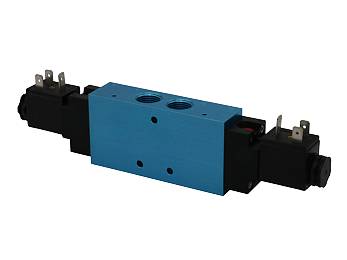




Compact Solenoid L Series Valves - Low Temperature Applications -40 to 123 F (-40 to 50 C)
 Operating Instructions - Bottom Mount Valves
Product Catalog - Compact L Series
Operating Instructions - Top Mount Valves
Operating Instructions - Bottom Mount Valves
Product Catalog - Compact L Series
Operating Instructions - Top Mount Valves
- Compact Design - Balanced spool construction
- Solenoid Pilot - Pilot uses full air line pressure to shift the valve, Solenoid guaranteed against burnout
- Weather-Proof Coils - Hermetically sealed as an integral water tight molded unit; robust enclosures to function in rugged environments
- Tapered Tee-Seal - Bidirectional tapered Tee-Seal eliminates sticking problems
- Tested Tough - proven reliable according to SAE specifications: rust & water injected every 864,000 cycles for 20-million cycle
- Manual Override - Allows the solenoid valve to be used manually in case of electrical failure, or for quick cycle testing
- External Pilot Supply - Easily field convertible to external pilot supply
Valves
The AV inline L20 series valves are directional control spool valves, designed for a wide range of fluid control applications, providing users with a space-saving and lightweight design. With both inline or manifold mount, the L20 series provide flexible options for mounting. The balanced spool construction allows ports to be plugged for 2 way or 3 way function, or restricted for inexpensive cylinder exhaust speed control. A wide variety of options and operators available.
Tapered Tee-Seal ........ Eats Dirt
Bidirectional tapered Tee-Seal eliminates sticking problems.
- Flexes to clean spool
- Mechanically Locked
- No Spiral Twist
- No Extrusion
- Air Line Sediment is Wiped Away
- Tested tough and proven reliable according to SAE specifications: Rust and water injected every 864,000 cycles for 20 million cycles.
Solenoid ... Guaranteed Against Burnout
Three-way pilot uses full air line pressure to shift the valve. The pilot is internally supplied when the pressure at port one is 35 to 150 PSIG (240 to 1030 kPa). The coil is hermetically sealed as an integral watertight molded unit. Intrinsically-safe and explosion-proof versions available. Push Non-Locking Override is standard. (Extended Turn and Turn-Locking available).
Unable to load products. Please try again.
loading...
loading...
Product Overview
The Automatic Valve Compact Solenoid L Series - Low Temperature is the cold environment configuration of the proven L20 directional control spool valve platform, rated for operation from -40 to 123 F (-40 to 50 C). This extended low-temperature rating makes the series suitable for pneumatic automation in blast freezing, cold chain distribution, refrigerated warehousing, arctic outdoor installations, and any application where standard valve seals and coils become unreliable at sub-zero temperatures.
The low-temperature operating capability is achieved through the combination of the standard Buna-N (treated NBR) seal material, which retains flexibility and sealing integrity well below the freezing point of water, and the standard weather-proof NEMA 4X hermetically sealed coil, which functions reliably at -40 F. The valve body, spool, and all mechanical components are manufactured from aluminum and maintain dimensional stability across the entire -40 to 123 F operating range.
The balanced spool design with Tapered Tee-Seal provides active spool cleaning on every cycle, a particularly important feature in cold and freezing environments where condensed moisture and frost can accumulate in air supply systems and settle on valve internals. The mechanically locked tee-cross-section seal prevents extrusion and twist even when elastomers are operating near their low-temperature flexibility limits, providing consistent sealing performance throughout the full cold temperature range.
The solenoid pilot operates from full port 1 pressure (35 to 150 psig), ensuring consistent actuation force even at low temperatures where pilot air viscosity effects and moisture in the pilot circuit could affect performance in lower-pressure pilot designs. For applications where port 1 inlet pressure may be reduced by system design or regulation, the valve is field-convertible to external pilot supply without disassembly of the valve body.
Key Engineering Features
- Low-Temperature Operation to -40 F (-40 C) - Buna-N seals and standard NEMA 4X coil deliver reliable directional control at continuous ambient and media temperatures down to -40 F (-40 C), enabling deployment in blast freezers, cold chain facilities, and arctic outdoor installations.
- Balanced Spool with Tapered Tee-Seal - The bidirectional tee-shaped seal actively wipes sediment and condensate from the spool bore on every cycle, preventing the ice and frost buildup that can cause sticking failures in conventional spool seals operating at sub-zero temperatures.
- SAE-Tested 20-Million-Cycle Durability - Proven to SAE specifications with rust and water injection every 864,000 cycles through 20 million cycles, documenting long-term mechanical reliability in the wet, corrosive conditions common to refrigerated and outdoor cold environments.
- Full-Pressure Solenoid Pilot - Three-way solenoid pilot uses full air line pressure at port 1 (35 to 150 psig), providing positive, consistent actuation force even in cold environments where low-pressure pilot designs may be sensitive to viscosity changes in the pilot circuit.
- Weather-Proof NEMA 4X Hermetically Sealed Coil - The coil is hermetically sealed as an integral watertight unit rated NEMA 4X, preventing moisture ingress and frost accumulation on coil internals in freezer, refrigeration, and outdoor wet environments.
- Field-Convertible External Pilot Supply - Internal-to-external pilot conversion requires only rotating the internal gasket 180 degrees, supporting installations in refrigerated spaces where line pressure may be regulated below 35 psig.
- Manual Override Standard - Push Non-Locking Manual Override is standard for commissioning, troubleshooting, and cycle verification in cold environments without requiring electrical actuation.
- Inline and Manifold Mount Configurations - L20 inline and L21 top-mount manifold bodies allow centralized control of multiple pneumatic actuators in cold rooms and freezer environments, reducing the number of individual valve penetrations through insulated enclosure walls.
- Air Must Be Dry Below 40 F (4 C) - A critical installation requirement for reliable low-temperature operation: compressed air must be dried to a dew point below the minimum operating temperature to prevent ice formation inside the valve. This operational constraint is integral to the valve design specification.
- CE, CSA, FM, and ATEX Certified - Full certification for North American and European industrial machinery and process control applications, including explosion-proof options for cold storage facilities handling flammable refrigerants.
Technical Specifications
General Specifications
| Parameter | Specification |
| Series | L20 (Inline), L21 (Top Mount / Manifold), L45 (1/2 inch Inline) |
| Valve Type | Directional Control Spool Valve |
| Valve Functions | 3-Way Normally Closed (3/2 NC); 3-Way Normally Open (3/2 NO) |
| Construction | Balanced Spool with Tapered Tee-Seal |
| Actuation | Solenoid Pilot (electrical) |
| Port Sizes | 1/4 inch, 3/8 inch (L20 / L21); 1/2 inch (L45) |
| Port Threads | NPT (standard); G/BSPP (Option W) |
| Flow Capacity (L20 1/4 and 3/8 inch) | 1.8 Cv (1,800 Nl/min) |
| Flow Capacity (L45 1/2 inch) | 4.0 Cv (3,940 Nl/min) |
| Operating Pressure | 35 to 150 psig (2.4 to 10.3 bar) / 240 to 1,030 kPa |
| External Pilot Supply Pressure | 35 to 150 psig (2.4 to 10.3 bar) |
| Ambient and Media Temperature | 40 to 123 F (-40 to 50 C) |
| Critical Air Dryness Requirement | Below 40 F (4 C), air must be dried to a dew point below the minimum operating temperature to prevent internal ice formation |
| Flow Media | Filtered air or inert gas |
| Filtration Requirement | 50 microns or better |
| Body Material | Aluminum |
| Spool Material | Aluminum |
| Seal Material | Treated Buna-N (NBR) |
| Mounting | Inline (L20); Top Mount / Manifold (L21); Inline (L45) |
| Duty Rating | Continuous Duty (100% ED) |
| Pilot Supply | Internal (standard); External (Option B, field convertible) |
| Manual Override | Push Non-Locking (standard); Push Turn-Locking (Option 1); Extended Turn-Locking (Option 2); None (Option 4) |
| Coil Enclosure | NEMA 4X (Weather-Proof, hermetically sealed) |
Temperature Ratings
The -40 to 123 F (-40 to 50 C) rating applies to both ambient and media temperature. When operating below 40 F (4 C), the compressed air supply must be dried to a dew point at or below the minimum operating temperature to prevent ice formation within the valve body, pilot circuit, and spool bore. Failure to maintain dry air at sub-freezing temperatures is the primary cause of valve sticking and blockage in cold applications.
| Configuration | Ambient Temperature | Media Temperature |
| Standard Buna-N Seals, Standard Coil |
Electrical Data (Solenoid Pilot Valves)
All solenoid coils are rated for 100% continuous duty. NEMA 4X weather-proof coils are the standard selection for cold storage and refrigerated environments. Coils are ordered separately from the valve body and specified by voltage code.
| Voltage | Power Consumption |
| 12 VDC | |
| 24 VDC | |
| 120 V AC 50/60 Hz | |
| 230/240 V AC 50/60 Hz | |
| Various (Low Watt option) | 2.5 Watts |
| 24 VDC only (Lowest Watt option) | 0.7 Watts |
Electrical Connection Options
| Connection Type | Coil Code |
| DIN EN 175301-803 Form B (Industrial) | |
| 18 inch Flying Leads | |
| 1/2 inch Conduit with 30 inch Leads | |
| Explosion-Proof 1/2 inch Conduit with 24 inch Leads (CSA, FM) | |
| ATEX Explosion-Proof with 39 inch Cable | |
| Intrinsically-Safe with Strain Relief (24 VDC only) |
Flow Performance Data
| Series | Port Size | Flow Cv | Flow Nl/min | Weight kg (lb) |
| L20 | 1/4 inch (NPT or G) | 1.8 | 1,800 | 0.27 (0.6) |
| L20 | 3/8 inch (NPT or G) | 1.8 | 1,800 | 0.27 (0.6) |
| L45 | 1/2 inch (NPT or G) | 4.0 | 3,940 | 0.68 (1.5) |
| L21 (Manifold) | 1/4 inch (NPT or G) | 1.8 | 1,800 | 0.40 (0.9) |
| L21 (Manifold) | 3/8 inch (NPT or G) | 1.8 | 1,800 | 0.40 (0.9) |
Certifications & Compliance
| Certification/Standard | Detail |
| CSA | C22.2 and UL Standard 429 certification for solenoid valves used in North American electrical installations. |
| Factory Mutual (FM) | FM approved for explosion-proof environments, applicable to cold storage facilities handling ammonia refrigerants or flammable refrigerant alternatives. |
| ATEX | Ex m II T5 PTB certification for European hazardous area locations in cold storage, ammonia refrigeration, and cryogenic processing facilities. |
| CE | EMC and Low Voltage Directive compliance for European machinery and process equipment. |
Typical Applications & Industries
Cold Storage and Refrigerated Warehousing
- Blast freezer and quick-freeze tunnel conveyor and door actuator controls where ambient temperatures reach -40 F and standard valve seals and coils fail through embrittlement or condensation-related freezing.
- Refrigerated distribution center sortation and conveyor divert system pneumatic actuators requiring reliable, high-cycle directional control in sustained sub-zero ambient environments.
- Cold room door and air curtain actuator controls where the valve must cycle reliably from warm ambient during entry to -40 F cold room conditions after door closure.
- Automated pallet handling and rack storage retrieval systems in temperature-controlled warehouses where pneumatic actuators operate continuously at low ambient with high cycle frequency.
Food and Beverage Processing
- Cryogenic food freezing lines, including liquid nitrogen and carbon dioxide tunnel freezing systems, where pneumatic controls adjacent to the freezing zone experience extreme low ambient temperatures.
- Ice cream and frozen food production line actuators for filling, forming, wrapping, and case packing equipment operating in freezer environments designed to maintain sub-zero product temperatures.
- Dairy and beverage cold fill operations where pneumatic control valves must operate reliably in refrigerated fill rooms maintained at near-freezing temperatures to meet product safety requirements.
- Frozen vegetable and seafood processing line actuators for blanching conveyors, IQF freezer infeed, and frozen product packaging lines operating in cold, wet, and washdown environments.
Pharmaceutical and Laboratory Cold Storage
- Pharmaceutical cold chain and vaccine storage automated retrieval systems operating in refrigerated or frozen storage environments at -40 F, where valve reliability is critical to product integrity.
- Laboratory ultra-low temperature storage room automation for biological sample retrieval, cryogenic sample handling, and cold room environmental control systems.
- Biorepository and biobank automated storage and retrieval pneumatic actuators operating at sustained sub-zero ambient temperatures in controlled storage environments.
- Plasma and blood product storage facility automation where low-temperature directional control valves must cycle reliably at cold storage temperatures without condensation-related failures.
Arctic and Cold Climate Outdoor Installations
- Pipeline control and automation in arctic or subarctic outdoor environments where pneumatic actuators for valve control, venting, and isolation must operate at ambient temperatures reaching -40 F.
- Oil and gas production facility surface automation in cold climate regions where production equipment and wellhead controls are exposed to prolonged sub-zero ambient conditions.
- Mining equipment pneumatic controls in cold climate open-pit and underground operations where mobile and fixed equipment must operate through winter conditions at extreme low temperatures.
- Transportation and rail pneumatic brake and door actuator pilot valves for vehicles and rolling stock operating in cold climate regions where air temperatures drop to -40 F during winter service.
Refrigeration Systems and HVAC
- Commercial refrigeration system actuator controls and compressed air pilot valves for large-scale refrigeration equipment operating in plant rooms at low ambient temperatures.
- Industrial chiller system automation and pneumatic control for evaporator defrost, condenser fan control, and refrigerant circuit management in cold ambient machine rooms.
- Ice-making and ice-storage system pneumatic actuators for ice harvesters, bin conveyors, and ice dispensing equipment operating in cold environments adjacent to the ice production zone.
- HVAC systems in cold climate buildings where outdoor air handling units and pneumatic damper actuators must operate through winter conditions without valve failure from low ambient temperature.
Transportation and Logistics Equipment
- Refrigerated trailer and container pneumatic door, floor, and locking system actuators for cold chain transport equipment operating in ambient temperatures reaching -40 F during winter transit.
- Airport ground support equipment and baggage handling pneumatic actuators in northern climates where overnight outdoor parking and early-morning operation expose equipment to extreme cold.
- Rail freight car and intermodal container gate and door pneumatic actuators required to cycle reliably after extended outdoor storage at sub-zero temperatures.
- Port cargo handling equipment pneumatic actuators for container handling cranes and automated stacking equipment in northern ports with winter ambient temperatures at or below -40 F.
Ordering and Model Number Configuration
The standard Buna-N seal and standard NEMA 4X coil provide full -40 to 123 F (-40 to 50 C) operating capability. No special seal or coil option is required beyond selecting the standard valve configuration.
For G (BSPP) threads on all ports, add suffix W to the model number.
For external pilot supply (port 1 pressure below 35 psig), add suffix B or perform field conversion by rotating the gasket 180 degrees.
For dustproof operation in freezers where frost or condensation may block vent ports, specify Option D (Dustproof). Vent ports are plugged and the spring pad breather vent is eliminated.
Low Watt (Option L, 2.5 W) and Lowest Watt (Option LL, 0.7 W, 24 VDC only) coils reduce power consumption, which may be relevant for battery-backed control systems in refrigerated environments where power efficiency is a design constraint.
Coils are ordered separately from the valve body; specify both the valve model and the coil part number with voltage code.
Related Products & Accessories
- Compact Solenoid L Series - Standard Temperature Applications - L Series solenoid spool valves for standard temperature applications, -20 to 123 F (-29 to 50 C). https://www.automaticvalve.com/series/2979-compact-solenoid-l-series-valves-standard-temperature-applications
- Compact Solenoid L Series - High Temperature Applications - L Series solenoid spool valves with CT coil option rated 0 to 180 F (-18 to 82 C) for high ambient environments. https://www.automaticvalve.com/series/2977-compact-solenoid-l-series-valves-high-temperature-applications
- Compact Air Pilot L Series - Low Temperature - L Series 3-way air pilot spool valves rated to -40 F (-40 C) for cold environment applications requiring no electrical supply. https://www.automaticvalve.com/series/2996-compact-air-pilot-l-series-valves-low-temperature
- Compact Air Pilot L Series - Standard Temperature - L Series air pilot spool valves for standard temperature applications without electrical power requirements. https://www.automaticvalve.com/series/2995-compact-air-pilot-l-series-valves-standard-temperature
- Compact Solenoid L Series - CSA/FM Explosion-Proof - L Series with CSA and FM explosion-proof coils for hazardous cold storage applications with ammonia or flammable refrigerants. https://www.automaticvalve.com/series/2980-compact-solenoid-l-series-valves-csafm-standard-temperature-applications
Frequently Asked Questions (FAQ)
Q: What is the minimum operating temperature for the Low Temperature L Series?
A: The minimum operating temperature is -40 F (-40 C) for both ambient and media conditions. This rating applies with the standard Buna-N seal material and standard NEMA 4X coil. No special seal or coil option is required for the rated low-temperature performance.
Q: Why must air be dry for temperatures below 40 F (4 C)?
A: At temperatures below 40 F (4 C), any water vapor present in the compressed air supply will freeze inside the valve body, pilot passage, and spool bore. Ice formation blocks the pilot circuit and prevents the spool from shifting, causing valve failure. A refrigerated compressed air dryer with a dew point rating below the minimum operating temperature of the installation is required to prevent this failure mode.
Q: Does the low-temperature rating require a special seal material?
A: No. The standard Treated Buna-N (NBR) seal material in the L Series provides the full -40 to 123 F (-40 to 50 C) operating range. The Tee-Seal design remains flexible and functional at -40 F. Fluoroelastomer seals (Option A) are available for lockout models only and are not required for low-temperature operation.
Q: What coil types are compatible with low-temperature operation?
A: The standard NEMA 4X Weather-Proof hermetically sealed coil is fully compatible with -40 F operation. The Dustproof option (Option D) is also compatible and recommended in environments where frost accumulation could block vent ports. Do not specify the high-temperature CT coil for low-temperature applications; the standard coil is the correct selection.
Q: Can the Dustproof option be used in cold storage applications?
A: Yes, and it is recommended. Option D plugs the vent ports and eliminates the spring pad breather vent, preventing frost and condensate ingress into the valve in environments with high humidity, frost cycling, or washdown exposure. This option is particularly relevant in blast freezer and cold room entry applications where temperature cycling creates condensation.
Q: What is the operating pressure range?
A: The operating pressure range is 35 to 150 psig (2.4 to 10.3 bar) at port 1 for internal pilot supply, and 35 to 150 psig for external pilot supply. This range is unchanged from the standard temperature configuration.
Q: Can explosion-proof coils be used in cold storage facilities with ammonia refrigerant?
A: Yes. CSA and FM explosion-proof coil options (Option Y for CSA/FM, Option Z for ATEX) are available for hazardous location applications including cold storage facilities using ammonia (R-717) refrigerant. Verify the specific hazardous area classification of the installation and specify the appropriate explosion-proof coil and conduit system accordingly.
Q: What is the flow capacity of the Low Temperature L Series?
A: Flow capacity is 1.8 Cv (1,800 Nl/min) for the L20 body in 1/4 and 3/8 inch port sizes, and 4.0 Cv (3,940 Nl/min) for the L45 body in 1/2 inch. These ratings are identical to the standard and high-temperature L Series configurations.
Q: How does the Tee-Seal perform at -40 F?
A: The Buna-N Tee-Seal retains sufficient flexibility at -40 F to maintain bidirectional sealing and the active spool-wiping action that clears sediment and condensate from the bore. The mechanically locked design prevents extrusion or spiral twist at cold temperatures when elastomers may be operating near their flexibility limits. The 20-million-cycle SAE durability test validates long-term reliability under the rust and water injection conditions representative of cold environment operation.
Q: What lubrication is recommended for cold temperature applications?
A: Lubrication is not required but is recommended for maximum service life. If used, select a petroleum-based lubricant with an ISO 32 viscosity and aniline range of 82 to 99 C (180 to 210 F) that remains pourable at the minimum installation temperature. Filter lubricant to 50 microns before introduction to the air supply. Avoid silicone-based lubricants, which are not compatible with Buna-N seals.
Q: Can the L Series Low Temperature valve be used for vacuum applications?
A: For internal pilot supply, the valve requires positive pressure (35 to 150 psig) at port 1 to shift the spool. For vacuum applications or applications where port 1 pressure may be below 35 psig, specify Option B for external pilot supply. The external pilot must be 35 to 150 psig from a separate supply source.
Q: What is the typical lead time for Low Temperature L Series valves?
A: Standard manufacturing lead times for quantities of 10 or fewer units are typically 3 to 4 weeks, with shipping available throughout the United States.
Installation & Maintenance Guidelines
- Supply compressed air that has been dried to a dew point at or below the minimum operating temperature of the installation. At temperatures below 40 F (4 C), any moisture in the air supply will freeze inside the valve, blocking the pilot passage and causing the valve to fail to shift. A refrigerated compressed air dryer with adequate pressure dew point rating for the application temperature is required.
- Supply filtered air at 50 microns or better. In cold environments, filter housings should be rated for the minimum installation temperature and located upstream of any cold zone to prevent condensate from entering the valve supply line.
- Lubrication is not required but is recommended for maximum service life. If oil lubrication is used, verify that the lubricant remains pourable and does not become viscous at the minimum operating temperature. ISO 32 viscosity petroleum-based oil with an aniline range of 82 to 99 C (180 to 210 F) is recommended.
- For external pilot supply conversion in installations where port 1 inlet pressure may be below 35 psig, remove the solenoid cap, rotate the internal gasket 180 degrees to cover the internal pilot passage, reinstall the cap, and connect the external pilot to the 1/8 NPTF port. Torque M3 screws to 1.02 N-m (9 in-lbs) plus or minus 10 percent.
- In dusty or frost-accumulating environments, specify Option D (Dustproof) to plug the vent ports and eliminate the spring pad breather vent, preventing frost or contaminant entry.
- Mount in any orientation. In cold environments where condensate may accumulate, orient the valve to allow drainage away from the spool bore and pilot ports if possible.
- For manifold-mount installations in cold rooms, locating the L21 manifold on the warm side of an insulated wall with pneumatic tubing runs to actuators on the cold side reduces the number of valve components exposed to the most extreme ambient temperatures.
Warranty & Global Support
Automatic Valve, a ROSS Controls company, provides a standard warranty on all products covering defects in material and workmanship from date of purchase.
Technical support and product configuration assistance are available through Automatic Valve at (248) 474-6761.
For complete technical data, dimensional drawings, CAD models, and ordering configuration, visit automaticvalve.com or contact the factory for application-specific cold temperature guidance.
Estimated ship dates are based on standard manufacturing times for quantities of 10 or fewer. Shipments are available throughout the United States.
Product Catalog - L Series Compact Inline Valves: https://www.automaticvalve.com/documents/6533/Compact_Inline_Valves_L_Series_AV-IV-L_EN.pdf
Service Instructions - Compact Inline Spool Valves: https://www.automaticvalve.com/documents/405/Compact_Inline_Valves_Service_Information_Form_AV-Compact-IL_OI.pdf
Download Documents
Compact Solenoid L Series Valves - Low Temperature Applications