



Compact Solenoid L Series Valves - CSA/FM, Standard Temperature Applications -20 to 123 F (-29 to 50 C)
 Operating Instructions - Bottom Mount Valves
Operating Instructions - Top Mount Valves
Product Catalog - Explosion-Proof & Intrinsically Safe Compact L Series
Operating Instructions - Bottom Mount Valves
Operating Instructions - Top Mount Valves
Product Catalog - Explosion-Proof & Intrinsically Safe Compact L Series
- Compact Design - Balanced spool construction
- Solenoid Pilot - Pilot uses full air line pressure to shift the valve, Solenoid guaranteed against burnout
- Solenoid Coils - Explosion-Proof CSA / FM and CSA / UL Certified
- Tapered Tee-Seal - Bidirectional tapered Tee-Seal eliminates sticking problems
- Tested Tough - proven reliable according to SAE specifications: rust & water injected every 864,000 cycles for 20-million cycle
- Manual Override - Allows the solenoid valve to be used manually in case of electrical failure, or for quick cycle testing
- External Pilot Supply - Easily field convertible to external pilot supply
Valves
The AV inline L20 series valves are directional control spool valves, designed for a wide range of fluid control applications, providing users with a space-saving and lightweight design. With both inline or manifold mount, the L20 series provide flexible options for mounting. The balanced spool construction allows ports to be plugged for 2 way or 3 way function, or restricted for inexpensive cylinder exhaust speed control. A wide variety of options and operators available.
Tapered Tee-Seal ........ Eats Dirt
Bidirectional tapered Tee-Seal eliminates sticking problems.
- Flexes to clean spool
- Mechanically Locked
- No Spiral Twist
- No Extrusion
- Air Line Sediment is Wiped Away
- Tested tough and proven reliable according to SAE specifications: Rust and water injected every 864,000 cycles for 20 million cycles.
Solenoid ... Guaranteed Against Burnout
Three-way pilot uses full air line pressure to shift the valve. The pilot is internally supplied when the pressure at port one is 35 to 150 PSIG (240 to 1030 kPa). The coil is hermetically sealed as an integral watertight molded unit. Intrinsically-safe and explosion-proof versions available. Push Non-Locking Override is standard. (Extended Turn and Turn-Locking available).
loading...
loading...
Product Overview
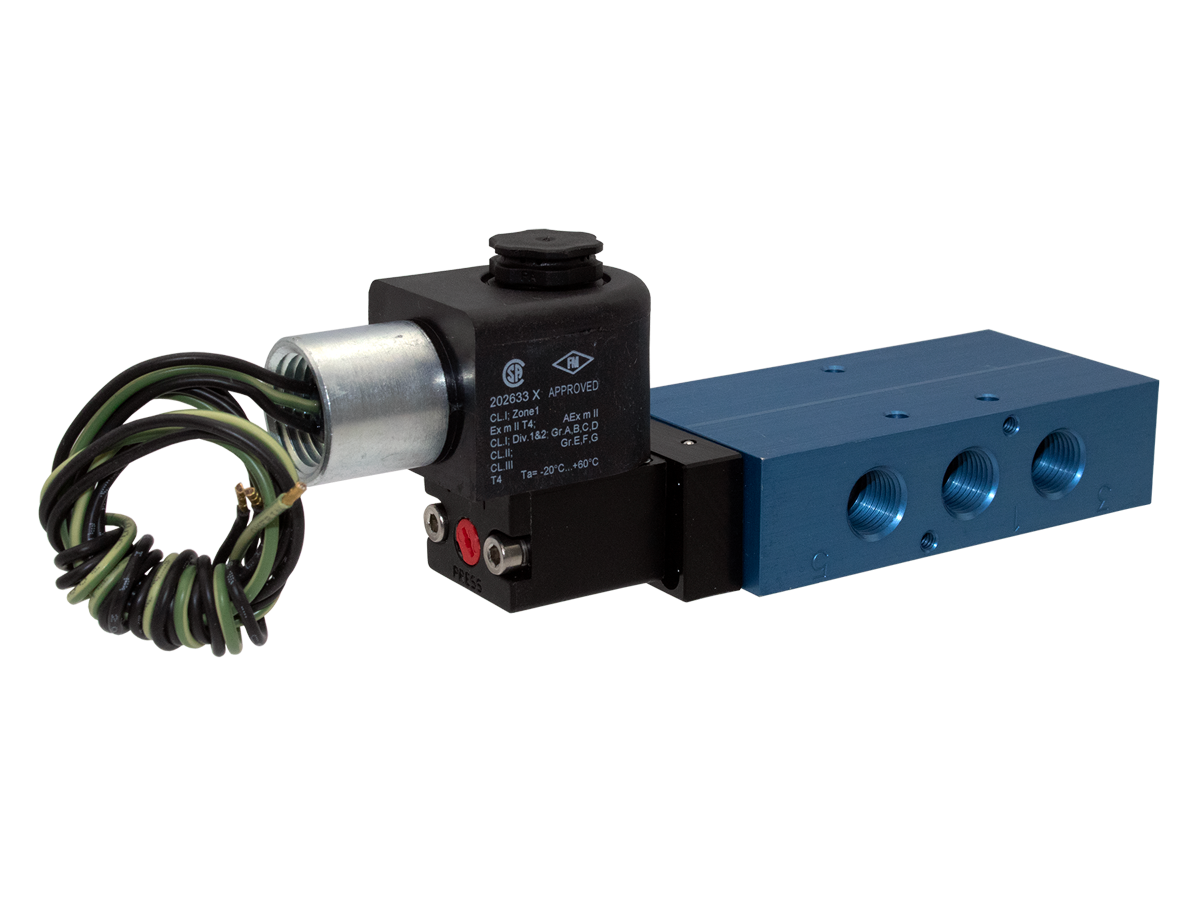
The Automatic Valve Compact L20 Series Solenoid Valves with CSA/FM certification are directional control spool valves purpose-built for pneumatic systems operating in classified hazardous locations. These valves combine the proven L20 compact spool platform with explosion-proof solenoid coils certified to CSA/FM (Class I Division 1, Groups A, B, C, D; Class II Groups E, F, G; Class III) and CSA/UL standards, making them the specified choice for oil and gas, chemical processing, petrochemical, and mining applications where ignition prevention is a code requirement.
The L20 series uses a balanced spool construction with Automatic Valve's proprietary Tapered Tee-Seal technology, which creates a bidirectional sealing interface that actively wipes contamination away from the spool bore. Unlike conventional O-ring seals that can spiral, extrude, or stick under cycling loads, the Tapered Tee-Seal is mechanically locked in position and flexes to clean the spool surface with every stroke. This design has been validated to 20 million cycles per SAE test specifications with rust and water injected every 864,000 cycles, demonstrating extreme durability in the harsh environments common to hazardous-location installations.
Valve functions include 5/2-way single solenoid spring return, 5/2-way double solenoid detented, 5/3-way double solenoid with closed center, open center, or pressure center configurations. Port sizes of 1/4 NPT and 3/8 NPT accommodate a broad range of cylinder and actuator connections. The solenoid pilot operates on full air line pressure (35 to 150 PSIG) for positive, reliable shifting at all rated operating pressures. The hermetically sealed coil assembly provides an integral watertight NEMA 4/4X enclosure, while the explosion-proof housing achieves NEMA 7C/7D/9 ratings required for classified area installations.
For OEM builders and plant engineers specifying pneumatic directional valves in hazardous environments, the CSA/FM L20 series delivers certified safety performance with the compact footprint, field-convertible external pilot supply, and inline or manifold mounting flexibility demanded in modern process and automation installations.
Key Engineering Features
- CSA/FM and CSA/UL Explosion-Proof Certification - Solenoid coils rated for Class I Division 1, Groups A, B, C, D; Class II Groups E, F, G; Class III Div. 1 T4 (Ta = -20 to +60 C). NEMA 4, 4X, 7C, 7D, 9 enclosure ratings for classified hazardous locations.
- Tapered Tee-Seal Technology - Bidirectional tapered Tee-Seal is mechanically locked, flexes to clean the spool, eliminates spiral twist and extrusion failure modes, and wipes air line sediment away from sealing surfaces. Validated to 20 million cycles with rust and water injection per SAE specifications.
- Balanced Spool Construction - Balanced spool design allows ports to be plugged for 2-way or 3-way function, or restricted for cylinder exhaust speed control without additional components, reducing BOM complexity for OEM applications.
- Solenoid Pilot on Full Air Line Pressure - Three-way pilot uses full air line pressure (35 to 150 PSIG / 240 to 1030 kPa) to shift the valve, ensuring positive actuation across the entire rated pressure range without reduced-pressure pilot instability.
- Hermetically Sealed Coil - Solenoid coil is hermetically sealed as an integral watertight molded unit with NEMA 4X ingress protection, guaranteed against burnout, and designed for continuous duty operation.
- Explosion-Proof Conduit Connection - 1/2-inch conduit coil with 24-inch leads provides a secure, code-compliant electrical connection for classified area wiring installations without exposed terminals or junction risks.
- Push Non-Locking Manual Override - Standard push non-locking override allows manual valve actuation for commissioning, troubleshooting, and functional verification without tools and without defeating the explosion-proof classification.
- Field-Convertible External Pilot Supply - Easily field convertible to external pilot supply for applications requiring vacuum-to-pressure operation or independent pilot and working pressure circuits.
- Inline and Manifold Mounting - Supports both inline pipe mounting and bottom manifold mounting, giving designers flexibility to consolidate multiple valves on a single manifold for simplified plumbing and compact installation.
- Compact and Lightweight Design - The L20 body measures 1.94 inches wide and 1.42 inches tall, with the complete 5/2 double solenoid assembly weighing 0.9 lb (0.5 kg), enabling installation in confined spaces common in process equipment and control panels.
Technical Specifications
General Specifications
| Parameter | Specification |
| Series | L20 (Compact Spool Valve) |
| Valve Type | Directional Control Spool Valve |
| Certification | CSA/FM Explosion-Proof; CSA/UL Certified |
| Valve Functions Available | 5/2-Way Single Solenoid (Spring Return); 5/2-Way Double Solenoid (Detented); 5/3-Way Double Solenoid (Closed Center, Open Center, Pressure Center) |
| Port Sizes | 1/4 NPT; 3/8 NPT |
| Port Thread Standard | NPT (G/BSPP available as option) |
| Construction | Balanced Spool with Tapered Tee-Seal |
| Flow Media | Filtered Air or Inert Gas (50 micron filtration or better) |
| Mounting | Inline; Manifold (Bottom Mount) |
| Body Material | Aluminum (303 and 316 Stainless Steel available as options) |
| Seal Material | Treated Buna-N (NBR) standard; Fluoroelastomer (FPM/FKM) available as Option A |
| Spool Material | Aluminum |
| Manual Override | Push Non-Locking (standard); Push Turn-Locking (Option 1); Extended Turn-Locking (Option 2); No Override (Option 4) |
| Pilot Supply | Internal (standard); External (Option B) |
| Duty Rating | Continuous Duty |
| Coil Enclosure | NEMA 4, 4X, 7C, 7D, 9 |
Temperature Ratings
Standard temperature configuration uses Treated Buna-N (NBR) seals. Fluoroelastomer (Option A) seals available for applications requiring chemical resistance. Temperature limits apply to both ambient and media conditions.
| Configuration | Ambient Temperature | Media Temperature |
| Standard (Buna-N seals, Standard Coil) | 20 to 123 F (-29 to 50 C) | 20 to 123 F (-29 to 50 C) |
| With Fluoroelastomer Seals (Option A) | 20 to 123 F (-29 to 50 C) | 20 to 123 F (-29 to 50 C) |
| High Temp Coil Option (CT) | 0 to 180 F (-18 to 82 C) | 0 to 180 F (-18 to 82 C) |
| CSA/FM Explosion-Proof Coil Rated (Ta) | 20 to 140 F (-29 to 60 C) | 20 to 123 F (-29 to 50 C) |
Important: For media temperatures below 40 F (4 C), compressed air supply must be dry to prevent ice formation inside the valve body and spool bore.
Electrical Data (Solenoid Pilot Valves)
CSA/FM explosion-proof coils are rated for continuous duty. The 1/2-inch conduit coil with 24-inch leads is standard for the explosion-proof configuration. All coils are hermetically sealed. Consult factory for additional voltage options.
| Voltage | Power Consumption |
| 12 VDC | 4.8 W (inrush); 3.5 W (holding) |
| 24 VDC | 4.8 W (inrush); 3.5 W (holding) |
| 120 VAC, 60 Hz | 6.9 VA (inrush); 3.4 VA (holding) |
| 240 VAC, 60 Hz | 6.4 VA (inrush); 3.3 VA (holding) |
| 24 VDC (Low Watt Option L) | 2.5 W |
| 24 VDC (Lowest Watt Option LL) | 0.7 W |
Electrical Connection Options
| Connection Type | Coil Code |
| Explosion-Proof 1/2" Conduit with 24" Leads (CSA/FM, NEMA 7/9) | Y (Option) |
| DIN 43650 Form B (Weather-Proof, NEMA 4X) | W (Standard Solenoid) |
| 18" Flying Leads (Weather-Proof, NEMA 4X, Option G) | G |
| 1/2" Conduit with 30" Leads (Weather-Proof, Option C) | C |
| 1/2" Conduit High Temp Coil with 30" Leads (Option CT) | CT |
Flow Performance Data
Flow performance data for L20 Series solenoid-operated directional control valves. 5/3-way functions have reduced flow due to center position flow path configuration.
| Series | Port Size | Flow 5/2 (Cv) | Flow 5/2 (Nl/min) | Flow 5/3 (Cv) | Flow 5/3 (Nl/min) | Weight |
| L07 | 1/8 NPT | 0.7 | 690 | 0.5 | 538 | 0.6 lb (0.27 kg) |
| L20 | 1/4 NPT | 1.8 | 1770 | 1.4 | 1381 | 0.9 lb (0.5 kg) |
| L20 | 3/8 NPT | 1.8 | 1770 | 1.4 | 1381 | 0.9 lb (0.5 kg) |
| L65 | 3/4 NPT | 9.0 | 8860 | 7.0 | 6911 | 3.5 lb (1.6 kg) |
| L65 | 1 NPT | 9.5 | 9350 | 7.4 | 7293 | 3.5 lb (1.6 kg) |
Response Time Formula: Operating pressure for standard 2-position valves: 35 to 150 PSIG (240 to 1030 kPa) at inlet port. 3-position valves require 50 to 150 PSIG (345 to 1030 kPa). External pilot option (B) extends inlet range to vacuum-35 PSIG with external pilot at 35 to 150 PSIG.
Certifications & Compliance
| Certification/Standard | Detail |
| CSA/FM Explosion-Proof | Class I Division 1 Groups A, B, C, D; Class II Groups E, F, G; Class III Div. 1; Temperature code T4 (Ta = -20 to +60 C). Certified for use in explosive gas and dust atmospheres. |
| CSA/UL Certification | CSA C22.2 and UL Standard 429 listing for solenoid valves. Dual-agency listing satisfies both Canadian and US national electrical code requirements. |
| NEMA Enclosure Ratings | NEMA 4, 4X (weather-proof, corrosion-resistant); NEMA 7C, 7D (explosion-proof for Class I locations); NEMA 9 (dust-ignitionproof for Class II locations). |
| CE Marking | CE conformity per EMF and Low Voltage Directives for export to European Union markets. |
| SAE Durability Testing | Rust and water injected every 864,000 cycles for 20 million total cycles per SAE test specifications, validating long-term reliability in contaminated environments. |
| Continuous Duty Rating | All explosion-proof coils are rated for 100% continuous energized duty at rated voltage and temperature. |
Typical Applications & Industries
Oil and Gas Production and Refining
- Wellhead and Christmas tree pneumatic actuator control in Class I Division 1 areas where flammable hydrocarbon vapors are continuously present.
- Separator vessel level control using pneumatic cylinders and actuators in gas processing plants where methane, propane, and other Group D hydrocarbons create classified atmospheres.
- Pipeline station control valves, emergency shutdown systems (ESD), and blowdown valve actuation in compressor stations and gas treating facilities.
- Refinery process unit valve sequencing for distillation columns, hydrotreaters, and fluid catalytic cracking units where explosion-proof classification is mandatory under API and OSHA requirements.
Chemical and Petrochemical Processing
- Batch reactor feed valve sequencing in chemical plants handling flammable solvents, where Class I Division 1 rated pneumatic controls are required by NFPA 70 (NEC) Article 501.
- Pump control and tank filling in bulk solvent storage terminals with classified area designations extending across loading and unloading platforms.
- Ethylene and polyethylene production facility automation where Groups A, B, and C flammable gas classifications mandate explosion-proof electrical equipment.
- Specialty chemical manufacturing for valve sequencing in areas handling chlorinated solvents, alcohols, and other Group C and D flammable materials.
Mining and Mineral Processing
- Coal mine pneumatic machinery controls in underground gassy mines where methane (Group D) classifications require explosion-proof rated components per MSHA regulations.
- Ore crushing and conveyor system pneumatic controls in surface mines with coal dust (Class II Group F) classified areas requiring NEMA 9-rated enclosures.
- Grain elevator and agricultural storage pneumatic controls in dust-classified locations (Class II Group G) for grain auger, diverter gate, and conveyor automation.
- Potash, trona, and other mineral processing where airborne dust concentrations create Class II classified environments requiring dust-ignitionproof enclosures.
Pharmaceutical and Bioprocessing
- Solvent extraction and purification process pneumatic valve controls in pharmaceutical manufacturing areas classified due to alcohol, ether, and ketone solvent handling.
- API (active pharmaceutical ingredient) synthesis reactor control in facilities where flammable solvent concentrations create Class I Division 1 conditions.
- CIP (clean-in-place) and SIP (sterilize-in-place) valve sequencing in bioprocessing suites handling flammable cleaning agents in classified utility areas.
Paint and Surface Finishing
- Automotive paint booth pneumatic actuator controls in spray booth areas classified Class I Division 1 due to continuous solvent vapor concentrations from lacquers, enamels, and basecoat/clearcoat materials.
- Industrial painting and powder coating conveyor system controls in areas where volatile organic compound (VOC) concentrations require explosion-proof rated components.
- Adhesive and sealant dispensing automation in assembly plants where flammable adhesive vapors create classified environments around mixing and application equipment.
Wastewater Treatment and Utilities
- Digester gas (biogas/methane) handling area pneumatic valve controls in wastewater treatment facilities where methane is classified as a Group D hazard.
- Pump station pneumatic controls in wet well areas where methane accumulation from decomposing organics creates Class I Division 1 classified spaces.
- Gas distribution and metering station pneumatic actuator controls for regulator bypass valves, pressure relief isolation, and emergency shutdown systems.
Ordering and Model Number Configuration
Automatic Valve L Series compact spool valves use a structured model number system. The example below shows the model number structure for an L20 Series 5/2-way single solenoid, 1/4 NPT, explosion-proof CSA/FM valve.
|
Model Number Example: L2003AAWR-DBY
L20 Series (L07=1/8-1/4 port; L20=1/4-3/8 port; L65=3/4-1 port)
0 Body Type (0 = Inline / Manifold)
3 Port Size (2=1/8", 3=1/4", 4=3/8", 6=3/4", 7=1")
A Function (A=5/2 single 2-pos; B=5/2 double 2-pos; C=5/3 block center; D=5/3 exhaust center; E=5/3 pressure center)
A Body Design (A=Single; B=Double body)
W Operator 1 (W=Weather-Proof Solenoid; V=Intrinsically-Safe; A=Air Pilot; F=Hand Lever; I=Palm Button; K=Foot Pedal; L=Lockout)
R Operator 2 (R=Spring Return; M=Detented; V=Center Operator)
DB Voltage Code (DA=12VDC or 24VAC; DB=24VDC; AA=120VAC/60Hz; AB=240VAC/60Hz)
Y Option Code (Y=Explosion-Proof CSA/FM; Z=Explosion-Proof ATEX; B=External Pilot; A=Fluoroelastomer Seals; C=Conduit Coil; CT=Conduit High Temp; G=18" Leads; L=Low Watt; LL=Lowest Watt; W=G/BSPP Threads; 1=Turn-Locking Override; 4=No Override) |
Explosion-proof CSA/FM coils (Option Y) are supplied with 1/2-inch conduit and 24-inch leads as standard. This coil configuration is rated NEMA 4, 4X, 7C, 7D, 9.
The intrinsically-safe version (Option V coil) operates on 24 VDC only and requires the A7106-374 Intrinsic Safety Barrier, which is not included in the valve package.
For G (BSPP) metric thread connections, add Option W to the model number. All other specifications remain unchanged.
Low-watt coil Option L (2.5 W) and lowest-watt Option LL (0.7 W, 24 VDC only with Type 2 override) are available for applications with power budget constraints. Consult factory for availability with explosion-proof coil.
External pilot supply Option B extends the inlet pressure range to vacuum-to-35 PSIG with pilot supplied at 35 to 150 PSIG, enabling use in vacuum circuits or low-pressure applications.
Fluoroelastomer (FPM/FKM) seal Option A provides enhanced chemical resistance while maintaining the standard temperature range. Required for applications involving petroleum-based media or aggressive fluids.
Voltage Code Reference
| Voltage Code | Voltage | Power (W/VA) |
| DA | 12 VDC | 4.8 W DC |
| DB | 24 VDC | 4.8 W DC |
| AA | 120 VAC, 50/60 Hz | 6.9 VA AC |
| AB | 240 VAC, 50/60 Hz | 6.4 VA AC |
| AB | 125 VDC | 5.9 W DC |
Key Model Number Examples - CSA/FM Explosion-Proof
| Model Number | Description |
| L2003AAWR-DBY | L20, 1/4 NPT, 5/2 Single Solenoid, Spring Return, 24 VDC, Explosion-Proof CSA/FM |
| L2003ABWW-DBY | L20, 1/4 NPT, 5/2 Double Solenoid, Detented, 24 VDC, Explosion-Proof CSA/FM |
| L2004AAWR-DBY | L20, 3/8 NPT, 5/2 Single Solenoid, Spring Return, 24 VDC, Explosion-Proof CSA/FM |
| L2003AAWR-AAY | L20, 1/4 NPT, 5/2 Single Solenoid, Spring Return, 120 VAC/60 Hz, Explosion-Proof CSA/FM |
| L2003CBWDW-DBY | L20, 1/4 NPT, 5/3 Closed Center, Double Solenoid, 24 VDC, Explosion-Proof CSA/FM |
Accessories
Manifolds for L20 Series
Aluminum manifolds for L20 series provide common inlet and common exhaust ports with top cylinder ports. Valve mounting screws attach from the bottom. Available in 2 through 10 station configurations. Seals and mounting hardware are included.
| Series | Stations | Model Number | Port Size |
| L20 | 2 | A8020-002 | 3/8 |
| L20 | 4 | A8020-004 | 3/8 |
Electrical Connectors - DIN 43650 Form B
Automatic Valve offers DIN 43650 Form B connectors for use with weather-proof solenoid coils. Options include strain relief without cord, strain relief with indicator light, 1/2-inch conduit entry, and molded 6-foot cord assemblies. Maximum cable diameter 9 mm (0.35 inch).
| Connector Model | Type | Voltage Range |
| 7020-001 | Strain Relief, No Cord | 100-240 VAC / 48-120 VDC |
| 7020-AA | Strain Relief with Indicator Light | 6-48 VAC/VDC |
| 7020-DB | 1/2" Conduit, No Cord | 100-240 VAC / 48-120 VDC |
| 7039-001 | Molded with 6-ft Cord | 100-240 VAC / 48-120 VDC |
Intrinsic Safety Barrier
The A7106-374 Intrinsic Safety Barrier is required when ordering the intrinsically-safe solenoid coil variant (Option V, 24 VDC only). The barrier must be installed in the safe area (non-classified zone) and is not included with the valve. Contact Automatic Valve for barrier selection and installation guidance.
Warning: The intrinsically-safe coil (Option V) operates at 24 VDC only and must be used in conjunction with the A7106-374 Intrinsic Safety Barrier. Do not energize intrinsically-safe coils without the properly rated barrier in the circuit.
Related Products & Accessories
- Compact L Series - ATEX Explosion-Proof, Standard Temperature - L20 Series compact spool valves with ATEX-certified explosion-proof solenoid coils for IECEx/ATEX Zone 1 and Zone 21 hazardous locations in European and international markets. https://www.automaticvalve.com/series/2982-compact-solenoid-l-series-valves-atex-standard-temperature-applications
- Compact L Series - Intrinsically Safe, Standard Temperature - L20 Series compact spool valves with intrinsically-safe solenoid coils (Ex ia) for Class I Division 1 applications where intrinsic safety is preferred over explosion-proof design. https://www.automaticvalve.com/series/2984-compact-solenoid-l-series-valves-intrinsically-safe-standard-temperature-applications
- Compact L Series - Intrinsically Safe, Low Temperature - L20 Series compact spool valves with intrinsically-safe coils for low-temperature hazardous location applications down to -40 F (-40 C). https://www.automaticvalve.com/series/2994-compact-solenoid-l-series-valves-intrinsically-safe-low-temperature-applications
- Compact L Series - Standard Temperature (Non-Hazardous) - L20 Series compact spool valves with weather-proof solenoid coils for general automation and non-classified industrial environments. https://www.automaticvalve.com/series/2979-compact-solenoid-l-series-valves-standard-temperature-applications
- L Series Manifolds - Multi-station aluminum manifolds for L07 and L20 series compact spool valves with common inlet/exhaust ports and top cylinder connections. https://www.automaticvalve.com
- Automatic Valve L Series Catalog - Complete catalog covering all L series compact spool valves including standard, explosion-proof, intrinsically safe, air pilot, manual/mechanical, and manifold configurations with full dimensional and electrical data. https://www.automaticvalve.com/documents
Frequently Asked Questions (FAQ)
Q: What does CSA/FM certification mean for this solenoid valve?
A: CSA/FM certification means the explosion-proof coil has been independently tested and listed by Canadian Standards Association (CSA) and Factory Mutual (FM) for use in classified hazardous locations. Specifically, these coils are rated for Class I Division 1 (flammable gas/vapor), Groups A, B, C, and D; Class II Division 1 (combustible dust), Groups E, F, and G; and Class III (ignitable fibers). The coil housing achieves NEMA 4, 4X, 7C, 7D, and 9 enclosure ratings. This dual listing satisfies NEC (NFPA 70) and CEC requirements for classified area equipment in the United States and Canada.
Q: What is the difference between explosion-proof and intrinsically safe protection methods?
A: Explosion-proof (Ex d) design contains any internal ignition within a robust enclosure that withstands the explosion pressure and prevents flame propagation to the surrounding atmosphere. The CSA/FM coil on this valve uses explosion-proof construction. Intrinsically safe (Ex ia) design limits the electrical energy in the circuit to levels too low to ignite a flammable atmosphere, using a Zener barrier or galvanic isolator in the safe area. Both methods are acceptable for Class I Division 1, but intrinsically safe requires an external barrier and is limited to low-power circuits, while explosion-proof handles standard power levels without a barrier.
Q: What hazardous gas groups are covered by the CSA/FM certification?
A: The explosion-proof CSA/FM coil covers Groups A (acetylene), B (hydrogen and equivalent gases), C (ethylene, cyclopropane, and similar), and D (propane, methane, gasoline, butane, and most common hydrocarbons). This comprehensive group coverage means a single part number satisfies the electrical area classification requirements for the majority of oil and gas, chemical, and hydrocarbon-handling applications.
Q: Can this valve be used in dust-classified areas (Class II locations)?
A: Yes. The CSA/FM explosion-proof coil is rated for Class II Division 1, Groups E (metal dusts), F (carbonaceous dusts including coal and coke), and G (grain dusts, flour, starch, and similar agricultural dusts), as well as Class III (ignitable fibers and flyings). The NEMA 9 rating covers dust-ignitionproof requirements for Class II environments.
Q: What operating pressure range does the valve support?
A: For standard 2-position configurations (5/2-way), the operating pressure at the inlet port is 35 to 150 PSIG (240 to 1030 kPa). For 3-position configurations (5/3-way), the minimum pressure increases to 50 PSIG (345 kPa) due to the spring forces required to maintain the center position. When the external pilot supply option (B) is specified, the inlet pressure can range from vacuum to 35 PSIG while the external pilot supply operates at 35 to 150 PSIG.
Q: What is the Cv rating and flow capacity?
A: The L20 Series with 1/4 and 3/8 NPT ports provides a Cv of 1.8 (1770 Nl/min) for 5/2-way configurations and Cv 1.4 (1381 Nl/min) for 5/3-way configurations. The smaller L07 Series (1/8 NPT) delivers Cv 0.7 (690 Nl/min) for 5/2 and Cv 0.5 (538 Nl/min) for 5/3. The larger L65 Series (3/4 and 1 NPT) achieves Cv up to 9.5 (9350 Nl/min) for 5/2 configurations.
Q: What electrical connection is provided on the explosion-proof version?
A: The CSA/FM explosion-proof coil (Option Y) is supplied with a 1/2-inch conduit fitting and 24-inch wire leads for field connection to classified area conduit wiring. This connection method is standard for explosion-proof equipment and complies with NEC Article 501 conduit sealing requirements. The weather-proof DIN 43650 Form B connector (standard W coil) is not rated for explosion-proof areas and should not be substituted.
Q: Can the valve be converted from internal to external pilot supply in the field?
A: Yes. The L20 series is easily field convertible to external pilot supply. On standard units, the external pilot port is plugged. Removing the plug and installing the external pilot supply line converts the valve to Option B operation, allowing inlet pressure below 35 PSIG or vacuum while supplying pilot pressure separately. Contact Automatic Valve for updated model number documentation if field conversion is performed.
Q: What filtration level is required for the air supply?
A: Filtered air at 50 microns or better is recommended. For applications with heavy contamination, a 40-micron coalescing filter upstream of the valve is preferred. The Tapered Tee-Seal technology provides additional contamination tolerance beyond conventional O-ring designs, but proper filtration remains essential for achieving full service life in high-cycle applications.
Q: Is lubrication required for the air supply?
A: Lubrication is not required but is compatible with the valve if used in systems that already supply lubricated air. Use only petroleum-based lubricants with an aniline point between 82 C (180 F) and 99 C (210 F), ISO 32 viscosity or lighter. Avoid phosphate-ester type additives, which degrade Buna-N and Fluoroelastomer seals. Once lubricated air has been used in a valve, the system should continue to supply lubricated air, as the seals condition to lubricated operation.
Q: What stainless steel body options are available?
A: The L20 series is available with 303 stainless steel or 316 stainless steel bodies as options for applications requiring corrosion resistance beyond the standard aluminum body, such as washdown environments, coastal facilities, or chemical exposure. Stainless steel bodies are not available for the L07 or L65 series. Contact Automatic Valve for model number suffix and pricing.
Q: What is the service life expectancy of the valve?
A: The L20 series has been validated to 20 million cycles per SAE test protocol with rust and water injection every 864,000 cycles. In clean, properly filtered compressed air service, service life can substantially exceed this validated minimum. The Tapered Tee-Seal's self-wiping action and mechanical locking reduce wear-induced seal degradation, extending time between maintenance intervals compared to conventional O-ring spool seals.
Q: How does the balanced spool allow 2-way or 3-way operation?
A: The balanced spool design allows unused ports to be plugged using NPT plug fittings without affecting valve operation. Plugging Port 3 (exhaust) on one side converts the valve to 3-way function. Plugging additional ports creates a 2-way normally-open or normally-closed configuration. Port restrictions can also be installed in exhaust ports to provide inexpensive cylinder speed control without separate flow control valves. This flexibility reduces SKU count for OEM applications with multiple circuit requirements.
Installation & Maintenance Guidelines
- Install the valve with the solenoid coil oriented to prevent moisture accumulation in the conduit entry. In outdoor or wash-down environments, face the conduit entry downward or use a drain fitting to prevent water ingress.
- Seal the conduit entry with an approved explosion-proof sealing fitting (conduit seal) within 18 inches of the valve enclosure per NEC Article 501.15. Conduit seals are mandatory for Class I Division 1 installations and prevent flame propagation through the conduit system.
- Supply filtered air at 50 microns or finer upstream of the valve. Install a lockout/tagout-capable shutoff valve upstream for maintenance isolation.
- Operating pressure must be maintained between 35 and 150 PSIG (240 to 1030 kPa) at the inlet port for 2-position valve functions. 3-position functions require a minimum of 50 PSIG (345 kPa).
- For external pilot supply (Option B), the pilot supply must be maintained at 35 to 150 PSIG independent of the inlet pressure. The inlet can operate at vacuum to 35 PSIG with external pilot.
- Verify that compressed air supply is dry (dew point below minimum operating temperature) for installations where ambient temperatures may fall below 40 F (4 C) to prevent ice formation in the spool bore.
- Mount the valve in any orientation. Inline mounting with solenoid vertical is preferred for condensate drainage and to prevent condensate accumulation in the solenoid housing.
- Do not exceed 150 PSIG (10.3 bar) at any port. Overpressure can damage the spool assembly and compromise the explosion-proof coil housing integrity.
- Use only petroleum-based lubricants with aniline point between 82 C and 99 C (180 F and 210 F) at approximately ISO 32 viscosity if lubricated air is used. Avoid phosphate-ester additives.
- Verify area classification and applicable hazardous location code (NEC, CEC, IEC) before installation. The CSA/FM coil is rated for North American Class/Division/Group classifications. ATEX-certified coils (Option Z) are required for IEC Zone-classified areas.
Warranty & Global Support
Automatic Valve provides a standard warranty covering defects in material and workmanship. Contact Automatic Valve directly for warranty terms and conditions applicable to hazardous location products.
Technical support is available through Automatic Valve's engineering team for application assistance, area classification questions, replacement part identification, and field service support. Contact: (248) 474-6761.
Automatic Valve is a ROSS Controls company. Replacement coils, seal kits, and manifold accessories are stocked and available for prompt shipment. Reference the model number on the valve body nameplate when ordering replacement parts.
For complete dimensional drawings, CAD models, and product certifications, visit automaticvalve.com or contact Automatic Valve at (248) 474-6761. Individual product data sheets are available on product catalog pages.
Product Catalog - L Series Hazardous Location Valves: https://www.automaticvalve.com/documents/6535/Hazardous_Locations_Valves_L_Series_AV-DCHL_L_EN.pdf
Service Instructions - Compact Inline Spool Valves: https://www.automaticvalve.com/documents/405/Compact_Inline_Valves_Service_Information_Form_AV-Compact-IL_OI.pdf
Download Documents
Compact Solenoid L Series Valves - CSA/FM, Standard Temperature Applications