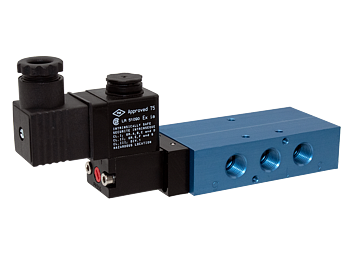




Compact Solenoid L Series Valves - Intrinsically Safe, Low Temperature Applications -40 to 123 F (-40 to 50 C)
 Operating Instructions - Bottom Mount Valves
Operating Instructions - Top Mount Valves
Product Catalog - Explosion-Proof & Intrinsically Safe Compact L Series
Operating Instructions - Bottom Mount Valves
Operating Instructions - Top Mount Valves
Product Catalog - Explosion-Proof & Intrinsically Safe Compact L Series
- Compact Design - Balanced spool construction
- Solenoid Pilot - Pilot uses full air line pressure to shift the valve, Solenoid guaranteed against burnout
- Solenoid Coils - Intrinsically Safe
- Tapered Tee-Seal - Bidirectional tapered Tee-Seal eliminates sticking problems
- Tested Tough - proven reliable according to SAE specifications: rust & water injected every 864,000 cycles for 20-million cycle
- Manual Override - Allows the solenoid valve to be used manually in case of electrical failure, or for quick cycle testing
- External Pilot Supply - Easily field convertible to external pilot supply
Valves
The AV inline L20 series valves are directional control spool valves, designed for a wide range of fluid control applications, providing users with a space-saving and lightweight design. With both inline or manifold mount, the L20 series provide flexible options for mounting. The balanced spool construction allows ports to be plugged for 2 way or 3 way function, or restricted for inexpensive cylinder exhaust speed control. A wide variety of options and operators available.
Tapered Tee-Seal ........ Eats Dirt
Bidirectional tapered Tee-Seal eliminates sticking problems.
- Flexes to clean spool
- Mechanically Locked
- No Spiral Twist
- No Extrusion
- Air Line Sediment is Wiped Away
- Tested tough and proven reliable according to SAE specifications: Rust and water injected every 864,000 cycles for 20 million cycles.
Solenoid ... Guaranteed Against Burnout
Three-way pilot uses full air line pressure to shift the valve. The pilot is internally supplied when the pressure at port one is 35 to 150 PSIG (240 to 1030 kPa). The coil is hermetically sealed as an integral watertight molded unit. Intrinsically-safe and explosion-proof versions available. Push Non-Locking Override is standard. (Extended Turn and Turn-Locking available).
Unable to load products. Please try again.
loading...
loading...
Product Overview
The Automatic Valve Compact L20 Series Solenoid Valves with Intrinsically Safe Low Temperature configuration are directional control spool valves engineered for pneumatic systems that must operate reliably in classified hazardous locations where ambient temperatures fall as low as -40 F (-40 C). This combination of intrinsic safety protection and low-temperature ratings addresses a demanding application set found in arctic oil and gas production, LNG terminals, cold storage facilities in classified areas, and outdoor industrial installations in northern climates.
The intrinsically-safe coil (Ex ia) limits circuit energy in the hazardous area to levels that cannot ignite a flammable atmosphere under normal or fault conditions, including wire breaks and short circuits. Operating at 24 VDC and 1.6 watts, the IS coil is compatible with standard IS barriers, DCS IS output modules, and SCADA RTU IS interfaces. The A7106-374 IS Barrier must be installed in the safe area. The A7106-374-DB coil and connector assembly is included with the valve.
The L20 series balanced spool construction uses Automatic Valve's Tapered Tee-Seal, a bidirectional sealing element that is mechanically locked to prevent spiral twist and extrusion. The Tee-Seal flexes to clean the spool surface with every stroke and wipes contamination from the sealing interface, maintaining reliable operation even after extended idle periods in cold environments where conventional O-ring seals can harden and stick. The valve has been validated to 20 million cycles per SAE test specifications with rust and water injection every 864,000 cycles.
The low-temperature rating extends the standard -20 F lower limit to -40 F (-40 C) in both ambient and media conditions, enabling installation in freezer rooms, cold chain facilities, outdoor arctic valve stations, and any classified location where the standard temperature range does not cover the minimum design temperature. The broader -40 to 123 F (-40 to 50 C) operating range covers virtually all terrestrial temperature extremes encountered in industrial applications, from subarctic outdoor installations to temperate indoor classified environments.
Key Engineering Features
- Intrinsically Safe (Ex ia) Certification - Solenoid coil certified Ex ia Class I Groups A, B, C, D; Class II Groups E, F, G; Class III Div. 1, Temperature Class T5. IS protection limits field circuit energy to non-ignition levels under normal operation and fault conditions.
- Extended Low-Temperature Rating to -40 F (-40 C) - Rated for ambient and media temperatures from -40 to 123 F (-40 to 50 C), extending 20 F below the standard IS model's -20 F limit. Covers arctic outdoor installations, cold storage classified areas, LNG facility periphery, and northern climate pipeline stations.
- Ultra-Low Power - 1.6 Watts at 24 VDC - The IS coil draws 1.6 watts, enabling reliable operation on solar, battery, or limited-capacity UPS power systems common in remote arctic and cold-climate installations where commercial power may be unreliable or unavailable.
- Tapered Tee-Seal for Cold-Temperature Reliability - The Tapered Tee-Seal's mechanical locking and flexing action prevents sticking and extrusion that affect conventional O-ring spool seals at low temperatures, ensuring positive shifting even after extended idle periods in cold environments where elastomers harden.
- No-Stick Operation After Extended Cold Idle - Balanced spool construction with Tapered Tee-Seal provides reliable actuation after prolonged cold idle periods, critical for emergency shutdown valves, safety relief isolation, and infrequently cycled process valves in cold-climate classified locations.
- Coil and Connector Assembly Included - The A7106-374-DB intrinsically-safe coil and connector assembly is included with the valve, eliminating a separate ordering step.
- IS Barrier Required in Safe Area - The A7106-374 Intrinsic Safety Barrier must be installed in the safe area (non-classified zone). The barrier limits energy in the hazardous area circuit to certified IS levels under all fault conditions.
- Balanced Spool with Port Flexibility - Balanced spool design allows ports to be plugged for 2-way or 3-way function and restricting exhaust ports for cylinder speed control, reducing SKU requirements for multi-function installations.
- Push Non-Locking Manual Override - Standard push non-locking override enables manual valve actuation for commissioning and testing in cold environments without electrical energy input to the classified area.
- Inline and Manifold Mounting - Supports both inline pipe mounting and bottom manifold mounting, compatible with all L20 Series manifold accessories.
Technical Specifications
General Specifications
| Parameter | Specification |
| Series | L20 (Compact Spool Valve) |
| Valve Type | Directional Control Spool Valve |
| Application | Intrinsically Safe - Low Temperature Hazardous Locations |
| IS Classification | Ex ia Class I Groups A, B, C, D; Class II Groups E, F, G; Class III Div. 1, T5 |
| Valve Functions Available | 5/2-Way Single Solenoid (Spring Return); 5/2-Way Double Solenoid (Detented); 5/3-Way Double Solenoid (Closed Center, Open Center, Pressure Center) |
| Port Sizes | 1/4 NPT; 3/8 NPT (G/BSPP available as Option W) |
| Port Thread Standard | NPT standard; G (BSPP) available as option |
| Construction | Balanced Spool with Tapered Tee-Seal |
| Flow Media | Filtered Air or Inert Gas (50 micron filtration or better) |
| Mounting | Inline; Manifold (Bottom Mount) |
| Body Material | Aluminum |
| Seal Material | Treated Buna-N (NBR) - low-temperature formulation |
| Spool Material | Aluminum |
| Manual Override | Push Non-Locking (standard); Push Turn-Locking (Option 1); Extended Turn-Locking (Option 2); No Override (Option 4) |
| Pilot Supply | Internal (standard); External (Option B) |
| IS Barrier Required | A7106-374 Intrinsic Safety Barrier (not included, must be ordered separately) |
| Duty Rating | Continuous Duty |
| Voltage | 24 VDC only |
Temperature Ratings
The low-temperature rating of -40 F (-40 C) is the primary differentiator from the standard IS series (2984), which is rated to -20 F (-29 C). The Buna-N (NBR) seal used in this configuration is a low-temperature formulation maintaining flexibility and sealing at the rated minimum temperature. Fluoroelastomer (FPM/FKM) seals are not recommended for this low-temperature configuration as FKM becomes brittle below -4 F (-20 C).
| Configuration | Ambient Temperature | Media Temperature |
| Standard Low-Temperature (Buna-N seals) | 40 to 123 F (-40 to 50 C) | 40 to 123 F (-40 to 50 C) |
| Standard IS Series (2984) for Reference | 20 to 123 F (-29 to 50 C) | 20 to 123 F (-29 to 50 C) |
| IS Coil Temperature Class (T5) | Max surface 100 C (212 F) | Not to exceed ambient limit |
| Compressed Air Dew Point Requirement | Below minimum operating temperature | Dry air required below 40 F (4 C) |
Important: Compressed air must be free of water vapor (dew point below minimum operating temperature) at all media temperatures below 40 F (4 C). Ice formation inside the valve body can prevent spool shifting and cause valve failure in cold-climate applications. A refrigerated air dryer or desiccant dryer is required upstream of cold-service valves.
Electrical Data (Solenoid Pilot Valves)
The intrinsically-safe coil operates at 24 VDC only and draws 1.6 watts in holding. The A7106-374-DB coil and connector assembly is included with the valve. The A7106-374 IS Barrier is a mandatory safe-area component not included in the valve package. The low-power IS circuit is compatible with solar and battery-backed power systems used in remote arctic installations.
| Voltage | Power Consumption |
| 24 VDC (only) | 1.6 W (holding, IS coil) |
| Note: No AC voltage options available for IS coil | IS protection requires 24 VDC only |
| Standard Coil Reference (non-IS, 24 VDC) | 4.8 W (standard coil - reference only) |
Electrical Connection Options
| Connection Type | Coil Code |
| Intrinsically-Safe Coil and Connector Assembly A7106-374-DB (included) | V (Operator Code) |
| IS Barrier A7106-374 (required in safe area, not included) | External Component |
| Field Wiring: IS-rated cable (blue sheathed per IEC 60446) | Field Supplied |
Flow Performance Data
Flow performance is identical to the standard IS series; the low-temperature rating affects seal material selection but not the hydraulic flow path geometry. Data below is for solenoid-operated configurations.
| Series | Port Size | Flow 5/2 (Cv) | Flow 5/2 (Nl/min) | Flow 5/3 (Cv) | Flow 5/3 (Nl/min) | Weight (valve only) |
| L07 | 1/8 NPT | 0.7 | 690 | 0.5 | 538 | 0.6 lb (0.27 kg) |
| L20 | 1/4 NPT | 1.8 | 1770 | 1.4 | 1381 | 0.9 lb (0.5 kg) |
| L20 | 3/8 NPT | 1.8 | 1770 | 1.4 | 1381 | 0.9 lb (0.5 kg) |
| L65 | 3/4 NPT | 9.0 | 8860 | 7.0 | 6911 | 3.5 lb (1.6 kg) |
| L65 | 1 NPT | 9.5 | 9350 | 7.4 | 7293 | 3.5 lb (1.6 kg) |
Response Time Formula: Operating pressure for standard 2-position valves: 35 to 150 PSIG (240 to 1030 kPa) at inlet port. 3-position valves require 50 to 150 PSIG (345 to 1030 kPa). External pilot option (B) extends inlet range to vacuum-to-35 PSIG with external pilot at 35 to 150 PSIG.
Certifications & Compliance
| Certification/Standard | Detail |
| Intrinsically Safe (Ex ia) | Ex ia Class I Division 1 Groups A, B, C, D; Class II Division 1 Groups E, F, G; Class III Div. 1. Temperature Class T5 (maximum surface temperature 100 C / 212 F). Coil assembly: A7106-374-DB. |
| IS Protection Level | Ex ia (intrinsically safe, level 'a') is the highest IS protection level, certified safe under two simultaneous faults in addition to normal operation, exceeding the Ex ib (one fault) protection level. |
| Required IS Barrier | A7106-374 IS Barrier must be installed in the safe area. The barrier limits available field circuit energy through Zener diodes and series resistance to levels certified below ignition thresholds for all covered hazardous gas and dust groups. |
| Low-Temperature Seal Validation | Buna-N (NBR) seal material in low-temperature formulation maintains elasticity and sealing integrity down to -40 F (-40 C), preventing brittleness cracking and seal-induced leakage at the rated minimum temperature. |
| SAE Durability Testing | 20 million cycle test with rust and water injection every 864,000 cycles per SAE protocol, confirming mechanical reliability in the contaminated and wet environments common to cold-climate industrial installations. |
| Continuous Duty Rating | The IS coil is rated for 100% continuous energized duty at 24 VDC and 1.6 watts, with no derating at low ambient temperatures. |
Typical Applications & Industries
Arctic and Cold-Climate Oil and Gas Production
- Wellhead pneumatic actuator controls in subarctic and arctic oil fields (Alaska North Slope, Siberia, northern Canada) where ambient temperatures routinely reach -40 F (-40 C) and classified hazardous areas require IS protection for hydrocarbon gas environments.
- Gas processing and dehydration plant pneumatic valve automation in arctic operations where the combination of methane group classification (Class I Group D) and extreme cold requires both IS certification and a -40 F rated valve.
- Pipeline integrity management valve controls and remote automated valve (RAV) stations in cold-climate pipeline systems where solar or battery-powered SCADA systems prefer low-power IS field devices over higher-power explosion-proof alternatives.
- Natural gas liquids (NGL) extraction facility pneumatic directional valve controls in outdoor northern installations where winter temperatures below -20 F exceed the standard IS model's lower limit.
LNG and Cryogenic Process Facilities
- LNG terminal pneumatic valve controls in classified areas adjacent to cryogenic storage tanks and loading arms, where ambient temperatures can be depressed by cold weather and cryogenic flash events in the surrounding area.
- LNG peak shaving facility pneumatic actuator controls in classified zones around vaporizers and storage areas, where IS protection integrates with the low-voltage, low-power field device architecture common in utility facility control systems.
- Small-scale LNG fueling station pneumatic directional valve automation where the combination of classified area requirements (flammable methane) and cold-weather operation (-40 F in northern states and Canada) requires both IS and low-temperature ratings.
- Cryogenic pipeline isolation valve pneumatic actuator controls where the ambient temperature around cryogenic line insulation can approach -40 F even in temperate climates during normal pipeline operation.
Cold Storage and Food Processing in Classified Areas
- Ammonia refrigeration system pneumatic valve controls in cold storage facilities where ammonia (Class I Group D) creates classified areas inside freezer rooms and engine rooms operating below -40 F ambient.
- Blast freezer and IQF (individually quick frozen) tunnel pneumatic actuator automation in food processing plants where ammonia or CO2 refrigerants create classified environments at sub-zero operating temperatures.
- Refrigerated warehouse automated storage and retrieval system (ASRS) pneumatic controls in ammonia refrigeration-classified freezer areas operating at temperatures below -20 F, requiring both IS certification and extended low-temperature rating.
- Cold chain distribution center pneumatic conveying and sorting system controls in classified areas where refrigerant-induced classification and cold ambient conditions combine below the standard IS series temperature range.
Outdoor Industrial and Infrastructure
- Outdoor pipeline valve stations in northern climates (northern United States, Canada, Alaska, Scandinavia) where winter ambient temperatures reach -40 F and the line carries flammable natural gas or petroleum products in classified areas.
- Remote pump station and compressor station pneumatic valve controls in unheated or minimally heated enclosures in arctic and sub-arctic regions, where IS protection combined with low-temperature ratings eliminates the need for heat tracing the valve itself.
- Offshore arctic platform process area pneumatic valve controls where sea spray, severe cold, and hydrocarbon classified areas combine to require robust, low-energy IS field devices that function reliably in extreme ambient conditions.
- Liquefied petroleum gas (LPG) storage and distribution facility pneumatic controls in outdoor northern installations where propane and butane classified areas in sub-zero ambient conditions exceed standard IS valve temperature ratings.
Chemical and Pharmaceutical Cold-Process Applications
- Low-temperature pharmaceutical API synthesis processes using chilled reactor systems in classified solvent areas, where process cooling brings ambient temperatures in the classified zone below -20 F during normal operations.
- Cold-temperature polymer and resin production requiring pneumatic actuator controls in classified areas where solvent exposure creates flammable atmospheres at temperatures approaching the rated minimum of the standard IS series.
- Specialty chemical crystallization and cold-separation processes where classified solvent atmospheres at temperatures below -20 F require both IS protection and extended low-temperature seal rating for reliable operation.
Utility and Power Generation Cold-Climate Applications
- Natural gas distribution gate station and city gate pneumatic valve controls in cold climates where the metering and pressure regulation enclosures experience sub-zero ambient temperatures and methane classified area designations.
- Landfill gas and biogas collection system pneumatic valve automation in outdoor northern installations where methane from waste decomposition creates classified areas at ambient temperatures reaching -40 F in winter.
- Compressed natural gas (CNG) fueling station pneumatic valve controls in cold-climate regions where both the methane classification and sub-zero ambient conditions require low-temperature IS rated directional valves.
Ordering and Model Number Configuration
The Intrinsically Safe Low Temperature series uses the same L Series model number structure as the standard IS series, with the V operator code for the IS solenoid. The critical difference is the low-temperature valve configuration, which specifies the -40 F rated seal package. The IS coil and connector (A7106-374-DB) are included; the A7106-374 IS barrier is ordered and installed separately.
|
Model Number Example: L2003GAVR-DB (Low Temperature IS Configuration)
L20 Series (L07=1/8-1/4 port; L20=1/4-3/8 port; L65=3/4-1 port)
0 Body Type (0 = Inline / Manifold)
3 Port Size (2=1/8", 3=1/4", 4=3/8", 6=3/4", 7=1")
G Function (G=3/2 Way NC; H=3/2 Way NO) - 3/2 Function shown or (A=5/2 single; B=5/2 double; C=5/3 block; D=5/3 exhaust; E=5/3 pressure)
A Body Design (A=Single; B=Double body)
V Operator 1 (V = Intrinsically-Safe Solenoid, 24 VDC only)
R Operator 2 (R=Spring Return; M=Detented; V=Center Operator)
DB Voltage Code (DB = 24 VDC only for IS coil)
Low Temperature Series: -40 to 123 F (-40 to 50 C) rated. IS coil assembly A7106-374-DB included. Barrier A7106-374 not included. 24 VDC only. Do NOT specify Fluoroelastomer seals (Option A) for low temp. |
The low-temperature IS series is configured with low-temperature Buna-N (NBR) seals as standard. Do not specify Fluoroelastomer (Option A) seals for this configuration; FKM becomes brittle below -4 F (-20 C) and is not suitable for -40 F service.
The A7106-374-DB intrinsically-safe coil and connector assembly is included with the valve.
The A7106-374 Intrinsic Safety Barrier is not included and must be ordered separately. This barrier is a critical safety component; do not operate without it.
The IS coil operates at 24 VDC only. All orders must use voltage code DB.
For G (BSPP) metric thread connections, add Option W to the model number.
External pilot supply Option B is available for applications where inlet pressure falls below 35 PSIG.
Contact Automatic Valve to confirm the specific low-temperature IS model number for your application, as the low-temperature configuration may use a specific part suffix to differentiate from the standard IS series.
Temperature Rating Comparison - IS Series
| Series | Min Ambient | Max Ambient | Seal |
| IS Low Temperature | 40 F (-40 C) | 123 F (50 C) | Buna-N (Low Temp) |
| IS Standard (2984) | 20 F (-29 C) | 123 F (50 C) | Buna-N (Standard) |
| CSA/FM Explosion-Proof (2980) | 20 F (-29 C) | 123 F (50 C) | Buna-N |
| ATEX Explosion-Proof (2982) | 20 F (-29 C) | 123 F (50 C) | Buna-N |
Key Model Number Examples - IS Low Temperature
| Model Number | Description |
| L2003GAVR-DB | L20, 1/4 NPT, 3/2-Way NC, Single IS Solenoid, Spring Return, 24 VDC, Low Temp |
| L2003ABVV-DB | L20, 1/4 NPT, 5/2-Way Double IS Solenoid, Detented, 24 VDC, Low Temp |
| L2003DBVDV-DB | L20, 1/4 NPT, 5/3-Way Open Center, Double IS Solenoid, 24 VDC, Low Temp |
| L2004GAVR-DB | L20, 3/8 NPT, 3/2-Way NC, Single IS Solenoid, Spring Return, 24 VDC, Low Temp |
Accessories
Intrinsic Safety Barrier - A7106-374
The A7106-374 Intrinsic Safety Barrier is a mandatory safe-area component for all intrinsically-safe L Series valve installations, including the low-temperature series. The barrier mounts in the non-classified control room, panel, or marshaling cabinet and limits the field circuit energy to certified IS levels. In cold-climate installations, the barrier is typically housed in a heated control building or equipment shelter remote from the classified outdoor valve location. Contact Automatic Valve for barrier specifications and entity parameter documentation.
Warning: The A7106-374 IS Barrier is NOT included with the valve. Operating the IS solenoid coil without the rated IS barrier in the safe area circuit defeats the intrinsic safety protection and creates an ignition hazard in the classified area.
Manifolds for L20 Series
Aluminum manifolds for L20 Series provide common inlet and common exhaust ports with top cylinder port connections. Low-temperature IS valves install on the same manifold hardware as other L20 Series variants. In cold-climate installations, manifold assemblies are often housed in heated valve enclosures to simplify the air supply installation and avoid moisture freeze-up in long outdoor tubing runs.
| Series | Stations | Model Number | Port Size |
| L20 | 2 | A8020-002 | 3/8 |
| L20 | 4 | A8020-004 | 3/8 |
Air Dryer - Upstream Cold Service Requirement
A refrigerated or desiccant air dryer is required upstream of any valve installation where media temperatures will fall below 40 F (4 C). The dryer must achieve a pressure dew point below the minimum operating temperature of the valve (below -40 F / -40 C for this series) to prevent ice formation in the valve body and spool bore. Contact Automatic Valve for dryer recommendations compatible with low-temperature IS pneumatic systems.
Warning: Failure to dry the compressed air supply to a dew point below the minimum operating temperature in cold-climate installations will result in ice formation inside the valve, causing spool seizure, valve failure, and potential loss of actuator control.
Related Products & Accessories
- Compact L Series - Intrinsically Safe, Standard Temperature - L20 Series compact spool valves with IS coils for classified hazardous locations with standard ambient temperature range -20 to 123 F. For applications that do not require the -40 F low-temperature rating. https://www.automaticvalve.com/series/2984-compact-solenoid-l-series-valves-intrinsically-safe-standard-temperature-applications
- Compact L Series - CSA/FM Explosion-Proof, Standard Temperature - L20 Series compact spool valves with CSA/FM explosion-proof coils for Class I Division 1 hazardous locations. Explosion-proof alternative to IS protection for standard temperature applications. https://www.automaticvalve.com/series/2980-compact-solenoid-l-series-valves-csafm-standard-temperature-applications
- Compact L Series - ATEX Explosion-Proof, Standard Temperature - L20 Series compact spool valves with ATEX explosion-proof coils for Zone 1 and Zone 21 hazardous locations in European and international markets. https://www.automaticvalve.com/series/2982-compact-solenoid-l-series-valves-atex-standard-temperature-applications
- Compact L Series - Standard Temperature (Non-Hazardous) - L20 Series compact spool valves with weather-proof solenoid coils for general automation in non-classified environments. https://www.automaticvalve.com/series/2979-compact-solenoid-l-series-valves-standard-temperature-applications
- L Series Manifolds - Multi-station aluminum manifolds for L20 IS low-temperature valves. In cold-climate installations, manifold assemblies are typically housed in heated valve shelters. https://www.automaticvalve.com
- Automatic Valve Documentation Library - Complete documentation for L Series compact spool valves including IS coil entity parameters, low-temperature seal data, and IS barrier specifications. https://www.automaticvalve.com/documents
Frequently Asked Questions (FAQ)
Q: What is the minimum operating temperature for this valve?
A: 40 F (-40 C) for both ambient and media conditions. This is 20 F lower than the standard IS series (2984), which is rated to -20 F (-29 C). The -40 F rating is achieved through a low-temperature Buna-N (NBR) seal formulation that maintains elasticity and sealing performance at subarctic temperatures where standard NBR and Fluoroelastomer seals become brittle and lose sealing integrity.
Q: Why is the low-temperature rating important for IS classified area valves?
A: Many classified hazardous locations exist in cold climates or cold-process environments: arctic oil and gas facilities, outdoor pipeline stations in northern regions, ammonia refrigeration classified areas in freezer rooms, LNG facilities, and cold-storage plants handling flammable refrigerants. In these locations, the combination of low ambient temperature and classified area requires both the IS protection method (for intrinsic safety) and the -40 F seal rating (for cold-temperature reliability). A standard IS valve rated only to -20 F would experience seal hardening, sticking, and leakage below that temperature.
Q: Why should Fluoroelastomer (FKM) seals not be used in this low-temperature configuration?
A: Fluoroelastomer (FKM/FPM) seals, while offering excellent chemical resistance and high-temperature performance, become brittle and lose their sealing properties at temperatures below approximately -4 F (-20 C). Using FKM seals in a valve rated to -40 F would result in seal failure, increased leakage, and potentially complete loss of sealing below the FKM brittle point. Low-temperature Buna-N (NBR) is the correct seal material for service to -40 F.
Q: Does the low-temperature rating affect the IS certification?
A: The IS certification (Ex ia classification) is based on the coil assembly entity parameters and is independent of the valve body temperature rating. The IS coil (A7106-374-DB) and its certification apply to the full rated temperature range of the valve, including -40 F ambient. The coil itself is rated for continuous duty at 24 VDC and 1.6 watts throughout the temperature range without derating.
Q: Is an air dryer required for this valve in cold service?
A: Yes, absolutely. Any valve installation where media or ambient temperatures will fall below 40 F (4 C) requires that the compressed air supply be dried to a pressure dew point below the minimum operating temperature. For this series rated to -40 F, the supply air dew point must be below -40 F (-40 C) to prevent ice formation inside the valve. A refrigerated air dryer or desiccant air dryer with sufficient capacity must be installed upstream of the valve. Failure to provide dry air is the most common cause of low-temperature valve failure.
Q: Can this valve be used outdoors in arctic climates without a heated enclosure?
A: The valve body and spool assembly are rated for direct exposure to -40 F ambient without a heated enclosure, provided the compressed air supply is adequately dried. However, in practice, most arctic valve installations use insulated and often heat-traced valve enclosures (also called valve boxes or electrical heat trace VB assemblies) to prevent condensate in tubing from freezing, protect downstream actuators, and maintain overall system reliability. The IS barrier must always be in a heated, non-classified safe area location, typically a remote control room.
Q: What is the operating pressure range?
A: For standard 2-position configurations (5/2-way), the operating pressure at the inlet port is 35 to 150 PSIG (240 to 1030 kPa). For 3-position configurations (5/3-way), the minimum pressure increases to 50 PSIG (345 kPa). External pilot supply Option B extends the inlet range to vacuum-to-35 PSIG with independent pilot supply at 35 to 150 PSIG. These pressure ratings apply across the full -40 to 123 F temperature range.
Q: What Cv and flow capacity does the low-temperature IS valve provide?
A: The low-temperature rating does not affect the hydraulic performance of the valve body. The L20 Series achieves Cv 1.8 (1770 Nl/min) for 5/2-way and Cv 1.4 (1381 Nl/min) for 5/3-way configurations at 1/4 and 3/8 NPT port sizes. The L07 (1/8 NPT) delivers Cv 0.7, and the L65 (3/4 and 1 NPT) achieves Cv up to 9.5.
Q: What IS hazardous groups does the certification cover?
A: The IS coil covers Class I, Groups A (acetylene), B (hydrogen), C (ethylene), and D (hydrocarbons including methane, propane, and butane); Class II, Groups E, F, and G (metal, carbonaceous, and agricultural dusts); and Class III (ignitable fibers). This coverage is identical to the standard IS series and applies at all rated temperatures down to -40 F.
Q: What wiring is recommended for cold-climate IS field circuits?
A: Use IS-rated cable (typically blue-sheathed per IEC 60446 or labeled for IS service) with a temperature rating equal to or lower than the minimum ambient temperature. Standard PVC-insulated cables become brittle below -4 F (-20 C) and may crack during installation or operation in arctic conditions. Use low-temperature rated XLPE, EPR, or TPU insulated cables rated to -40 F or lower for arctic installations. Maintain IS circuit separation from non-IS wiring per IEC 60079-14 or applicable national codes.
Q: How does the Tapered Tee-Seal perform at -40 F?
A: The Tapered Tee-Seal's mechanical locking design prevents the extrusion and spiral-twist failures common in conventional O-ring seals at low temperatures. The self-wiping flexing action maintains spool contact even as the elastomer stiffens in cold conditions, and the overall geometry prevents the seal from taking a compression set that would cause sticking after cold idle periods. This is a significant advantage over conventional O-ring spool valves, which are prone to cold-stick and require increased pilot pressure to shift after extended cold idle. The SAE validation (20 million cycles with rust and water injection) demonstrates the seal's robustness under the wet, contaminated conditions common in cold-climate operations.
Q: Can the manual override be used in cold ambient conditions?
A: Yes. The push non-locking manual override operates mechanically and functions at any temperature within the valve's rated range, including -40 F. In cold environments, use bare or lightly gloved fingers to operate the override; thick insulated gloves may not provide sufficient force on the small override button. Extended turn-locking or push turn-locking override options (Options 1 and 2) are available for applications requiring locked manual actuation in cold conditions where positive engagement is needed.
Installation & Maintenance Guidelines
- Install the A7106-374 IS Barrier in the safe area (non-classified, heated location) before commissioning. The barrier must be in a location maintaining a safe ambient temperature range; IS barriers are not rated for -40 F operation.
- Wire the IS field circuit using low-temperature rated cable (XLPE, EPR, or TPU insulation, rated to -40 F or lower) from the safe area barrier through any outdoor conduit or cable trays to the IS coil connector in the classified area.
- Install a refrigerated or desiccant air dryer upstream with capacity to dry the supply air to a pressure dew point below -40 F (-40 C). This is a mandatory requirement, not optional, for reliable low-temperature valve operation.
- Maintain IS circuit separation from non-IS wiring throughout the installation per NEC Article 504 (for Class I Division 1 IS installations) or IEC 60079-14 requirements.
- Supply filtered air at 50 microns or finer upstream of the valve. In cold climates, locate the filter in a heated location or use a low-temperature rated filter assembly.
- Maintain operating pressure between 35 and 150 PSIG at the inlet for 2-position valves. 3-position valves require a minimum of 50 PSIG.
- Mount in any orientation. In outdoor arctic installations, consider valve orientation to minimize moisture pooling and to facilitate manual override access when wearing cold-weather personal protective equipment.
- Insulate or heat-trace external tubing runs between the valve and downstream actuators to prevent condensate freeze in long tubing sections, even with a dry air supply.
- Do not exceed 150 PSIG at any port.
- Allow the valve to warm to above the minimum temperature before energizing after storage below -40 F. Seal materials may be temporarily stiffer than normal below the rated minimum but recover quickly as temperature rises.
Warranty & Global Support
Automatic Valve provides a standard warranty covering defects in material and workmanship. Contact Automatic Valve directly for warranty terms applicable to low-temperature IS products.
Technical support is available through Automatic Valve's engineering team for low-temperature application assistance, IS barrier selection, dew point and air dryer sizing, and cold-climate installation guidance. Contact: (248) 474-6761.
Automatic Valve is a ROSS Controls company. IS coil assemblies (A7106-374-DB), IS barriers (A7106-374), low-temperature seal kits, and replacement parts are available for prompt shipment.
For IS coil entity parameters, low-temperature seal material data, dimensional drawings, and IS certification documentation, visit automaticvalve.com or contact Automatic Valve at (248) 474-6761.
Product Catalog - L Series Hazardous Location Valves: https://www.automaticvalve.com/documents/6535/Hazardous_Locations_Valves_L_Series_AV-DCHL_L_EN.pdf
Service Instructions - Compact Inline Spool Valves: https://www.automaticvalve.com/documents/405/Compact_Inline_Valves_Service_Information_Form_AV-Compact-IL_OI.pdf
Download Documents
Compact Solenoid L Series Valves - Intrinsically Safe, Low Temperature Applications