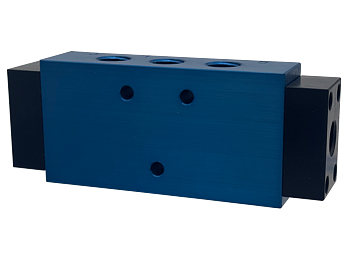




H20 5/2 Double Air Pilot Valves 1/4" & 3/8" Port Sizes
 Product Catalog
- Balanced spool construction
- Compact size
- Low profile
- High performance
Unable to load products. Please try again.
loading...
loading...
Product Overview
The Automatic Valve H20 5/2 Double Air Pilot Valve is a bar-stock aluminum spool valve engineered for applications where an electrical solenoid pilot is undesirable, impractical, or restricted by area classification. Built on the H20 2-inch bar-stock platform, it delivers 1.8 Cv (1,800 Nl/min) flow through 1/4 and 3/8 inch NPT porting while replacing the solenoid coil and electrical connection found on the solenoid variant with a 1/4 inch NPT pneumatic pilot port.
The double air pilot body design uses two opposing 1/4 inch NPT pilot ports. Momentarily applying pressure to one pilot port shifts the spool to the corresponding position; the spool remains in that position, held by internal detent, until the opposing pilot signal is applied. This last-position memory behavior persists even if both pilot signals are subsequently removed, making the double air pilot H20 valve well suited to circuits that must retain state through a pilot air interruption.
The valve retains the core mechanical construction of the H20 platform: a balanced spool for consistent, low-force shifting; anodized bar-stock aluminum body and hardcoat/PTFE anodized aluminum spool for corrosion resistance and long bore life; and Buna-N (nitrile) seals rated across the full -40 to 180 F (-40 to 82 C) ambient and media temperature range. The external pilot supply is rated 35 to 150 psig (2.4 to 10.3 bar), independent of the main line pressure setting within the valve's 0 to 150 psig operating range.
Because the air pilot H20 valve contains no coil, wiring, or electrical connection of any kind, it is the preferred H20 configuration for hazardous-area pneumatic circuits, for remote or mobile equipment lacking electrical infrastructure, and for fully pneumatic cascade or sequencing logic systems that switch valves from upstream pressure signals rather than a PLC output.
Key Engineering Features
- Pneumatic Pilot Actuation, No Electrical Supply Required - The 1/4 inch NPT pilot port accepts an external compressed air signal between 35 and 150 psig (2.4 to 10.3 bar), shifting the 5/2 spool without any coil, wiring, or voltage requirement.
- Balanced Spool Construction - The balanced spool design equalizes pressure across the spool land geometry, reducing actuation force requirements and providing consistent shifting response across the full 0 to 150 psig operating pressure range.
- Bar-Stock Aluminum Body - Machined from anodized bar-stock aluminum for a rigid, corrosion-resistant valve body suited to demanding industrial environments.
- Nitrile Seal Package - Buna-N (nitrile rubber) seals provide reliable sealing across the -40 to 180 F (-40 to 82 C) operating temperature range on filtered air service.
- 1.8 Cv Flow Capacity - 1.8 Cv (1,800 Nl/min) flow capacity in both 1/4 inch and 3/8 inch NPT port sizes supports fast cylinder response for typical industrial actuator loads.
- Inline Mounting - Inline NPT porting installs directly into the air line with no manifold hardware required, simplifying retrofit and OEM machine builds.
- Suitable for Hazardous and Electrically Restricted Areas - With no coil or electrical connection, the air pilot H20 valve avoids the ignition source and area-classification burden associated with solenoid coils in hazardous or electrically sensitive locations.
- Compatible with Pneumatic Logic and Cascade Circuits - Air pilot actuation integrates directly into fully pneumatic sequencing and cascade logic circuits using pressure signals from limit valves, pushbutton pilots, and other pneumatic logic elements without PLC hardware.
- Detented Last-Position Memory - The double air pilot body retains the last commanded spool position when both pilot signals are removed, providing last-position memory for the connected actuator without electrical latching or PLC state logic.
- CE, RoHS 3, and REACH Compliant - Full compliance with EU Machinery Directive, RoHS 3, and REACH requirements supports deployment on CE-marked machinery without additional regulatory review.
Technical Specifications
General Specifications
| Parameter | Specification |
| Valve Series | H20 |
| Valve Type | 2-inch bar-stock spool directional control valve |
| Valve Function | 5/2 (5-way, 2-position) |
| Actuation | Pneumatic (double air pilot) |
| Return Type | Detented (last-position memory) |
| Construction | Balanced spool, inline mounted |
| Port Sizes | 1/4 inch and 3/8 inch NPT |
| Port Threads | NPT (standard) |
| Flow Capacity | 1.8 Cv (1,800 Nl/min) |
| Operating Pressure | 0 to 150 psig (0 to 10.3 bar) |
| Ambient Temperature | -40 to 180 F (-40 to 82 C) |
| Media Temperature | -40 to 180 F (-40 to 82 C) |
| Low Temperature Caution | For temperatures below 32 F (0 C), air must be free of water vapor to prevent formation of ice |
| Flow Media | Filtered air |
| Body Material | Anodized bar-stock aluminum |
| Spool Material | Aluminum, hardcoat / PTFE anodized |
| Seal Material | Nitrile rubber (Buna-N) |
| Mounting | Inline |
| Port Protector | Not included |
| Weight | 0.78 lb (0.354 kg) |
| Pilot Port | 1/4 inch NPT |
| Pilot Supply Pressure | External, 35 to 150 psig (2.4 to 10.3 bar) |
| No Electrical Supply Required | Air pilot valves have no coil, no voltage requirement, and no electrical connection |
Flow Performance Data
| Series | Function | Port Size | Flow Cv | Flow Nl/min | Weight kg (lb) |
| H20 | 5/2 | 1/4 inch NPT | 1.8 | 1,800 | 0.354 (0.78) |
| H20 | 5/2 | 3/8 inch NPT | 1.8 | 1,800 | 0.354 (0.78) |
Certifications & Compliance
| Certification/Standard | Detail |
| CE Marking | Compliant with EU Machinery Directive requirements for industrial fluid power components installed on CE-marked machinery. |
| RoHS 3 | Compliant with EU Directive 2011/65/EU (as amended) restricting hazardous substances in electrical and electronic equipment. |
| REACH | Compliant with EU Regulation (EC) No 1907/2006 for registration, evaluation, authorization, and restriction of chemicals. |
Typical Applications & Industries
General Industrial Automation
- Pneumatic cylinder actuation for clamping, indexing, transfer, and positioning tasks across general-purpose machine automation, where the H20 balanced spool construction and 1.8 Cv flow rating deliver consistent cylinder response across a wide range of bore sizes and stroke lengths.
- Multi-station assembly automation requiring reliable, repeatable directional switching at moderate to high cycle rates, where the bar-stock aluminum body and Buna-N seals provide long service life without excessive maintenance intervention.
- Retrofit and OEM machine builds where the H20's compact 2-inch envelope and standard NPT porting simplify integration into existing pneumatic manifolds and panel layouts.
- General shop air distribution circuits where valves must tolerate normal industrial air quality variation while maintaining consistent switching performance over the 0 to 150 psig operating range.
Automotive Manufacturing
- Body-in-white fixture clamping and locating pin actuation, where consistent spool shifting under repeated cycling supports high-throughput assembly line takt times.
- Weld cell tooling and part-present sensing circuits where the anodized aluminum body resists the particulate and thermal exposure typical of weld cell environments.
- Paint and sealer application equipment pneumatic actuator control, where dependable directional switching supports coating process consistency.
- Powertrain assembly torque tool and press-fit tooling pneumatic circuits requiring dependable, repeatable valve actuation over high daily cycle counts.
Packaging Machinery
- Case erecting, carton folding, and glue application cycle actuation where the H20's flow capacity supports rapid cylinder response at typical packaging line speeds.
- Palletizing and depalletizing end-of-arm tooling actuation for vacuum cup or gripper circuits requiring dependable directional switching.
- Stretch wrap and shrink wrap machine pneumatic clamp and cutter actuation, where consistent valve performance supports continuous production runs.
- Labeling and filling machine indexing and stop-gate actuation requiring precise, repeatable timing in the pneumatic control circuit.
Material Handling
- Conveyor diverter, stop-gate, and pop-up transfer actuation across distributed material handling systems where the H20's straightforward inline porting simplifies field wiring or piloting.
- Automated storage and retrieval system (AS/RS) shuttle and clamp actuation requiring dependable directional control integrated into centralized or distributed valve panels.
- Palletizer and depalletizer clamp, lift, and rotate function actuation in high-cycle distribution center operations.
- Sortation system gate and kicker actuation where fast, repeatable valve response is required to maintain sortation accuracy at line speed.
Machine Tool
- Coolant valve, chip conveyor, and tool-change clamp actuation on CNC machining centers, where the H20's rugged bar-stock body withstands oil mist and metal particulate common in machining environments.
- Fixture clamping and part-locating pneumatic circuits on dedicated and flexible machining systems requiring consistent, repeatable clamp force timing.
- Automatic tool changer air-blast and clamp release circuits where dependable valve switching supports unattended machining cycles.
- Way-wiper and guard actuation circuits on machine tools requiring simple, low-maintenance pneumatic control elements.
Assembly Automation
- Multi-axis pick-and-place end effector actuation where the H20 provides dependable directional switching for gripper open/close and rotate functions.
- Press-fit, staking, and riveting tooling actuation requiring precise timing coordination with upstream sensing and control logic.
- Rotary and linear indexing table clamp and lock actuation supporting synchronized multi-station assembly sequences.
- Component feeder and escapement actuation in high-mix assembly cells requiring compact, reliable valve packages.
Rubber and Plastics Processing
- Injection molding auxiliary equipment actuation, including mold clamp assist, ejector, and part-removal robot end-of-arm tooling.
- Extrusion line cutter, puller, and takeoff equipment pneumatic actuator control requiring dependable cycling in warm, particulate-laden production environments.
- Blow molding and thermoforming clamp, trim, and part-transfer actuation where consistent valve response supports process cycle time targets.
- Rubber curing press and de-molding equipment pneumatic circuits requiring valves rated for the extended temperature range typical of these processes.
Ordering and Model Number Configuration
Air pilot valves require no voltage code; the model number ends after the operator and return codes.
The pilot port is 1/4 inch NPT on all H20 air pilot models. Pilot supply pressure must be maintained between 35 and 150 psig (2.4 to 10.3 bar) independent of the main line pressure.
Port protector is not included as standard; specify suffix P if a factory-installed port protector is required.
For temperatures below 32 F (0 C), specify dried air supply on both the main line and pilot line to prevent internal ice formation.
The double air pilot (detented) body retains the last commanded position when both pilot signals are removed. Confirm this last-position memory behavior is acceptable for the application's fail-safe requirements before specifying.
Related Products & Accessories
- Automatic Valve H20 3/2 Single Air Pilot Valves - Spring Return - 3/2 single air pilot H20 valve with spring return, for hazardous or electrically restricted locations. https://www.automaticvalve.com/series/4011-h20-32-single-air-pilot-valves
- Automatic Valve H20 3/2 Double Air Pilot Valves - 3/2 double air pilot H20 valve with detented last-position memory and no electrical components. https://www.automaticvalve.com/series/4012-h20-32-double-air-pilot-valves
- Automatic Valve H20 5/2 Single Air Pilot Valves - Spring Return - 5/2 single air pilot H20 valve with spring return for double-acting actuator control without electrical supply. https://www.automaticvalve.com/series/4030-h20-52-single-air-pilot-valves
- Automatic Valve H20 3/2 Manual Control Valves - Detent Push-Pull Knob - 3/2 manual push-pull knob H20 valve with detent, both positions mechanically held until reset. https://www.automaticvalve.com/series/4034-h20-32-manual-control-valves-detent
- Automatic Valve H20 5/2 Manual Control Valves - Detent Push-Pull Knob - 5/2 manual push-pull knob H20 valve with detent, both positions mechanically held until reset. https://www.automaticvalve.com/series/4039-h20-52-manual-control-valves-detent
- Automatic Valve H20 3/2 Single Solenoid Valves - Spring Return - 3/2 single solenoid H20 valve with spring return and standard manual override. https://www.automaticvalve.com/series/4045-h20-32-single-solenoid-valves-spring-return
- Automatic Valve H20 5/2 Single Solenoid Valves - Spring Return - 5/2 single solenoid H20 valve with spring return and standard manual override. https://www.automaticvalve.com/series/4049-h20-52-single-solenoid-valves-spring-return
- Automatic Valve H20 5/2 Double Solenoid Valves - 5/2 double solenoid H20 valve with detented last-position memory and dual pressure feature standard. https://www.automaticvalve.com/series/4084-h20-52-double-solenoid-valves
- Compact Solenoid L Series Valves - Standard Temperature Applications - Smaller-envelope L20 platform solenoid valve for applications where the compact L Series footprint is preferred over the H20 bar-stock body, including CSA/FM explosion-proof and ATEX coil options not offered on the general-purpose H20 family. https://www.automaticvalve.com/series/2979-compact-solenoid-l-series-valves-standard-temperature-applications
- Compact Air Pilot L Series Valves - Standard Temperature - Smaller-envelope L20 platform air pilot valve for hazardous-location or electrically isolated circuits where the compact L Series footprint is preferred over the H20 bar-stock body. https://www.automaticvalve.com/series/2995-compact-air-pilot-l-series-valves-standard-temperature
Frequently Asked Questions (FAQ)
Q: What is the primary advantage of an H20 air pilot valve over a solenoid version?
A: The air pilot H20 eliminates the solenoid coil and all associated electrical components: wiring, connector, and voltage supply. This simplifies installation in remote or mobile equipment, removes coil failure as a maintenance concern, and avoids the area-classification requirements that apply to solenoid coils in hazardous or electrically restricted locations.
Q: What pilot pressure is required to shift the H20 air pilot valve?
A: The pilot supply pressure must be 35 to 150 psig (2.4 to 10.3 bar), applied to the 1/4 inch NPT pilot port. This pilot supply is external and independent of the main line pressure at port 1, which operates over the full 0 to 150 psig (0 to 10.3 bar) range.
Q: What flow capacity does the H20 air pilot valve provide?
A: The H20 air pilot valve provides 1.8 Cv (1,800 Nl/min) flow capacity in both 1/4 inch and 3/8 inch NPT port sizes.
Q: What is the operating temperature range?
A: The H20 air pilot valve operates from -40 to 180 F (-40 to 82 C) for both ambient and media temperature. For operation below 32 F (0 C), the air supply must be free of water vapor to prevent ice formation inside the valve.
Q: What body and seal materials are used?
A: The H20 air pilot valve body is anodized bar-stock aluminum, the spool is hardcoat/PTFE anodized aluminum, and the seals are Buna-N (nitrile rubber).
Q: Is lubrication required for the H20 air pilot valve?
A: Lubrication is not required. The valve is designed for reliable operation on filtered air without supplemental air line lubrication.
Q: Can the H20 air pilot valve be used in hazardous locations?
A: The absence of any electrical component in the air pilot H20 valve removes the coil-related ignition source that applies to solenoid valves, making the air pilot configuration a common choice for hazardous or electrically restricted areas. Confirm specific area classification requirements with the authority having jurisdiction for the installation.
Q: What port sizes are available?
A: The H20 air pilot valve is available in 1/4 inch NPT and 3/8 inch NPT port sizes, both rated at 1.8 Cv flow capacity.
Q: Is a port protector included standard?
A: No. Port protector is not included as standard on the H20 air pilot valve. Specify the port protector option (suffix P) at time of order if required.
Q: What is the typical lead time for H20 air pilot valves?
A: Standard manufacturing lead times for quantities of 10 or fewer units are typically 3 to 4 weeks, with shipping available throughout the United States.
Q: How does the double air pilot (detented) configuration differ from single air pilot?
A: The double air pilot body uses two opposing pilot ports. Momentarily applying pressure to either pilot port shifts the spool to the corresponding position, where it remains held by internal detent until the opposing pilot signal is applied. This provides last-position memory, in contrast to the single air pilot's spring return to a fixed normal position.
Q: What happens if both pilot signals are removed on the double air pilot valve?
A: The spool remains in its last commanded position. The double air pilot (detented) body has no return spring forcing it to a default position; it holds state mechanically until the opposing pilot port receives a signal.
Q: Can the double air pilot valve be actuated with only a momentary pilot signal?
A: Yes. Because the detent mechanically holds the spool position, only a momentary pilot pressure pulse at each pilot port is required to shift and hold the valve; continuous pilot pressure is not necessary to maintain position.
Installation & Maintenance Guidelines
- Supply filtered air to the H20 valve inlet port. No specific filtration micron rating is mandated for the H20 family beyond keeping the air supply free of liquid water and bulk contaminants; use a standard industrial air line filter appropriate to the installation's air quality.
- For operation at temperatures below 32 F (0 C), the air supply must be free of water vapor to prevent formation of ice inside the valve body and spool bore. Use a refrigerated or desiccant air dryer upstream of the valve for any application where ambient or media temperature may fall below freezing.
- Mount the valve in any orientation. The inline 1/4 inch and 3/8 inch NPT ports accept standard pipe fittings or push-in adapters; ensure adequate clearance around the operator end for actuation and, on manual and solenoid variants, for manual override access.
- Connect the external pneumatic pilot signal to the 1/4 inch NPT pilot port. Pilot pressure must be maintained between 35 and 150 psig (2.4 to 10.3 bar) for reliable, complete spool shifting.
- Do not exceed the 0 to 150 psig (0 to 10.3 bar) operating pressure rating. Verify upstream regulator setpoints before commissioning.
- Do not restrict the exhaust port beyond the requirements of the application circuit. Restricted exhaust flow increases cycle time and can cause elevated internal temperatures during high-cycle operation.
- Inspect the valve periodically for external air leakage at port connections and at the actuator cap seal. Nitrile (Buna-N) seals are standard; verify seal material compatibility if the application introduces any lubricant, cleaning agent, or process media exposure beyond filtered air.
- Because the double air pilot body retains its last commanded position when pilot signals are removed, verify that this last-position memory behavior is acceptable and safe for the application before commissioning.
Warranty & Global Support
Automatic Valve, a ROSS Controls company, provides a standard warranty on all products covering defects in material and workmanship from date of purchase.
Technical support and product configuration assistance are available through Automatic Valve at (248) 474-6761.
For complete technical data, dimensional drawings, CAD models, and ordering configuration, visit automaticvalve.com or contact the factory directly.
Estimated ship dates are based on standard manufacturing times for quantities of 10 or fewer. Shipments are available throughout the United States.
Valve Installation and Service User Manual: https://www.automaticvalve.com/documents/424
Solenoid Coils, Electrical Connectors, and Exhaust Silencers Catalog: https://www.automaticvalve.com/documents/868/solenoid-coils-and-connectors-exhaust-silencers
Download Documents
H20 5/2 Double Air Pilot Valves