




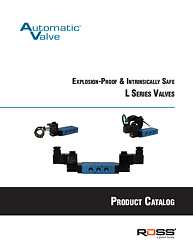
Hazardous Locations L Series Valves by Automatic Valve
Overview of Explosion-Proof and Intrinsically Safe L Series Valves
The Automatic Valve hazardous location L Series valves are compact inline directional control spool valves engineered for environments where explosive atmospheres demand certified protection against electrical ignition. These explosion-proof and intrinsically safe solenoid pilot controlled valves deliver the same space-saving design and reliable performance as standard L Series valves while meeting rigorous hazardous area classification requirements.
The hazardous location L Series spans the L07, L20, L45, and L65 series with inlet port sizes from 1/8 inch to 1 inch. Valve functions include 3/2 normally closed, 5/2 directional, and 5/3 center-position configurations. Maximum flow capacity reaches Cv 9.5 (9,300 Nl/min) for 5/2 valves and Cv 7.4 (7,300 Nl/min) for 5/3 configurations, while 3/2 valves achieve Cv 4.0 (3,900 Nl/min).
Every hazardous location L Series valve is certified for use in Class I Division 1 environments and carries FM, CSA, CSA-UL, and ATEX approvals. Intrinsically safe versions provide an alternative protection method by limiting electrical energy below ignition thresholds. All models are certified by SGS-TUV Saar in accordance with IEC 61508, achieving SIL 2 rating for safety-critical process automation applications.
Certifications and Hazardous Area Ratings
Automatic Valve hazardous location L Series valves carry comprehensive certifications from globally recognized agencies. FM Approved explosion-proof models are rated for Class I, Division 1, Groups A, B, C, and D with T4 temperature classification. Additional FM ratings cover encapsulation/explosion-proof for Class I Zone 1, dust-ignition proof for Class II and III Division 1 Groups E, F, and G, non-incendive for Class I Division 2, and suitability for Class II and III Division 2 locations.
CSA and CSA-UL certifications provide additional third-party validation for North American installations, covering Class I Division 1 Groups A through D, Class II Groups E, F, and G, and Class III environments. ATEX Approved models carry II 2 G Ex mb IIC T5 and II 2 G Ex mb tb IIIC T95 degrees C designations for European zone-classified installations.
Intrinsically safe versions are rated IS Class I, II, and III Division 1, Groups A through G, with T5 temperature class and ambient temperature range of -40 degrees C to 50 degrees C. These valves require a separate Factory Mutual Entity Approved or CSA rated safety barrier in the circuit to maintain intrinsic safety integrity.
Key Features and Protection Methods
Hazardous location L Series valves incorporate the same proven engineering features as standard L Series valves with additional hazardous area protection. The balanced spool construction provides compact size, low profile, and high performance. The solenoid pilot design uses full air line pressure to shift the valve with burnout-proof solenoids. The bidirectional tapered Tee-Seal eliminates sticking problems and has been validated over 20 million cycles under SAE test conditions.
Explosion-proof coils are engineered to contain any spark originating within the coil or housing, preventing the ignition of flammable material in the surrounding environment. These coils are available with FM/CSA and ATEX certifications and consume 4.5 watts in DC applications. Intrinsically safe coils take the alternative approach of limiting available electrical energy to below ignition thresholds, consuming only 1.6 watts at 24V DC.
Manual override allows operators to actuate valves manually during electrical failure or for cycle testing, with push non-locking, push turn-locking, and extended turn-locking options. The external pilot supply is field-convertible for vacuum service and specialized applications. Weather-proof construction with IP65 NEMA 7 enclosure rating ensures reliable operation in harsh outdoor and industrial environments.
Technical Specifications and Operating Parameters
Hazardous location L Series valves are designed for the same broad environmental conditions as their standard counterparts. Standard temperature models operate from -20 degrees F to 123 degrees F (-29 degrees C to 50 degrees C), while low temperature models extend to -40 degrees F (-40 degrees C). Air must be free of water vapor below 40 degrees F to prevent ice formation. The flow media is filtered air.
Operating pressure and flow capacity scale across the series range. The L07 series handles smaller flows suitable for pilot and instrument applications, the L20 series covers mid-range requirements, and the L45 and L65 series deliver higher flow capacity up to Cv 9.5 for larger actuator control. Port sizes range from 1/8 inch to 1 inch across the series.
Explosion-proof solenoids are available in 12V DC, 24V DC, 120V AC 60 Hz, and 240V AC 60 Hz options with 4.5-watt DC power consumption. Intrinsically safe solenoids operate on 24V DC only at 1.6 watts. Construction materials include aluminum valve bodies, Polyamide 66 solenoid housings, and Buna-N or Fluoroelastomer seal options. Electrical connections for explosion-proof models include 1/2-inch conduit coils with leads, while intrinsically safe models use strain relief connections.
Manifold Systems for Hazardous Locations
Hazardous location L Series valves support manifold mounting configurations for multi-valve installations in classified areas. The L21 series supports top-mount manifolds for 3/2 explosion-proof valves, while 5/2 and 5/3 explosion-proof valves are available on manifold bases across multiple series. Manifold mounting reduces piping complexity, minimizes potential leak points, and simplifies installation in hazardous environments where minimizing ignition sources is critical.
Manifold accessories for hazardous location installations include end stations, blanking plates, and connection adapters. These components allow engineers to configure multi-valve assemblies tailored to specific process control requirements. All manifold components maintain the same hazardous area ratings as the individual valves, ensuring system-level certification compliance.
The compact inline design of the L Series is particularly advantageous in hazardous locations where installation space is often constrained by safety clearance requirements, blast walls, and explosion containment structures. The lightweight construction also reduces mounting stress in vibration-prone environments common in petrochemical, oil and gas, and chemical processing facilities.
Applications and System Integration
Automatic Valve hazardous location L Series valves serve a wide range of industries where explosive atmospheres are present. Petrochemical refineries, oil and gas production platforms, chemical processing plants, pharmaceutical manufacturing, grain handling and storage, mining operations, and paint spray facilities all benefit from the certified protection these valves provide.
System integration is straightforward due to the standard inline and manifold mounting interfaces. Engineers can select from explosion-proof CSA/FM, explosion-proof ATEX, or intrinsically safe coil types based on the hazardous area classification, available power supply, and regional certification requirements. The model number configurator system allows precise specification of every valve parameter including series, port size, function, actuation, voltage, seal material, body material, and certification type.
High-flow exhaust silencers in zinc-plated steel and stainless steel, electrical connectors, and prewired cable assemblies complete the system offering. Downloadable CAD models support efficient plant design, and Automatic Valve's global support network through the ROSS Global Family provides engineering assistance, technical documentation, and aftermarket support worldwide.
Frequently Asked Questions About Hazardous Location L Series Valves
What hazardous area classifications do L Series explosion-proof valves cover?
Automatic Valve hazardous location L Series valves are certified for Class I Division 1 Groups A, B, C, and D (flammable gases and vapors), Class II Division 1 Groups E, F, and G (combustible dust), and Class III (ignitable fibers). FM, CSA, CSA-UL, and ATEX certifications are available. Division 2 and Zone 1 ratings are also included for broader installation flexibility.
What is the SIL rating of hazardous location L Series valves?
Hazardous location L Series valves are certified by SGS-TUV Saar per IEC 61508 and achieve Safety Integrity Level 2 (SIL 2) rating. This certification supports their use in safety-critical process automation applications across hazardous environments.
What flow capacity do hazardous location L Series valves provide?
Flow capacity ranges up to Cv 9.5 (9,300 Nl/min) for 5/2 valve configurations in the larger L45 and L65 series. The 5/3 valves reach Cv 7.4 (7,300 Nl/min), and 3/2 valves achieve Cv 4.0 (3,900 Nl/min). Smaller series offer proportionally lower flow capacities for pilot and instrument applications.
Can intrinsically safe L Series valves be manifold mounted?
Manifold mounting for hazardous location L Series valves is available for explosion-proof valve versions. The L21 series supports top-mount manifolds for 3/2 explosion-proof valves, and 5/2 and 5/3 explosion-proof valves can be mounted on manifold bases. Consult Automatic Valve for specific intrinsically safe manifold configuration options.
What is the difference in power consumption between explosion-proof and intrinsically safe L Series coils?
Explosion-proof L Series coils consume 4.5 watts in DC applications and are available in 12V DC, 24V DC, 120V AC, and 240V AC. Intrinsically safe coils consume only 1.6 watts and operate exclusively on 24V DC, requiring a separate safety barrier in the circuit to maintain intrinsic safety certification.