




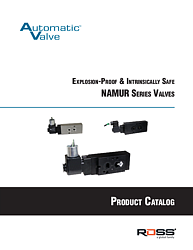
Hazardous Locations NAMUR Interface Valves by Automatic Valve
Overview of Explosion-Proof and Intrinsically Safe NAMUR Valves
Automatic Valve hazardous location NAMUR interface valves are purpose-built for environments where the risk of ignition from electrical energy demands the highest levels of protection. These explosion-proof and intrinsically safe solenoid pilot controlled valves are designed to mount directly to pneumatic valve actuators in accordance with the VDI/VDE 3845 NAMUR standard, delivering the same reliable performance as standard NAMUR valves while meeting stringent hazardous area certification requirements.
The hazardous location NAMUR portfolio includes 3/2, 5/2, and 5/3 valve configurations in D06 and D20 series. Flow capacity reaches Cv 1.8 (1,800 Nl/min) for 3/2 and 5/2 valves and Cv 1.4 (1,400 Nl/min) for 5/3 configurations. Explosion-proof versions are available with FM, CSA, and ATEX certified coils, while intrinsically safe versions provide an alternative protection methodology by limiting the energy available to cause sparks or ignition.
These valves are ideal for applications in petrochemical plants, oil and gas facilities, chemical processing, pharmaceutical manufacturing, grain handling, mining, and any environment where flammable gases, vapors, combustible dust, or easily ignitable fibers may be present. Every hazardous location NAMUR valve is certified by SGS-TUV Saar in accordance with IEC 61508, achieving SIL 2 in singular application and SIL 3 in redundant application.
Certifications and Hazardous Area Classifications
Automatic Valve hazardous location NAMUR valves carry a comprehensive set of certifications from internationally recognized agencies. FM Approved models are rated explosion-proof for Class I, Division 1, Groups A, B, C, and D with T4 temperature classification at Ta equal to 60 degrees C. Additional FM ratings include encapsulation/explosion-proof for Class I, Zone 1, dust-ignition proof for Class II and III Division 1 Groups E, F, and G, non-incendive for Class I Division 2, and suitable for Class II and III Division 2 hazardous classified locations.
CSA Approved models cover Class I Division 1 Groups A, B, C, and D as well as Class II Groups E, F, and G and Class III environments, with additional Division 2 ratings for Class I Groups A through D. ATEX Approved models carry the designation II 2 G Ex mb IIC T5 and II 2 G Ex mb tb IIIC T95 degrees C, making them suitable for European ATEX zone classifications.
Intrinsically safe versions are rated IS Class I, II, and III Division 1, Groups A through G, with T5 temperature class and an ambient range of -40 degrees C to 50 degrees C. These intrinsically safe valves require a Factory Mutual Entity Approved or CSA rated safety barrier in the circuit, limiting the electrical energy available to below ignition thresholds. The IP65 NEMA 7 enclosure rating provides robust environmental protection for all hazardous location coil types.
Explosion-Proof Versus Intrinsically Safe Protection Methods
Automatic Valve offers two distinct protection methodologies for hazardous location NAMUR valves, each suited to different application requirements and safety philosophies. Explosion-proof coils are designed to contain any spark originating from within the coil or housing, preventing the ignition of flammable material in the surrounding environment. These coils are available with both CSA/FM and ATEX certification and consume 4.5 watts in DC applications or 6.5 to 6.8 VA in AC applications.
Intrinsically safe coils take a fundamentally different approach by limiting the amount of electrical energy available in the circuit to a level below what could cause sparks or ignition. Intrinsically safe NAMUR valves consume only 1.6 watts and operate exclusively on 24V DC. They require a safety barrier in the circuit, which Automatic Valve does not supply, to maintain the intrinsic safety rating. The holding current for intrinsically safe coils is 0.05 Amps.
The choice between explosion-proof and intrinsically safe protection depends on factors including the hazardous area classification, available power supply, wiring infrastructure, and overall safety system architecture. Explosion-proof valves accept a broader range of voltages including 12V DC, 24V DC, 120V AC, and 240V AC, making them more versatile for retrofit applications. Intrinsically safe valves offer lower power consumption and simpler wiring but are limited to 24V DC operation.
Technical Specifications and Operating Parameters
Hazardous location NAMUR interface valves from Automatic Valve share the same robust mechanical specifications as their standard counterparts. Standard temperature models operate from -20 degrees F to 123 degrees F (-29 degrees C to 50 degrees C), while low temperature models extend down to -40 degrees F (-40 degrees C). For temperatures below 40 degrees F, air must be free of water vapor to prevent ice formation. The flow media is filtered air.
Operating pressure varies by valve function and series. D06 Series 3/2 valves operate from 0 to 150 psig (0 to 10.3 bar), D20 Series 3/2 valves require 35 to 150 psig (2.4 to 10.3 bar), 5/2 valves need 35 to 150 psig, and 5/3 valves require 50 to 150 psig (3.4 to 10.3 bar). External pilot supply pressure ranges from 35 to 150 psig for 3/2 and 5/2 functions and 50 to 150 psig for 5/3 functions.
Construction materials include aluminum bar stock and stainless steel (Grade 303 and 316) valve bodies, Polyamide 66 solenoid bodies, and aluminum spools. Buna-N and Fluoroelastomer seal options accommodate a range of media compatibility requirements. Electrical connections for explosion-proof models include 1/2-inch conduit coils with 24-inch leads for CSA/FM certified coils and strain relief with 10 feet of cord for ATEX certified coils. Intrinsically safe models feature strain relief connectors without cord. Port threads are available in NPT and G configurations.
Valve Functions and Ordering Configuration
The hazardous location NAMUR valve range covers 3/2 normally closed, 5/2 directional, and 5/3 center-position valve functions. The 3/2 valve is available in D06 and D20 series with single solenoid actuation and top, left, or right pilot mounting positions. The 5/2 valve, available in the D20 series, offers single and double solenoid actuation for controlling double-acting actuators. The 5/3 valve provides closed center, open center, and power center configurations with double solenoid actuation.
The model number configurator encodes every specification into a structured part number. For explosion-proof valves, the coil certification code Y designates CSA/FM and Z designates ATEX. Intrinsically safe valves leave the coil type field blank. Solenoid location codes differ between explosion-proof (AWR/CWR for standard, AYR/CYR for CSA/FM low-temp, AZR/CZR for ATEX low-temp) and intrinsically safe (AVR/CVR) versions.
For example, model number D2013GAWR-DBY indicates a D20 series, 1-inch body height, 3/2 normally closed, single solenoid, top-mounted, 24V DC, explosion-proof CSA/FM certified valve. All hazardous location NAMUR valves support the same accessory ecosystem as standard NAMUR valves, including speed control valves, lockout and vent valves, quick exhaust, dual flow controls, 90-degree mounting plates, and transition plates.
Accessories and System Integration
Automatic Valve hazardous location NAMUR valves integrate seamlessly with the full range of NAMUR mounting accessories. The Speed Control Valve (Model A7106-554) mounts between the directional control valve and actuator on the NAMUR pad, providing adjustable dual-port flow control with operating pressure from 35 to 150 psig and operating temperature from 0 degrees F to 125 degrees F. The Interposed Lockout and Vent Valve (Model D20-106) prevents unintended air flow during maintenance, serving as an energy isolation device.
The NAMUR Quick Exhaust (Model D20-111 in aluminum, D20-111S in stainless steel) mounts between the control valve and actuator to improve closing speed and prevent corrosive atmospheres from being pulled into the spring chamber. The Dual Flow Control (Model D20-112) manages double-acting actuator speed, while the Dual Function Flow Control (Model D20-113) independently controls opening and closing speeds for spring-return actuators.
High-flow exhaust silencers are available in zinc-plated steel (Model 84C-2) and stainless steel (Model 84C-2S) with 1/4-inch port size and Cv 2.3 (2,300 Nl/min) flow capacity. The 1/4 NPT NAMUR Adapter (Model D20-114) provides standard connections for remote valve and accessory mounting. Downloadable CAD models are available for all hazardous location NAMUR valves and accessories, supporting efficient plant design and integration into safety instrumented systems.
Frequently Asked Questions About Hazardous Location NAMUR Valves
What hazardous area classifications do Automatic Valve NAMUR valves cover?
Automatic Valve hazardous location NAMUR valves are certified for Class I Division 1 Groups A, B, C, and D (flammable gases and vapors), Class II Division 1 Groups E, F, and G (combustible dust), and Class III (easily ignitable fibers). They also carry ratings for Division 2 locations and ATEX Zone 1 classifications. Both FM and CSA certifications are available for North American installations, with ATEX certification for European applications.
What is the difference between explosion-proof and intrinsically safe NAMUR valves?
Explosion-proof NAMUR valves contain any spark within the coil housing, preventing external ignition. They consume 4.5 watts DC and accept 12V, 24V DC, 120V, or 240V AC. Intrinsically safe NAMUR valves limit circuit energy below ignition thresholds, consuming only 1.6 watts at 24V DC. Intrinsically safe installations require a separate safety barrier in the circuit. The choice depends on area classification, available voltage, power budget, and overall safety system design.
Do hazardous location NAMUR valves achieve functional safety certification?
Yes, all Automatic Valve hazardous location NAMUR valves are certified by SGS-TUV Saar per IEC 61508. They achieve Safety Integrity Level 2 (SIL 2) in singular application with hardware fault tolerance of 0, and SIL 3 with Performance Level e in redundant application with hardware fault tolerance of 1 or greater.
Can explosion-proof NAMUR valves use the same accessories as standard NAMUR valves?
Yes, hazardous location NAMUR valves share the same NAMUR mounting interface per VDI/VDE 3845 and are compatible with all standard NAMUR accessories including speed control valves, lockout and vent valves, quick exhaust modules, dual flow controls, 90-degree mounting plates, NAMUR adapters, and transition plates.
What electrical connections are available for hazardous location NAMUR coils?
Explosion-proof CSA/FM certified coils use 1/2-inch conduit connections with 24-inch leads. ATEX certified explosion-proof coils feature strain relief connections with 10 feet (3 meters) of cord. Intrinsically safe coils have strain relief connections without cord and require a separately sourced safety barrier rated 28V max / 300 Ohms minimum or equivalent.