

Non-Use of Conflict Minerals Declaration — Automatic Valve Industrial
About This Conflict Minerals Declaration
ROSS Controls, ROSS DECCO, and Automatic Valve Industrial (collectively referred to as ROSS) have issued this Non-Use of Conflict Minerals declaration to affirm their commitment to responsible mineral sourcing. The declaration confirms that, to the best of ROSS's knowledge, its products do not contain conflict minerals or their derivatives, specifically gold (Au), tantalum (Ta), tungsten (W), or tin (Sn), sourced from mines that directly or indirectly finance or benefit armed groups in the Democratic Republic of the Congo (DRC) or any adjoining country.
This declaration reflects ROSS's commitment to being an environmentally and socially responsible manufacturer. ROSS works proactively with its supply base to ensure compliance with the conflict minerals provisions of applicable federal law and to ensure that only DRC conflict-free materials are used in its products. The determination is based on declarations of non-use obtained from ROSS Tier 1 suppliers.
The Four Conflict Minerals (3TG)
The four minerals designated as conflict minerals under U.S. federal law are collectively known as 3TG: tin (Sn), tantalum (Ta), tungsten (W), and gold (Au). These minerals and their derivatives are widely used in manufacturing across many industries. Tin is used in soldering, tin plating, and as a component of alloys such as bronze. Tantalum is used in electronic capacitors, superalloys, and chemical processing equipment. Tungsten is used in cutting tools, wear-resistant materials, and electrical contacts. Gold is used in electronics, connectors, and corrosion-resistant coatings. In the context of pneumatic valve manufacturing, these minerals may be present in electronic components, solder joints, plated surfaces, and specialty alloys used in valve assemblies.
What Are Conflict Minerals and Why Do They Matter?
Conflict minerals refer to tin, tantalum, tungsten, and gold that are mined in conditions of armed conflict and human rights abuses, particularly in the eastern regions of the Democratic Republic of the Congo and adjoining countries. The extraction and trade of these minerals in conflict-affected areas has been linked to the financing of armed groups responsible for widespread violence, forced labor, child labor, and environmental destruction. Revenue from the sale of conflict minerals has fueled decades of armed conflict in the region, contributing to one of the most devastating humanitarian crises in modern history.
The global manufacturing community has a responsibility to ensure that its supply chains do not contribute to these abuses. By tracing the origin of 3TG minerals and sourcing from conflict-free sources, manufacturers can help reduce the demand for minerals from conflict-affected areas and support the development of responsible mining practices in the DRC and surrounding region.
Section 1502 of the Dodd-Frank Act
In 2010, the United States Congress enacted Section 1502 of the Dodd-Frank Wall Street Reform and Consumer Protection Act, which requires publicly traded companies to disclose whether their products contain conflict minerals originating from the DRC or adjoining countries. The law directs the Securities and Exchange Commission (SEC) to issue rules requiring companies to perform due diligence on their supply chains and to file annual conflict minerals reports. While the Dodd-Frank reporting requirements apply directly to SEC-reporting companies, the law has created a cascading effect throughout manufacturing supply chains, as publicly traded companies require their suppliers to provide conflict minerals declarations and due diligence information.
OECD Due Diligence Guidance
The Organisation for Economic Co-operation and Development (OECD) has published the Due Diligence Guidance for Responsible Supply Chains of Minerals from Conflict-Affected and High-Risk Areas, which provides a five-step framework for companies to identify, assess, and mitigate risks in their mineral supply chains. The five steps are: establish strong company management systems, identify and assess risks in the supply chain, design and implement a strategy to respond to identified risks, carry out independent third-party audits of supply chain due diligence, and report annually on supply chain due diligence. The OECD guidance is the internationally recognized standard for conflict minerals due diligence and is referenced by both U.S. and EU regulations.
ROSS's Conflict Minerals Compliance Approach
ROSS takes a proactive approach to ensuring that its products are free from conflict minerals sourced from conflict-affected areas. The company's compliance strategy is based on several key elements. ROSS works within its supply chain to strengthen compliance and to ensure that only DRC conflict-free materials are used in its products. This determination is based on declarations of non-use obtained from ROSS Tier 1 suppliers, who are expected to provide attestations regarding the origin of 3TG minerals in the materials they supply.
ROSS expects its Tier 1 suppliers to undertake commercially reasonable due diligence with their respective supply chains to ensure that minerals used in materials supplied to ROSS are not sourced from mines in conflict areas. In addition, ROSS expects its suppliers, as responsible corporate citizens, to conduct worldwide operations in a manner that does not result in labor or human rights violations. This expectation extends beyond conflict minerals to encompass broader social responsibility and ethical business practices.
Supplier Due Diligence and Declarations
ROSS's conflict minerals compliance program relies on obtaining declarations from Tier 1 suppliers regarding the origin of 3TG minerals in their products. Suppliers are expected to trace the source of tin, tantalum, tungsten, and gold used in their materials and to provide assurances that these minerals are not sourced from conflict-affected mines in the DRC or adjoining countries. Many suppliers use the Conflict Minerals Reporting Template (CMRT) developed by the Responsible Minerals Initiative (RMI) to standardize their reporting and facilitate information sharing across the supply chain.
Commitment to Ethical Manufacturing
ROSS's commitment to conflict-free sourcing is part of its broader commitment to being an environmentally and socially responsible manufacturer. The company recognizes that responsible supply chain management involves not only regulatory compliance but also ethical business practices that respect human rights, protect workers, and preserve the environment. By holding its suppliers to high standards of social responsibility, ROSS aims to ensure that its products are manufactured without contributing to human suffering or environmental degradation at any point in the supply chain.
Why Conflict Minerals Compliance Matters for Industrial Customers
For OEMs, system integrators, and machine builders, conflict minerals compliance is increasingly important for both regulatory and reputational reasons. Publicly traded companies subject to SEC reporting requirements under Section 1502 of the Dodd-Frank Act must trace the origin of 3TG minerals in their products and disclose their findings annually. These companies rely on their suppliers, including pneumatic valve manufacturers, to provide conflict minerals declarations and due diligence information.
Beyond regulatory requirements, many companies have adopted corporate social responsibility policies that require conflict-free sourcing across their supply chains. Customers, investors, and other stakeholders increasingly expect companies to demonstrate responsible mineral sourcing practices. Having documented conflict minerals declarations from key suppliers like Automatic Valve Industrial supports these corporate commitments and reduces reputational risk.
The European Union has also implemented its own conflict minerals regulation (EU Regulation 2017/821), which requires EU importers of tin, tantalum, tungsten, and gold to carry out due diligence on their supply chains. This regulation became mandatory on January 1, 2021, creating additional demand for conflict minerals compliance documentation from manufacturers and suppliers worldwide.
Download the Non-Use of Conflict Minerals Declaration
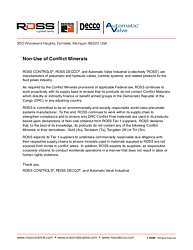
The complete Non-Use of Conflict Minerals declaration issued by ROSS Controls, covering Automatic Valve Industrial and ROSS DECCO products, is available for download in PDF format. This document can be used by procurement teams, compliance officers, corporate social responsibility managers, and supply chain quality engineers to support conflict minerals due diligence reporting, SEC filings, supplier qualification files, and corporate responsibility documentation.
Frequently Asked Questions
What are the four conflict minerals addressed in this declaration?
The four conflict minerals, collectively known as 3TG, are tin (Sn), tantalum (Ta), tungsten (W), and gold (Au). ROSS declares that, to the best of its knowledge, its products do not contain any of these conflict minerals or their derivatives sourced from conflict-affected areas in the Democratic Republic of the Congo or adjoining countries.
Is ROSS required to file conflict minerals reports with the SEC?
The SEC conflict minerals reporting requirements under Section 1502 of the Dodd-Frank Act apply to publicly traded companies. ROSS provides conflict minerals declarations to support its customers who may have their own SEC reporting obligations. The declaration is based on due diligence conducted with ROSS Tier 1 suppliers.
How does ROSS verify that its products are conflict-free?
ROSS obtains declarations of non-use from its Tier 1 suppliers and expects those suppliers to undertake commercially reasonable due diligence with their own supply chains. Suppliers are expected to trace the origin of 3TG minerals and confirm that they are not sourced from conflict-affected mines. ROSS continuously works with its supply base to strengthen compliance.
Does the EU also regulate conflict minerals?
Yes. The European Union enacted Regulation 2017/821, which requires EU importers of tin, tantalum, tungsten, and gold to carry out supply chain due diligence. The regulation became mandatory on January 1, 2021. ROSS's commitment to conflict-free sourcing supports compliance with both U.S. and EU conflict minerals regulations.
Can I use the ROSS conflict minerals declaration for my company's SEC reporting?
Yes. The ROSS Non-Use of Conflict Minerals declaration can be included as part of your supply chain due diligence documentation. It provides supplier-level confirmation that products sourced from ROSS, Automatic Valve Industrial, and ROSS DECCO are manufactured with a commitment to conflict-free mineral sourcing.