

TSCA Compliance Declaration — Automatic Valve Industrial
About This TSCA Compliance Declaration
ROSS Controls, ROSS DECCO, Automatic Valve Industrial, and Master Pneumatic (collectively referred to as ROSS) have issued this TSCA Compliance Declaration to confirm that products manufactured by ROSS comply with the Toxic Substances Control Act (TSCA) final rules issued by the U.S. Environmental Protection Agency (EPA). This declaration covers all pneumatic and hydraulic valves, control systems, filters, regulators, lubricators, and related fluid power products manufactured by ROSS.
The declaration specifically addresses the EPA's final rules targeting persistent, bioaccumulative, and toxic (PBT) chemicals. ROSS has reviewed its production processes and the processes of its key suppliers and has confirmed TSCA compliance with respect to the five PBT chemicals identified in the EPA's regulations. This document is revised as of Q4 2025 (Revision 2) and is available for download in PDF format.
Regulated PBT Chemicals Under TSCA
The EPA's TSCA final rules specifically target five chemicals classified as persistent, bioaccumulative, and toxic. These chemicals are: Decabromodiphenyl Ether (DecaBDE), a brominated flame retardant historically used in plastics, textiles, and electronic housings; Phenol, Isopropylated Phosphate (3:1), commonly known as PIP (3:1), a flame retardant and plasticizer used in lubricants, hydraulic fluids, rubber products, and adhesives; 2,4,6-Tris(tert-butyl) Phenol (2,4,6-TTBP), used as an antioxidant and fuel additive; Hexachlorobutadiene (HCBD), a chlorinated solvent and byproduct of chemical manufacturing; and Pentachlorothiophenol (PCTP), used as a peptizer in rubber manufacturing. ROSS has confirmed that its products and manufacturing processes do not use these regulated chemicals.
What Is the Toxic Substances Control Act (TSCA)?
The Toxic Substances Control Act is a United States federal law enacted in 1976 that provides the Environmental Protection Agency with the authority to require reporting, recordkeeping, testing, and restrictions relating to chemical substances and mixtures. TSCA addresses the production, importation, use, and disposal of specific chemicals and gives the EPA broad authority to regulate chemicals that pose unreasonable risks to human health or the environment.
TSCA was significantly strengthened in 2016 through the Frank R. Lautenberg Chemical Safety for the 21st Century Act, which amended TSCA to require the EPA to evaluate existing chemicals with clear and enforceable deadlines, use risk-based chemical assessments, increase public transparency for chemical information, and provide a consistent source of funding for the EPA's chemical review activities. The Lautenberg amendments represent the most significant reform of U.S. chemical safety law in four decades.
TSCA PBT Final Rules
In January 2021, the EPA finalized rules under TSCA Section 6(h) to reduce exposure to five PBT chemicals. These rules establish specific prohibitions and restrictions on the processing, distribution, and use of the five targeted chemicals. The PBT designation means that these chemicals persist in the environment for extended periods, accumulate in living organisms, and are toxic to humans and wildlife. Unlike many chemical regulations that set maximum concentration thresholds, some of the TSCA PBT rules establish outright prohibitions on certain uses while allowing time-limited exemptions for specific critical applications where alternatives are not yet available.
PIP (3:1) Regulations and Industrial Impact
Among the five regulated PBT chemicals, PIP (3:1) has the broadest impact on the manufacturing sector. PIP (3:1) is widely used as a flame retardant and plasticizer in lubricants, hydraulic fluids, adhesives, sealants, rubber products, and coatings. The EPA's final rule phased in restrictions on the processing and distribution of PIP (3:1) for certain uses, with exemptions for specific applications including in the automotive, aerospace, and defense industries where alternatives are still being developed. For pneumatic valve manufacturers, the key concern relates to the potential presence of PIP (3:1) in lubricants, sealants, and rubber compounds used in valve assemblies. ROSS has verified through its supply chain review that its products comply with the PIP (3:1) restrictions.
How ROSS Ensures TSCA Compliance
ROSS is committed to being an environmentally and socially responsible manufacturer and has implemented a comprehensive approach to ensuring ongoing TSCA compliance. The company's compliance strategy involves three primary mechanisms: strict control of the materials and finishes used in products, periodic audits of suppliers to verify compliance with TSCA requirements, and periodic analysis of products on an as-needed basis to confirm that regulated chemicals are not present.
ROSS has reviewed its production processes and the processes of its key suppliers to confirm compliance with respect to all five PBT chemicals regulated under the TSCA final rules. The company expects its suppliers to undertake commercially reasonable due diligence within their respective supply chains to ensure that restricted substances supplied to ROSS do not exceed TSCA threshold limits. Furthermore, ROSS expects its suppliers to conduct worldwide operations in an environmentally responsible manner.
Supply Chain Diligence and Supplier Expectations
ROSS recognizes that effective TSCA compliance extends beyond its own manufacturing operations to encompass its entire supply chain. The company works closely with its Tier 1 suppliers to obtain declarations and certifications regarding the chemical content of materials and components. Suppliers are expected to undertake commercially reasonable due diligence to ensure that materials supplied to ROSS are free from regulated PBT chemicals or, where applicable, comply with any use-specific exemptions established by the EPA. This supply chain approach creates multiple verification points that strengthen overall compliance assurance.
Why TSCA Compliance Matters for Industrial Customers
TSCA compliance is important for companies operating in the United States and for international companies that export products to the U.S. market. The TSCA PBT rules create obligations not only for chemical manufacturers and importers but also for downstream processors, distributors, and users of products containing regulated chemicals. Companies that incorporate pneumatic valves and related components into their own products need to ensure that those components do not contain regulated PBT chemicals in prohibited concentrations or applications.
For OEMs, system integrators, and machine builders, having documented TSCA compliance declarations from their component suppliers simplifies their own compliance obligations. The ROSS TSCA Compliance Declaration provides evidence that pneumatic valves, solenoid valves, and related fluid power products sourced from Automatic Valve Industrial are manufactured in compliance with the EPA's TSCA PBT final rules, reducing the need for additional testing or verification by the customer.
Environmental and Workplace Safety Benefits
TSCA compliance contributes to broader environmental and workplace safety objectives. PBT chemicals are of particular concern because they persist in the environment, accumulate in biological organisms through the food chain, and can cause toxic effects even at low concentrations. By ensuring that pneumatic valve products are free from regulated PBT chemicals, ROSS helps its customers maintain safe working environments, comply with environmental regulations, and meet corporate sustainability commitments. This is particularly relevant for customers in industries with stringent environmental requirements, such as food and beverage processing, pharmaceutical manufacturing, and cleanroom operations.
Download the TSCA Compliance Declaration
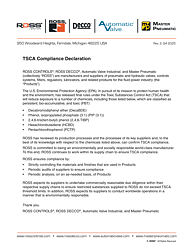
The complete TSCA Compliance Declaration issued by ROSS Controls, covering Automatic Valve Industrial, ROSS DECCO, and Master Pneumatic products, is available for download in PDF format. This document can be used by procurement teams, environmental compliance officers, EHS managers, and supply chain quality engineers to support regulatory compliance documentation, supplier qualification, and environmental management system records.
Frequently Asked Questions
What specific chemicals does the ROSS TSCA declaration address?
The TSCA Compliance Declaration specifically addresses five persistent, bioaccumulative, and toxic (PBT) chemicals regulated under the EPA's TSCA final rules: Decabromodiphenyl Ether (DecaBDE), Phenol Isopropylated Phosphate (PIP 3:1), 2,4,6-Tris(tert-butyl) Phenol (2,4,6-TTBP), Hexachlorobutadiene (HCBD), and Pentachlorothiophenol (PCTP). ROSS has confirmed that its products and manufacturing processes comply with the regulations for all five chemicals.
Does TSCA apply to all Automatic Valve products sold in the United States?
TSCA is a U.S. federal law that applies to chemical substances manufactured in, imported into, or distributed within the United States. The TSCA PBT rules specifically regulate the five identified chemicals. ROSS's declaration confirms compliance across its full range of pneumatic and hydraulic products, including those manufactured by Automatic Valve Industrial.
How does TSCA differ from the EU REACH regulation?
TSCA is a U.S. federal regulation administered by the EPA, while REACH is a European Union regulation administered by ECHA. Both regulations address chemical safety, but they differ in structure and approach. TSCA focuses on evaluating and regulating specific chemicals identified as posing unreasonable risks, while REACH requires registration of all chemical substances manufactured or imported above certain tonnage thresholds and maintains a candidate list of Substances of Very High Concern. ROSS provides separate compliance declarations for both TSCA and REACH.
How does ROSS verify that suppliers comply with TSCA PBT rules?
ROSS ensures compliance through strict control of materials and finishes used in products, periodic audits of suppliers, and periodic product analysis on an as-needed basis. Suppliers are expected to undertake commercially reasonable due diligence within their supply chains to ensure restricted substances do not exceed TSCA threshold limits.
What should I do if I need more detailed chemical composition data for ROSS products?
For questions about specific chemical content, material composition, or TSCA compliance for particular product lines, contact ROSS Controls directly. The TSCA Compliance Declaration provides a high-level assurance of compliance across the full product portfolio, and ROSS can provide additional detail for specific applications or regulatory requirements upon request.