


Restriction of Hazardous Substances (RoHS 3) Compliance Declaration — Automatic Valve Industrial
About This RoHS 3 Compliance Declaration
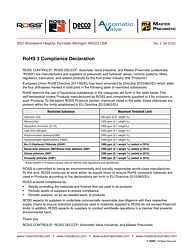
ROSS Controls, ROSS DECCO, Automatic Valve Industrial, and Master Pneumatic (collectively referred to as ROSS) have issued this RoHS 3 Compliance Declaration to affirm that products manufactured by ROSS comply with the European Union's Restriction of Hazardous Substances Directive, as amended. This self-declaration covers all pneumatic and hydraulic valves, control systems, filters, regulators, lubricators, and related fluid power products manufactured by ROSS, as well as components supplied to ROSS for inclusion in those products.
The declaration confirms that, to the extent ROSS products contain chemicals listed in the RoHS restricted substances table, those chemicals are present within the maximum concentration limits established by EU Directive 2015/863/EU. This document is revised as of Q4 2025 (Revision 2) and is available for download in PDF format.
RoHS 3 Restricted Substances and Threshold Limits
The RoHS 3 directive restricts the use of ten hazardous substances in electrical and electronic equipment. The restricted substances and their maximum threshold limits are: Cadmium (Cd) at 100 ppm or 0.01% by weight; Mercury (Hg) at 1,000 ppm or 0.1% by weight; Hexavalent Chromium (Cr VI) at 1,000 ppm or 0.1% by weight; Lead (Pb) at 1,000 ppm or 0.1% by weight (with exemptions for brass content); Polybrominated Biphenyls (PBB) at 1,000 ppm or 0.1% by weight; Polybrominated Diphenyl Ethers (PBDE) at 1,000 ppm or 0.1% by weight; Bis(2-Ethylhexyl) Phthalate (DEHP) at 1,000 ppm or 0.1% by weight; Benzyl Butyl Phthalate (BBP) at 1,000 ppm or 0.1% by weight; Dibutyl Phthalate (DBP) at 1,000 ppm or 0.1% by weight; and Diisobutyl Phthalate (DIBP) at 1,000 ppm or 0.1% by weight. The last four phthalate substances were added under EU Directive 2015/863/EU, which is the amendment that defines RoHS 3.
What Is the EU RoHS Directive?
The Restriction of Hazardous Substances (RoHS) Directive is a European Union regulation that restricts the use of specific hazardous materials in electrical and electronic equipment (EEE). The original RoHS Directive (2002/95/EC), known as RoHS 1, was enacted in 2003 and took effect in 2006, initially restricting six substances. The recast directive (2011/65/EU), known as RoHS 2, expanded the scope and introduced a CE marking requirement. The amendment under Directive 2015/863/EU, commonly called RoHS 3, added four phthalate substances to the restricted list, bringing the total to ten restricted substances.
RoHS applies to a wide range of product categories, including industrial monitoring and control instruments, which can encompass pneumatic control equipment used in automated manufacturing environments. The directive is enforced by EU member state market surveillance authorities, and non-compliant products may be withdrawn from the European market.
Evolution from RoHS 1 to RoHS 3
The RoHS directive has evolved significantly since its inception. RoHS 1 initially covered six substance categories and applied to a limited range of product types. RoHS 2 broadened the scope to include medical devices and monitoring and control instruments, introduced the CE marking requirement, and established a more comprehensive conformity assessment process. RoHS 3 further strengthened the directive by adding four phthalate substances (DEHP, BBP, DBP, and DIBP) to the restricted list. These phthalates are plasticizers commonly found in PVC and other polymer materials, and their restriction reflects growing scientific evidence of endocrine-disrupting properties. Manufacturers selling into the EU market must ensure compliance with all ten restricted substances.
Exemptions and Brass Components
The RoHS directive includes specific exemptions for certain materials and applications where suitable alternatives do not yet exist or where substitution would be technically impractical. For pneumatic valve manufacturers like ROSS, one relevant exemption relates to lead in copper alloys, including brass. Brass is widely used in pneumatic valve bodies, fittings, and manifold components due to its excellent machinability, corrosion resistance, and pressure-handling characteristics. The RoHS directive permits lead content in brass up to 4% by weight under specific exemption categories. ROSS notes in its declaration that brass content in its products complies with all relevant lead regulations and exemptions.
How ROSS Ensures RoHS 3 Compliance
ROSS is committed to being an environmentally and socially responsible manufacturer and has implemented a multi-faceted approach to ensure ongoing RoHS 3 compliance across its product lines. The company ensures compliance through three primary mechanisms: strict control of the materials and finishes used in its products, periodic audits of suppliers to verify their compliance with RoHS requirements, and periodic analysis of products on an as-needed basis to confirm that restricted substance concentrations remain within permitted limits.
ROSS also expects its suppliers to undertake commercially reasonable due diligence within their own supply chains to ensure that restricted substances used in materials supplied to ROSS do not exceed the established threshold limits. In addition, ROSS expects its suppliers to conduct worldwide operations in a manner that prevents environmental harm. This supply chain approach creates multiple layers of compliance assurance, from raw material sourcing through final product assembly.
Why RoHS 3 Compliance Matters for Industrial Customers
RoHS 3 compliance is important for customers who export products to the European Union or who incorporate components into equipment destined for EU markets. Non-compliance with RoHS can result in products being denied entry into EU markets, facing recalls, or being subject to fines and penalties. By sourcing RoHS-compliant pneumatic valves and components from Automatic Valve Industrial, OEMs and system integrators can ensure that their finished equipment meets EU requirements without the need for additional testing or material substitution.
Beyond regulatory compliance, RoHS 3 adherence reflects a manufacturer's commitment to reducing the environmental and health impact of its products. For companies with corporate sustainability goals or environmental management systems such as ISO 14001, working with RoHS-compliant suppliers supports broader environmental objectives and simplifies sustainability reporting.
Global Impact of RoHS-Type Regulations
While RoHS originated in the European Union, similar regulations have been adopted in numerous countries and regions worldwide, including China (China RoHS), South Korea, Turkey, India, and the United Arab Emirates. Products designed to comply with EU RoHS 3 are generally well-positioned to meet the requirements of these parallel regulations, making RoHS compliance a practical baseline for global market access. For multinational OEMs and distributors, sourcing from RoHS-compliant suppliers like Automatic Valve Industrial simplifies regulatory compliance across multiple jurisdictions.
Download the RoHS 3 Compliance Declaration
The complete RoHS 3 Compliance Declaration issued by ROSS Controls, covering Automatic Valve Industrial, ROSS DECCO, and Master Pneumatic products, is available for download in PDF format. This document includes the full table of restricted substances and their threshold limits. Procurement teams, compliance officers, and environmental managers can use this document to support supplier qualification, CE marking documentation, and technical file assembly for EU market access.
Frequently Asked Questions
What is the difference between RoHS 2 and RoHS 3?
RoHS 2 refers to EU Directive 2011/65/EU, which recast the original RoHS directive and expanded its scope. RoHS 3 refers to the amendment under EU Directive 2015/863/EU, which added four phthalate substances (DEHP, BBP, DBP, and DIBP) to the list of restricted substances, bringing the total to ten. ROSS's declaration confirms compliance with all ten restricted substances under RoHS 3.
Are all Automatic Valve products RoHS 3 compliant?
ROSS's self-declaration states that, to the extent its products contain chemicals listed in the RoHS restricted substances table, those chemicals are present within the maximum concentration limits established by EU Directive 2015/863/EU. Brass content in products complies with all relevant lead regulations and exemptions applicable under RoHS.
Does RoHS 3 apply to pneumatic valves?
RoHS applies to electrical and electronic equipment (EEE), including industrial monitoring and control instruments. Pneumatic valves with electrical components such as solenoid operators may fall within the scope of RoHS. Even for purely mechanical pneumatic valves, many customers and industries require RoHS compliance as part of their procurement standards and sustainability programs.
How does ROSS verify RoHS 3 compliance in its supply chain?
ROSS ensures compliance by strictly controlling the materials and finishes used in its products, conducting periodic audits of suppliers to verify compliance, and performing periodic analysis of products on an as-needed basis. ROSS also expects its suppliers to undertake commercially reasonable due diligence with their own supply chains to ensure restricted substances do not exceed threshold limits.
Can I use the ROSS RoHS 3 declaration for my own CE marking documentation?
Yes. The ROSS RoHS 3 Compliance Declaration can be included as part of the technical documentation supporting CE marking and conformity assessment for equipment that incorporates ROSS, Automatic Valve, ROSS DECCO, or Master Pneumatic components destined for EU markets.