


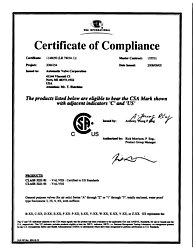
CSA Certificate of Compliance for Automatic Valves Solenoid Coils and Valves
What Is the CSA Certificate of Compliance?
The CSA Certificate of Compliance is an official certification document issued by the Canadian Standards Association (CSA Group) confirming that Automatic Valves solenoid coils and pneumatic valve products have been tested, evaluated, and found to comply with applicable safety standards for use in hazardous classified locations. This certificate is a critical credential for any electrical or electromechanical equipment destined for installation in environments where flammable gases, vapors, or combustible dusts may be present in North American industrial facilities.
CSA Group is one of the most recognized testing, inspection, and certification organizations in the world. A CSA Certificate of Compliance demonstrates that Automatic Valves products have undergone rigorous third-party evaluation by an accredited laboratory, verifying that they meet the stringent safety requirements for hazardous location equipment. This certification is widely accepted by regulatory authorities, electrical inspectors, insurance companies, and plant safety managers throughout the United States and Canada.
Role of CSA Certification in North American Markets
In North America, the installation of electrical equipment in hazardous classified locations is governed by the National Electrical Code (NEC, NFPA 70) in the United States and the Canadian Electrical Code (CEC) in Canada. Both codes require that equipment used in these locations be listed or certified by a nationally recognized testing laboratory (NRTL) such as CSA Group, UL, or FM Approvals. The CSA certification mark on Automatic Valves products provides immediate recognition that the product has met the required safety standards and is suitable for installation in the specified hazardous location classifications.
Scope of CSA Certification for Automatic Valves
The CSA Certificate of Compliance for Automatic Valves covers solenoid coils and complete valve assemblies that are designed for operation in hazardous classified locations. This includes explosion-proof solenoid coils rated for Class I, Division 1 locations (where flammable gases or vapors may exist under normal operating conditions) and intrinsically safe solenoid coils rated for Class I, Division 1 and Division 2 locations. The certification encompasses the full range of NAMUR interface valves, including 3/2, 5/2, and 5/3 valve configurations used in process control and industrial automation applications.
Understanding Hazardous Location Classifications in North America
North American hazardous location classification follows a system defined by the National Electrical Code (NEC) and Canadian Electrical Code (CEC) that categorizes dangerous environments based on the type of hazard present, the likelihood of the hazardous substance being in ignitable concentrations, and the specific properties of the flammable material. Understanding this classification system is essential for properly specifying and installing CSA-certified pneumatic valve products from Automatic Valves.
Classes, Divisions, and Groups
The NEC/CEC system organizes hazardous locations into three Classes based on the type of hazardous material present. Class I locations contain flammable gases or vapors, Class II locations contain combustible dust, and Class III locations contain ignitable fibers or flyings. Each Class is further divided into Divisions: Division 1 areas where the hazardous substance is expected to be present in ignitable concentrations during normal operations, and Division 2 areas where the hazardous substance is present only under abnormal conditions such as equipment failure or container rupture. Groups (A through G) further classify the specific flammable gas, vapor, or dust based on its ignition characteristics and explosion pressure. Automatic Valves CSA-certified products are rated for specific Class, Division, and Group combinations as detailed in the Certificate of Compliance.
Zone Classification System
In addition to the traditional Class/Division system, North American codes also recognize a Zone classification system that aligns more closely with the international IEC and European ATEX standards. Zone 0 (continuous hazard), Zone 1 (likely hazard during normal operations), and Zone 2 (unlikely hazard, only under abnormal conditions) correspond to the gas classifications, while Zone 20, 21, and 22 apply to dust hazards. Many modern industrial facilities, particularly those with international operations, use the Zone system for hazardous area classification, and CSA-certified products from Automatic Valves can be specified for both classification systems.
Protection Methods for Hazardous Location Valves
Automatic Valves employs multiple protection methods to ensure safe operation of pneumatic solenoid valves in hazardous classified locations. Each protection method addresses the ignition risk in a different way, and the appropriate method depends on the specific hazardous area classification, the installation requirements, and the operational needs of the application. The CSA Certificate of Compliance specifies which protection methods have been evaluated and approved for each product type.
Explosion-Proof Protection (Class I, Division 1)
Explosion-proof protection, designated as type "d" under IEC nomenclature or suitable for Class I, Division 1 under NEC classification, involves enclosing the electrical components (the solenoid coil and its connections) in a robust housing that can contain an internal explosion and prevent it from propagating to the surrounding explosive atmosphere. The enclosure is designed with flame paths that cool hot gases to below the ignition temperature of the surrounding atmosphere before they can escape. Automatic Valves explosion-proof solenoid coils feature rugged housings constructed from high-strength materials and are tested to withstand internal explosion pressures significantly exceeding the pressures expected during an actual ignition event.
Intrinsic Safety Protection (Class I, Division 1 and Division 2)
Intrinsic safety is a protection method that limits the electrical energy available to the solenoid coil to levels below the minimum ignition energy of the hazardous atmosphere. This is achieved through the use of intrinsically safe barriers or isolators installed in the safe area that restrict voltage, current, and stored energy to safe levels. Automatic Valves intrinsically safe solenoid coils are designed with specific electrical parameters (maximum voltage, current, capacitance, and inductance) that ensure safe operation when used with approved barriers. This protection method is particularly advantageous for applications requiring live maintenance, as the energy levels are inherently too low to cause ignition.
Product Specifications Covered by CSA Certification
The CSA Certificate of Compliance for Automatic Valves encompasses a range of solenoid-operated pneumatic valve products engineered for hazardous location service. These products share common design principles of robust construction, reliable solenoid actuation, and compliance with the NAMUR (VDI/VDE 3845) mounting interface standard for direct mounting on rotary and linear actuators.
Key product specifications include spool-type valve construction with bar stock aluminum valve bodies, solenoid pilot-controlled actuation, threaded NPT port connections, push-type non-locking manual override, and operating pressure ranges from 0 to 150 psig depending on the valve configuration. The solenoid coils are constructed from Polyamid 66 (nylon) material and are rated for continuous duty operation. Temperature ratings for CSA-certified products extend from -29°C to 50°C (-20°F to 123°F), with the requirement that air supply must be free of water vapor when operating below 4°C (40°F) to prevent ice formation.
Valve Configurations Available
CSA-certified Automatic Valves NAMUR products are available in multiple valve configurations to suit various actuator control requirements. The 3/2 normally closed configuration is commonly used for single-acting actuators, while the 5/2 configuration provides double-acting actuator control. For applications requiring a defined actuator position upon loss of air or signal, 5/3 valves are available in closed center, open center, and power center configurations. Each configuration is covered under the CSA Certificate of Compliance for both explosion-proof and intrinsically safe solenoid options.
Importance of CSA Certification for Plant Safety and Compliance
Selecting CSA-certified pneumatic valve products is not merely a regulatory requirement but a fundamental component of an effective plant safety strategy. In hazardous classified locations, every piece of electrical or electromechanical equipment represents a potential ignition source. By specifying CSA-certified products from Automatic Valves, plant engineers and safety managers ensure that their valve installations have been independently verified to operate safely in the specified hazardous environment.
CSA certification also provides significant benefits during facility audits and inspections. When electrical inspectors or insurance auditors review hazardous area installations, they look for evidence that all installed equipment bears appropriate certification marks from recognized testing organizations. The CSA mark on Automatic Valves products provides immediate, recognizable proof of compliance, streamlining the inspection process and reducing the risk of costly compliance findings.
Additionally, specifying CSA-certified products helps protect organizations from liability in the event of an incident. Products that carry third-party certification from an organization like CSA Group demonstrate that the manufacturer has taken appropriate steps to ensure product safety, which can be an important factor in legal and insurance proceedings.
Download the CSA Certificate of Compliance
The complete CSA Certificate of Compliance for Automatic Valves solenoid coils and valve products is available for download in PDF format from this page. This document should be maintained in your facility's equipment documentation files and referenced during equipment specification, procurement, installation, and compliance audits.
Automatic Valves, part of the ROSS Controls global family, is exclusively focused on fluid power, delivering high-quality and cost-effective pneumatic solutions for the automation, transportation, process, and automotive industries. Since 1945, Automatic Valves has been serving customers with expertly engineered solutions specialized to their pneumatic needs. For technical support or application assistance, contact Automatic Valves Technical Service through their website at www.automaticvalve.com.
Frequently Asked Questions
What is a CSA Certificate of Compliance?
A CSA Certificate of Compliance is an official document issued by CSA Group (Canadian Standards Association) confirming that a product has been tested, evaluated, and certified to meet applicable safety standards. For Automatic Valves products, this certificate verifies that solenoid coils and pneumatic valves are safe for use in hazardous classified locations where flammable gases, vapors, or combustible dusts may be present.
Which Automatic Valves products are covered by CSA certification?
The CSA Certificate of Compliance covers Automatic Valves solenoid coils and complete NAMUR Series valve assemblies designed for hazardous classified locations. This includes both explosion-proof and intrinsically safe solenoid valve configurations in 3/2, 5/2, and 5/3 valve types used in process control and industrial automation applications.
Is CSA certification accepted in the United States?
Yes. CSA Group is accredited as a Nationally Recognized Testing Laboratory (NRTL) by the Occupational Safety and Health Administration (OSHA) in the United States. CSA-certified products are accepted by electrical inspectors and authorities having jurisdiction (AHJs) throughout both the United States and Canada. The CSA certification mark is one of the most widely recognized safety marks in North America.
How does CSA certification relate to ATEX and IECEx certifications?
CSA certification is specific to the North American market and follows the NEC/CEC Class/Division classification system, while ATEX certification applies to the European market under EU Directive 2014/34/EU and uses the Zone classification system. IECEx is an international certification scheme. Automatic Valves products hold multiple certifications, including CSA, ATEX, and FM approvals, enabling global deployment in hazardous environments.
How do I verify that my Automatic Valves product is CSA certified?
CSA-certified Automatic Valves products bear the CSA certification mark directly on the product label or solenoid housing. You can verify current certification status by referencing the CSA Certificate of Compliance available for download on this page, checking the CSA Group product listing database, or contacting Automatic Valves Technical Service for assistance with specific product model certification details.