



NAMUR Interface Valves 4-Way to 3-Way Valve Conversion Instructions
Overview of the NAMUR 4-Way to 3-Way Conversion Process
The Automatic Valve NAMUR Valves Conversion Instructions document provides a clear, step-by-step guide for converting D20 series NAMUR interface solenoid valves from 4-way operation to 3-way operation. This conversion is accomplished by repositioning a plug assembly within the valve body, changing the air flow path configuration without requiring replacement of the entire valve. The ability to perform this field conversion provides significant flexibility for process engineers and maintenance teams who need to adapt existing valve installations to changing application requirements.
This document is published by Automatic Valve, a member of the ROSS Group of companies. It is designed for trained pneumatic equipment professionals and includes visual diagrams showing the plug position for both 4-way and 3-way configurations, step-by-step conversion instructions with torque specifications, the conversion kit model number and contents, and comprehensive safety warnings and cautions. The conversion procedure is straightforward and can be completed with basic hand tools, requiring only a 3 mm screwdriver.
Understanding 4-Way vs. 3-Way Valve Operation
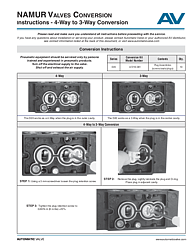
The fundamental difference between 4-way and 3-way operation in a NAMUR interface valve lies in the position of the plug assembly within the valve body. In the 4-way configuration, the plug is installed in the outer cavity of the valve body, allowing full 4-way directional control of air flow to and from the actuator. A 4-way valve provides two output ports, enabling double-acting actuator control where air is alternately directed to both sides of the actuator piston. In the 3-way configuration, the plug is moved to the center cavity of the valve body, which blocks one of the output flow paths and converts the valve to single-acting operation. A 3-way valve provides pressurized air to one port while venting the other, making it suitable for spring-return actuators and applications requiring only single-direction pneumatic force.
Step-by-Step 4-Way to 3-Way Conversion Procedure
The NAMUR valve conversion from 4-way to 3-way operation is a simple three-step process that can be performed in the field by trained pneumatic technicians. The entire procedure involves loosening a retention screw, relocating the plug assembly, and retightening the screw to the specified torque value. Before performing the conversion, ensure that all safety preparation steps have been followed, including disconnecting electrical power and exhausting the pneumatic supply.
Step 1: Loosen the Plug Retention Screw
Using a 3 mm screwdriver, loosen the plug retention screw that secures the plug assembly in its current position within the outer cavity of the valve body. Take care not to strip the screw head or damage the threads during removal. The plug retention screw holds the plug assembly firmly in place during operation and must be fully loosened before the plug can be removed.
Step 2: Relocate the Plug Assembly
Remove the plug assembly from the outer cavity. Lightly lubricate the plug and its O-ring seal with a compatible lubricant to ensure a proper seal in the new position and to ease insertion. Then place the plug in the adjacent center cavity of the valve body. The center cavity position converts the valve from 4-way to 3-way operation by blocking the air flow path through the center port. Ensure the plug seats fully and squarely in the center cavity to prevent air leaks.
Step 3: Tighten the Plug Retention Screw
Tighten the plug retention screw to 0.68 N-m (6 in-lbs) with a tolerance of plus or minus 10 percent. This torque specification is critical to ensuring the plug remains securely in place during valve operation while avoiding over-tightening that could damage the screw or plug assembly. After the screw is torqued, verify that the plug is secure and does not move within the cavity.
Conversion Kit Information and Ordering
Automatic Valve provides a dedicated conversion kit for the D20 series NAMUR interface valve. The conversion kit model number is A7216-081, and it contains 10 plug assemblies, each consisting of a plug with integrated screws and seals. The kit is designed to support multiple conversions, making it economical for facilities managing large valve populations or standardizing valve configurations across multiple process lines.
The plug assemblies included in the conversion kit are compatible with all D20 series NAMUR interface valves, regardless of whether the valve uses Buna-N or fluoroelastomer seals for its primary spool service kit. The plug assembly is a separate component from the valve's internal spool and seal system, so the conversion does not affect the valve's seal material or service kit configuration. To order conversion kits or for additional technical support, contact Automatic Valve directly or reach out to an authorized AV distributor.
Safety Warnings and Service Precautions
The NAMUR valve conversion document includes the same comprehensive safety warnings that apply to all ROSS Group pneumatic products. These warnings must be reviewed and followed before performing the 4-way to 3-way conversion or any other service work on the valve.
Energy Isolation and Lockout Requirements
Before performing the conversion or any service on a pneumatic component, all sources of energy must be turned off, the entire pneumatic system shut down and exhausted, and all power sources locked out in accordance with OSHA 1910.147 and EN 1037. Pneumatic equipment should be serviced only by trained and experienced personnel. The valve must be removed from all electrical and air power sources, and all stored air power must be fully exhausted before beginning work. After the conversion is complete, the valve must be functionally tested before being returned to active service to verify correct 3-way operation.
Filtration and Lubrication Warnings
The ROSS Group recommends a 5-micron rated air filter for normal applications to prevent contaminants from interfering with valve operation. Air line lubrication is not required but is recommended to maximize service life. Compatible lubricants are petroleum-based oils with oxidation inhibitors, an ISO 32 or lighter viscosity, and an aniline point between 82 degrees Celsius (180 degrees Fahrenheit) and 99 degrees Celsius (210 degrees Fahrenheit). Avoid oils with phosphate-type additives that can damage polyurethane components. Polycarbonate filter bowls are for compressed air only and must not be exposed to alcohol, liquefied petroleum gas, or other aggressive fluids.
Exhaust and Intake Restriction Warnings
After converting the valve to 3-way operation, ensure that air flow in the supply line is not restricted, as this could reduce supply pressure below minimum valve requirements and cause erratic action. Do not restrict the valve's exhaust port. Exhaust silencers must be resistant to clogging and must have flow capacities at least as great as the valve's exhaust capacity. Contaminated silencers can cause reduced flow and increased back pressure, degrading valve performance. These precautions are especially important after a configuration change, as the air flow characteristics of the converted valve may differ from the original 4-way setup.
Warranty and Technical Support
The NAMUR valve conversion kit and all D20 series products are covered by the ROSS Group's standard one-year warranty from the date of purchase. Filters, Regulators, and Lubricators carry a seven-year warranty. Products are warranted to be free of defects in material and workmanship during the warranty period. The warranty obligation is limited to repair, replacement, or refund at the ROSS Group's sole discretion. Warranties are voided by misuse, misapplication, improper maintenance, modification, or tampering.
For questions about the 4-way to 3-way conversion process, ordering conversion kits, locating authorized distributors, or any other technical support needs, contact Automatic Valve at +1-248-474-6700 or visit www.automaticvalve.com. A general user manual with more detailed product information is also available online at the Automatic Valve website.
Frequently Asked Questions
Can I convert a NAMUR valve from 3-way back to 4-way operation?
Yes, the conversion between 4-way and 3-way operation is fully reversible. The process is simply the reverse of the procedure described in this document: loosen the plug retention screw, remove the plug from the center cavity, lubricate the plug and O-ring, place it back in the outer cavity, and tighten the retention screw to 0.68 N-m (6 in-lbs) plus or minus 10 percent. The same plug assembly and tools are used for both conversion directions.
What tools do I need to perform the 4-way to 3-way conversion?
The conversion requires only a 3 mm screwdriver and a torque wrench or torque-limiting screwdriver capable of measuring 0.68 N-m (6 in-lbs). A small amount of compatible lubricant is also needed to lubricate the plug and O-ring before reinserting into the new cavity. No special tools, equipment, or disassembly of the valve's internal spool mechanism are required.
What is the conversion kit model number and what does it include?
The conversion kit for D20 series NAMUR interface valves is model number A7216-081. It contains 10 complete plug assemblies, each including the plug, screws, and seals. The kit supports multiple valve conversions, making it cost-effective for facilities managing numerous NAMUR valves across process lines.
Does the 4-way to 3-way conversion affect the valve's seal material or service kit?
No, the conversion involves only repositioning the plug assembly within the valve body. It does not affect the valve's internal spool, tee-seals, piston seals, bushing, or any other serviceable components. The plug assembly is a separate component that is compatible with all D20 series NAMUR valves regardless of whether Buna-N or fluoroelastomer seals are installed.
What is the torque specification for the plug retention screw?
The plug retention screw must be tightened to 0.68 N-m (6 in-lbs) with a tolerance of plus or minus 10 percent. This is a different and lower torque specification than the operator cap screws (which require 1.02 N-m or 9 in-lbs). Using the correct torque value is essential to secure the plug without damaging the screw threads or the plug assembly.