




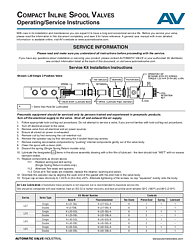
Compact Inline Spool Valves Operating and Service Instructions
Overview of the Compact Inline Spool Valve Service Manual
The Automatic Valve Compact Inline Spool Valves Operating and Service Instructions document provides technicians and maintenance professionals with the essential guidance needed to properly service, maintain, and rebuild compact inline spool valves from the AV product line. This comprehensive manual covers the L07, L20, L45, and L65 series compact inline spool valves and is applicable to both single spring return and double solenoid configurations.
This document is produced by Automatic Valve Industrial, a member of the ROSS Group of companies that includes ROSS Operating Valve, ROSS Controls, and ROSS DECCO. The manual includes detailed assembly diagrams, step-by-step service kit installation procedures, lubrication guidelines, torque specifications, and important safety warnings. It is designed to be used by trained pneumatic equipment professionals who are responsible for maintaining valve performance and ensuring safe operating conditions in industrial environments.
Valve Series Covered in This Document
The operating instructions apply to four distinct series of compact inline spool valves. The L07 series is available in single and double configurations with service kits K-L07-SGL and K-L07-DBL for Buna-N seals, or K-L07-SGL-A and K-L07-DBL-A for fluoroelastomer seals. The L20 series, which is featured in the primary assembly diagram, uses service kits K-L20-SGL and K-L20-DBL (Buna-N) or K-L20-SGL-A and K-L20-DBL-A (fluoroelastomer). The L45 series utilizes kits K-L45-SGL and K-L45-DBL (Buna-N) or K-L45-SGL-A and K-L45-DBL-A (fluoroelastomer). Finally, the L65 series is serviced with kits K-L65-SGL and K-L65-DBL (Buna-N) or K-L65-SGL-A and K-L65-DBL-A (fluoroelastomer). Each single-valve service kit includes six tee-seals, one piston seal, one spring, and one lubricant packet, while double-valve kits contain six tee-seals, two piston seals, and one lubricant packet but omit the spring.
Step-by-Step Service Kit Installation Procedure
The service kit installation process for Automatic Valve compact inline spool valves requires careful attention to safety protocols and correct component assembly. Before beginning any service work, technicians must ensure that all energy sources have been disconnected and proper lockout/tagout procedures are followed in accordance with OSHA 1910.147 and EN 1037 standards. Only trained and experienced pneumatic equipment personnel should perform these procedures.
Pre-Service Safety and Preparation Steps
Before servicing the compact inline spool valve, follow the appropriate lock-out/tag-out procedures. Do not attempt to service the valve if you are unfamiliar with these safety protocols. Turn off the electrical power supply to the valve. Remove the valve from all electrical and air power sources. Ensure that all stored air power has been completely exhausted from the system. These preparatory steps are critical to preventing accidental valve actuation during the service procedure, which could result in personal injury or equipment damage.
Disassembly and Component Removal
Begin disassembly by removing the coil, which requires first removing the coil retention nut. Next, remove the operator cap by unfastening the four M3 socket head cap screws. The operator cap screws should be torqued to 1.02 N-m (9 in-lbs) with a tolerance of plus or minus 10 percent during reassembly. Gently push the existing internal serviceable components out of the valve body. Clean the spool thoroughly with a clean cloth. For single spring return models only, discard the existing spring as a new one is included in the service kit.
Lubrication and Reassembly Instructions
Apply a thin film of lubricant to all components marked with a plus sign in the assembly drawing. These components include the tee-seals, the bushing, the piston seal, the valve body bore, and the spool major diameter. The lubricated surfaces should appear wet with no excess lubricant visible. Reassemble the components in the correct order: first replace the spring pad and spring for single spring return models, then alternate tee-seals and spacers until all six tee-seals are installed. After that, replace the retainer, bushing, and piston. Orientate the operator cap by aligning the open end of the gasket with the pilot hole in the valve body. Torque the cap screws into the body to 1.02 N-m (9 in-lbs) plus or minus 10 percent, alternating the tightening pattern so the cap squeezes evenly onto the body.
Air Line Lubrication and Filtration Requirements
Air line lubrication of Automatic Valve compact inline spool valve products is not required for normal operation, but it is recommended to maximize service life and extend the interval between service kit replacements. When lubrication is used, oils should be compatible with the seal material installed in the valve. Lubricants must have an ISO 32 or lighter viscosity and an aniline point between 82 degrees Celsius (180 degrees Fahrenheit) and 99 degrees Celsius (210 degrees Fahrenheit). Avoid oils with phosphate-type additives, as these can damage polyurethane components and potentially lead to valve failure.
Proper filtration is equally important for maintaining valve performance. Dirt, scale, moisture, and other contaminants are present in virtually every compressed air system. The ROSS Group recommends installing a filter with a 5-micron rating for normal applications to prevent contaminants from interfering with valve operation. All standard ROSS Group filters and lubricators with polycarbonate plastic bowls are designed for compressed air applications only. Do not expose these products to fluids such as alcohol or liquefied petroleum gas, as they can cause bowls to rupture, creating combustible conditions and hazardous leakage.
Important Safety Warnings and Cautions
The Automatic Valve compact inline spool valve operating instructions include several critical safety warnings that must be understood and followed by all service personnel. These warnings address pre-installation safety, intake and exhaust restrictions, and safety applications for hazardous machinery.
Pre-Installation and Service Safety Requirements
Before servicing a valve or any pneumatic component, ensure that all sources of energy are turned off, the entire pneumatic system is shut down and exhausted, and all power sources are locked out in accordance with OSHA 1910.147 and EN 1037. All ROSS Group products, including service kits and parts, should be installed and serviced only by trained and experienced personnel. Overhauled or serviced valves must be functionally tested prior to installation and use. Each product must be used within its specification limits, and only genuine ROSS Group components should be used for repairs.
Avoiding Intake and Exhaust Restrictions
Do not restrict air flow in the supply line, as this could reduce supply air pressure below the minimum requirements for the valve, causing erratic action. Do not restrict a valve's exhaust port, as this can adversely affect its operation. Exhaust silencers must be resistant to clogging and must have flow capacities at least as great as the exhaust capacities of the valves. Contamination of the silencer can result in reduced flow and increased back pressure, degrading valve performance.
Safety Applications for Hazardous Machinery
Mechanical power presses and other potentially hazardous machinery using pneumatically controlled clutch and brake mechanisms must use a press control double valve with a monitoring device. Safe Exhaust (dump) valves without a self-contained monitoring device should be used only in conjunction with a control system that assures monitoring of the valve. All installations involving hazardous applications should incorporate a monitoring system that inhibits further valve and machine operation in the event of a valve mechanism failure.
Service Kit Reference and Warranty Information
Automatic Valve provides a complete range of service kits for compact inline spool valves. Service kits are available in both Buna-N and fluoroelastomer seal materials to accommodate different application environments and media compatibility requirements. Buna-N seals are suitable for standard compressed air applications, while fluoroelastomer seals provide enhanced chemical and temperature resistance for more demanding environments.
All products sold by the ROSS Group are warranted for a one-year period from the date of purchase, with the exception of Filters, Regulators, and Lubricators (FRLs) which carry a seven-year warranty. Products are warranted to be free of defects in material and workmanship during the warranty period. The warranty obligation is limited to repair, replacement, or refund of the purchase price for products determined to be defective. All warranties become void if a product has been subject to misuse, misapplication, improper maintenance, modification, or tampering. Products for which warranty protection is sought must be returned freight prepaid.
Frequently Asked Questions
What service kit do I need for my compact inline spool valve?
The service kit required depends on your valve series (L07, L20, L45, or L65) and configuration (single or double). For example, the L20 single spring return valve uses kit K-L20-SGL for Buna-N seals or K-L20-SGL-A for fluoroelastomer seals. Double solenoid models use the corresponding DBL kit. Each single kit contains six tee-seals, one piston seal, one spring, and lubricant. Double kits include six tee-seals, two piston seals, and lubricant but no spring. Consult the service kit reference table in the document for your specific model.
What is the correct torque specification for the operator cap screws?
The operator cap screws on compact inline spool valves should be torqued to 1.02 N-m (9 in-lbs) with a tolerance of plus or minus 10 percent. It is important to alternate the tightening of the screws so that the cap squeezes evenly onto the valve body, ensuring a proper seal and preventing gasket damage.
Is air line lubrication required for compact inline spool valves?
Air line lubrication is not required for Automatic Valve compact inline spool valves, but it is recommended to maximize service life. If lubrication is used, oils must be compatible with the valve's seal material, have an ISO 32 or lighter viscosity, and have an aniline point between 82 degrees Celsius (180 degrees Fahrenheit) and 99 degrees Celsius (210 degrees Fahrenheit). Avoid lubricants containing phosphate-type additives, as they can damage polyurethane components.
What safety procedures must be followed before servicing these valves?
Before servicing any compact inline spool valve, you must follow appropriate lock-out/tag-out procedures per OSHA 1910.147 and EN 1037. Turn off all electrical power to the valve, remove the valve from all electrical and air power sources, and ensure all stored air power is fully exhausted. Only trained and experienced pneumatic equipment personnel should perform service work. After service is complete, the valve must be functionally tested before being returned to active use.
What is the difference between Buna-N and fluoroelastomer service kits?
Buna-N service kits are designed for standard compressed air applications and offer reliable performance under typical industrial operating conditions. Fluoroelastomer service kits (identified by the -A suffix in the model number) provide superior chemical resistance and higher temperature tolerance, making them suitable for more demanding environments where the valve may be exposed to aggressive media or elevated temperatures. Both seal types are available for all four series (L07, L20, L45, and L65) in single and double configurations.